
One year after the Palm Springs bombing, a survivor is still picking up the pieces
A marketing concierge injured in the fertility clinic attack one year ago this weekend has faced homelessness, denied benefits, and mounting debt — but found a lifeline in the city’s LGBTQ community center.
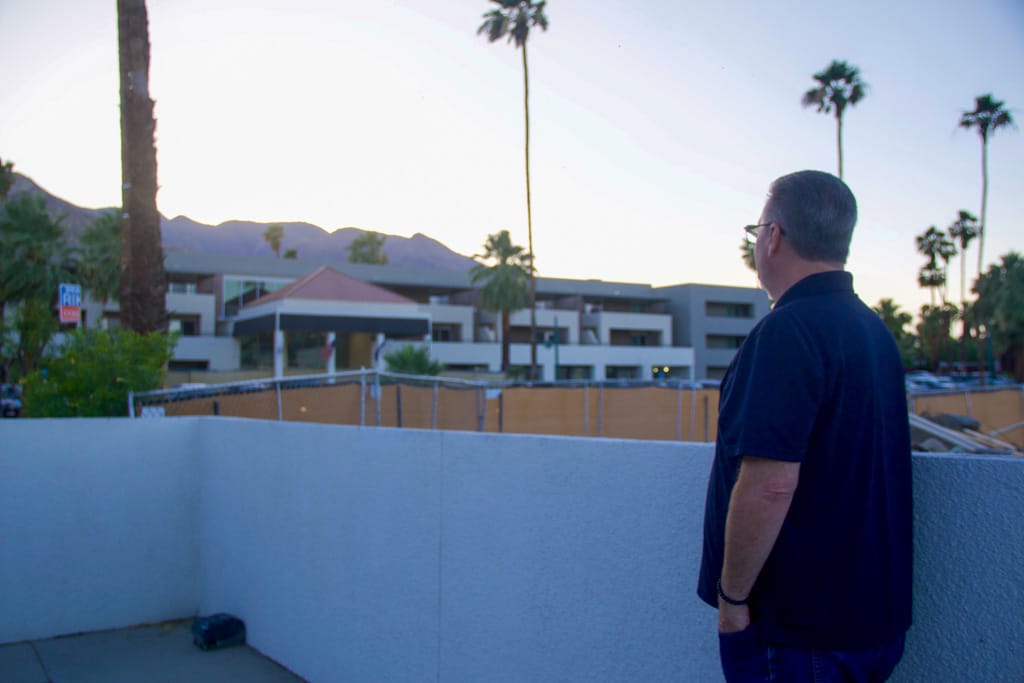
For Sean Bates, May 17, 2025, began like any other day. After moving to Palm Springs that January to start a new life, he found work at WorldMark Palm Springs as a marketing concierge. As a gay man, he was excited to live in Palm Springs and become part of the community. That morning, he was chatting with a coworker behind his desk in the hotel’s main lobby.
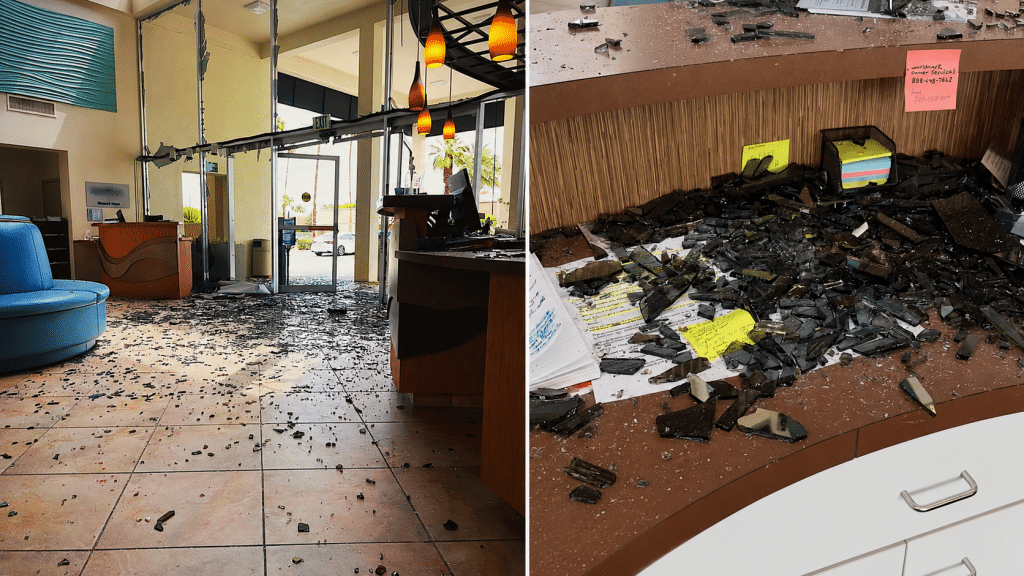
Bates says what happened next felt like slow motion. He saw glass from the hotel’s large entrance fly past his head, and then he heard the boom he would later learn was a car bombing targeting the American Reproductive Centers just steps away.
Local reporting and journalism you can count on.
Subscribe to The Palm Springs Post
“I said to myself ‘I think you just died, and it’s okay,’” recalled Bates, describing how he watched more and more glass rain down around him. Then he heard the screams of the coworker he had just been speaking with. “All of a sudden her screams knocked me out of it, and I got into action mode.”
He looked over and saw blood dripping down his coworker’s head, so he took her to the front desk and found beach towels to apply pressure to the wound. The coworker asked him to call her mother. Bates asked for the number and wrote it down on his arm.
“I never want to make that phone call again,” said Bates.
Bates has always worked in hospitality, so he is used to helping other people. But while assisting his coworker, he realized that his own head and arms were bleeding.
“And my back was on fire,” said Bates, recalling how another coworker came out and applied pressure to his wound while he continued helping the injured employee. “I turned my head down, and then glass just fell out of my head. It was just glass everywhere.”
An ambulance transported Bates and his coworker to Desert Regional Medical Center.
But the injuries from the blast were only the beginning.
‘I just went to work’
Bates did not know it at the time, but the bombing would mark the beginning of a year-long battle for healthcare, housing, and financial stability that would eventually leave him living out of his car just a month after the attack.
Bates suffered both external and internal injuries from the blast, which he says involved 270 pounds of ammonium nitrate with little more than a window to contain the force. After the resort closed for repairs and he lost the ability to work because of his injuries, he began ongoing medical treatment that included multiple visits to VIP Urgent Care, emergency room visits for vision loss and concussion evaluations, X-rays and MRIs for spinal injuries, and specialist care for eye, spine, and rotator cuff injuries. He also became responsible for mounting out-of-pocket expenses for medications, transportation, and medical services.
Because he had only recently moved to Palm Springs, much of his savings had gone toward moving expenses and the purchase of a new Jeep. The vehicle had broken down just two days before the bombing and remained in the shop for three months afterward. Bates says he would have eventually recovered financially through income from his new job, but the bombing left him unable to work while medical bills continued piling up. He received temporary disability payments, but they fell far below his pre-injury earnings because they did not account for the commission-based portion of his income as a marketing concierge.
“I lost everything because I went through a system that had me do it alone. There was no one to help me navigate it, and it failed. Physically, mentally, financially, I’m just trying to survive. But I’m a fighter, I’m an optimist, and it’s like something is going to help, something’s going to work out.”
— Sean Bates
“I had to fight since day one. The workers’ compensation system just put me on medication. They did nothing else. I had to fight for care. I had to fight to talk to somebody,” Bates told the Post, explaining that the hardest part of the attack has been the year that followed it. “This changed my whole life through no fault of my own. I just went to work.”
On June 22, 2025, Bates became homeless due to the loss of income and inability to work. He lived out of his car for a week before posting on the neighborhood app Nextdoor, where a community member connected him with someone offering a room.
He later attempted to return to work after getting a job at the Westin Hotel as a food and beverage manager, but worsening symptoms forced him to leave in September. In October, he became homeless again before eventually finding a small casita in November, which he has managed to pay for by selling nearly everything he owned and maxing out his credit cards.
He continues to experience chronic pain, mobility limitations, and neurological and systemic health issues that have prevented him from returning to work. He is currently receiving treatment for blood abnormalities and internal bleeding caused by the attack.
Trauma after the headlines
In addition to his physical injuries, Bates was diagnosed with PTSD. He says he can still hear his coworker’s screams.
According to Jill Hingston, chief behavioral health officer at The LGBTQ Community Center of the Desert, this kind of trauma response is common after an event such as the fertility clinic bombing, especially in a small city like Palm Springs, where many residents felt their sense of safety shattered.
“I think what we heard repeatedly was that Palm Springs has always felt like a really safe sort of bubble, and then that was shattered,” said Hingston, who organized three drop-in group therapy sessions for those affected by the bombing.
Some attendees, she recalled, had witnessed body parts in the street.
“People have witnessed things that people in wars see,” Hingston said. “I think it was a reminder to folks that we are so insulated, or we think that, but the reality is that anything can happen any time.”
That is exactly what Bates did at The Center. He first attended those group therapy sessions, and last December he was able to obtain Medi-Cal coverage and was paired with Associate Social Worker Meghan Sullivan for therapy and advocacy support through the organization’s services program.
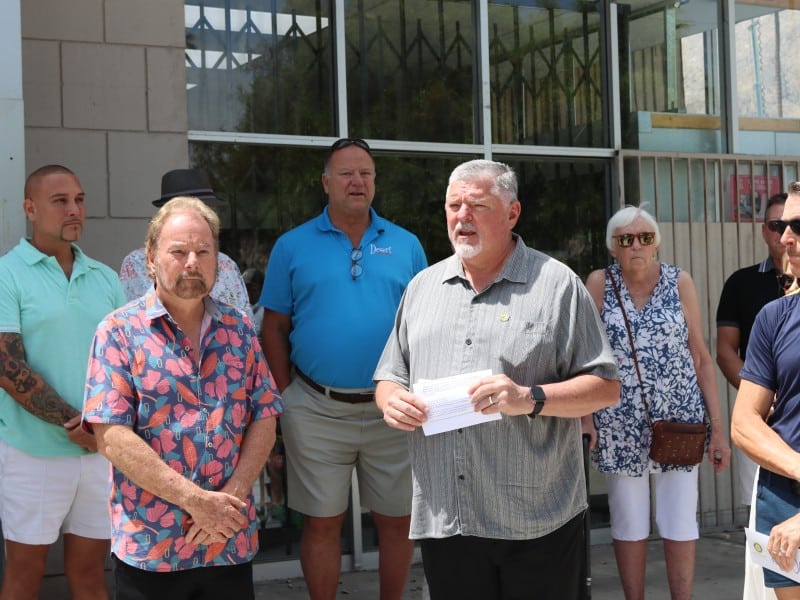
“The Center has been fantastic. They’ve been helping me. I can’t say enough. I would not be here without them. They got together as a team and rallied around me,” said Bates.
Sullivan later met with Hingston, Chief Programs Officer Lex Ortega, and CEO Mike Thompson to discuss ways the organization could support Bates as a team.
“He’s had the worst luck,” Hingston said. “And anybody could have this horrible luck and end up where he is. That’s the thing.”
Medical crises are a major contributor to housing instability in California, where high housing costs often leave little room for financial disruption. Research from the UC Berkeley Labor Center found that nearly 30% of adults experiencing homelessness cited medical debt as a contributing factor to their housing crisis.
Fighting for help
Bates says Sullivan has been instrumental in helping him navigate the aftermath of the bombing by providing emotional support and encouraging him to keep fighting.
“She’s the realist. She’s the one where she’s helped me to fight again. She’s helped me to say no, this isn’t right. You have to stand on your own two feet, and you’re going to be okay,” said Bates.
In December, Bates began applying to the California Victim Compensation Board, a state program that reimburses eligible victims of violent crime for expenses related to physical injury or the threat of injury. The program serves as a payer of last resort, covering costs not paid by insurance or other sources, up to $70,000.
“I started in December trying to get an advocate [at CalVCB]. No one would call me back. I went to the ombudsman, I went to the council people, I went to the FBI, and I said, I just need someone to help me file it so I don’t file it incorrectly,” Bates said. “I have certified letters. Nobody got back to me. So I filed it. I just thought I filed it with as much detail as I could.”
“He’s amazing. He didn’t give up. Other people may have ended their life, and he kept pushing, because there’s something in him that tells him to.”
— Jill Hingston, chief behavioral health officer at The Center
The team at The Center has continued calling people in positions of authority on Bates’ behalf, helping him navigate different departments and systems. They have also assisted with day-to-day support, and recently created a GoFundMe to help cover expenses as he once again faces the possibility of homelessness after maxing out his credit cards.
Bates suffered another setback this week, just before the one-year anniversary of the bombing, when he learned moments before our interview that his application to the California Victim Compensation Board had been denied. The FBI has connected him with a victims advocate in Riverside that is helping him reapply for the victim fund but he doesn’t know when he will hear back.
“I lost everything because I went through a system that had me do it alone,” said Bates. “There was no one to help me navigate it, and it failed. Physically, mentally, financially, I’m just trying to survive. But I’m a fighter, I’m an optimist, and it’s like something is going to help, something’s going to work out.”
“He’s amazing,” said Hingston. “He didn’t give up. Other people may have ended their life, and he kept pushing, because there’s something in him that tells him to.”
Hingston said no one should have to endure what Bates has experienced.
“Nobody should have to work this hard just to get what they deserve,” she said. “I think that was a heartbreaking piece, because he felt like nobody cared for way too long.”
Author
Related Articles
Rebuild Palm Springs closes fund, makes final grants a year after bombing
The grassroots fund tied to last year’s fertility clinic bombing raised nearly $160,000 and is sending its remaining balance to health grants, a police equipment purchase and emergency prep workshops.
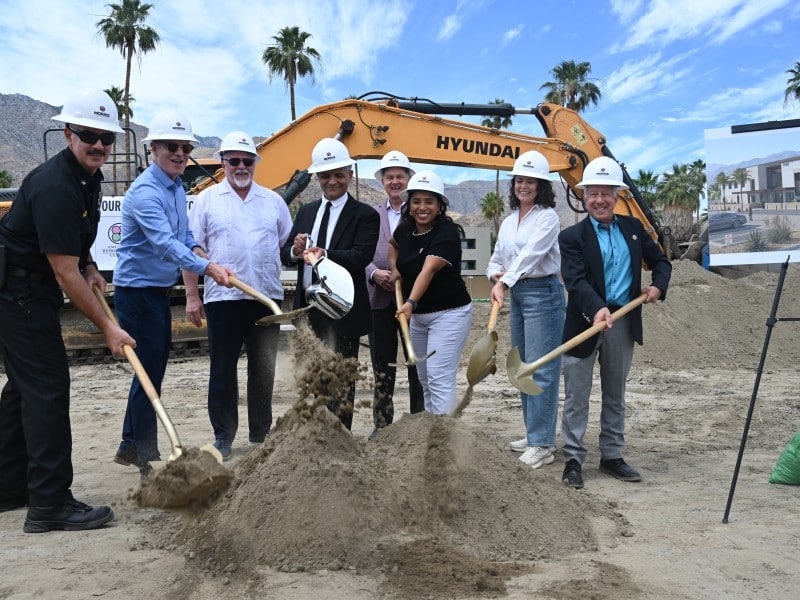
American Reproductive Centers breaks ground on new Palm Springs facility nearly one year after bombing
The groundbreaking marks a turning point for the fertility clinic that was destroyed in a May 2025 bombing, with construction targeting an ambitious Dec. 31 completion and a goal of full operations by 2027.
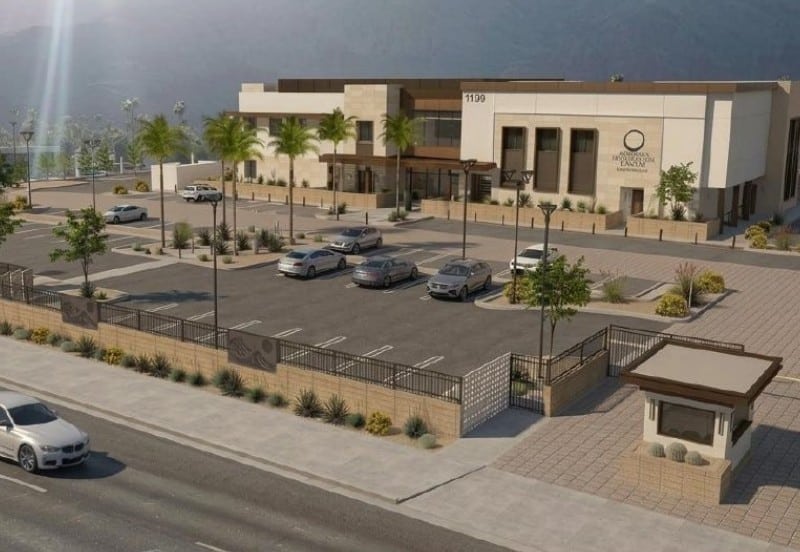
Committee approves design plans for fertility clinic destroyed in 2025 terrorist attack
Revised plans reviewed Monday evening shift the building’s style from Mediterranean to contemporary, addressing concerns about compatibility with the area’s midcentury modern architecture.