
Committee approves design plans for fertility clinic destroyed in 2025 terrorist attack
Revised plans reviewed Monday evening shift the building’s style from Mediterranean to contemporary, addressing concerns about compatibility with the area’s midcentury modern architecture.
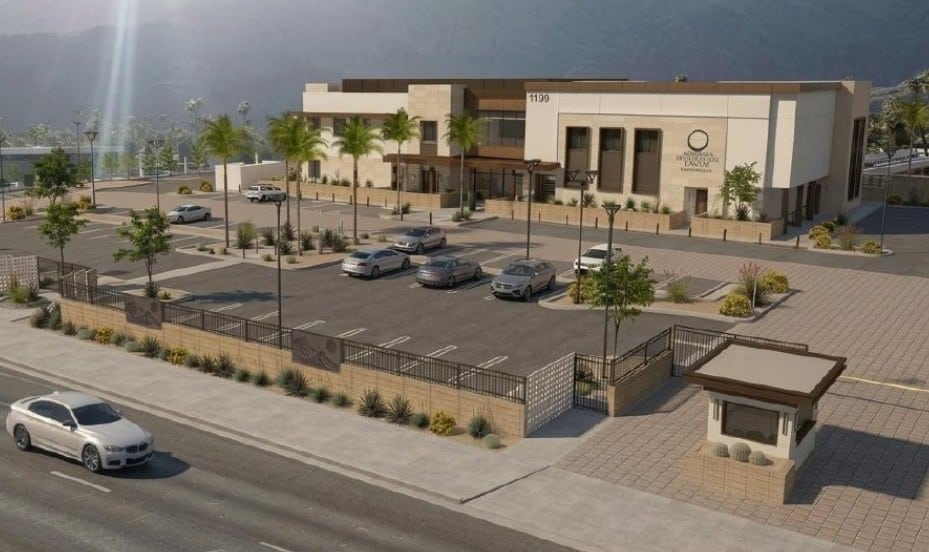
The Palm Springs Architectural Review Committee (ARC) on Monday approved architectural plans for the reconstruction of the fertility clinic destroyed in a domestic terrorist attack last year.
TJ Property Holdings, doing business as American Reproductive Center, is proposing a 19,347-square-foot, two-story medical office building at 1199 North Indian Canyon Dr., replacing the previous facility that was destroyed on May 17, 2025.
Local reporting and journalism you can count on.
Subscribe to The Palm Springs Post
Back in February, the clinic presented rebuilding plans to the Planning Commission that largely focused on increasing security for patients and staff. The commission ultimately opted to move the project forward to the architectural review committee, but requested 11 changes to the project’s design and architectural style.
The architectural review committee on Monday was tasked with considering the project’s major architectural application, the building design, colors, and materials, and lighting and landscaping. The project is under an expedited review process because it’s in a “Disaster Overlay Zone” created by the city council shortly after the attack to ease the rebuilding process.
Revised plans submitted to the Architectural Review Committee showed that the applicant had readjusted in response to each of the Planning Commission’s eleven requests. These requests included revising the building’s style from Mediterranean to be more contemporary, following concerns from some commissioners and the Palm Springs Modern Committee that the proposal didn’t fit in with the surrounding midcentury modern architecture. New renderings show a more modern project with simple and clean lines.
Other changes requested by the Planning Commission and completed by the applicant included swapping out what species of palm trees are used in the landscaping, increasing building setbacks, adding pedestrian access along North Indian Canyon Drive, and adding a walkway with benches along North Palm Canyon Drive.
Additional conditions added by the ARC on Monday included adding more shade-providing trees (rather than palm trees) on the Indian Canyon Drive side of the property, making the fence styles more consistent, adding large boulders and rocks along North Palm Canyon Drive, and making the building facades more cohesive, along with other design-focused changes.
While discussion at the two recent city meetings has largely focused on building design and aesthetics, American Reproductive Center’s main priority in the rebuild project is increasing safety and security at the facility.
“A key element of this site is the concern that the doctor had with the situation happening again,” said the project’s architect on Monday. New security features include surrounding the site with a perimeter block wall and raised planters to prevent a car from driving directly up to the building again, and a new guardhouse that will be staffed 24/7 and control access to the parking lot.
Committee members also turned their attention to the design of this guardhouse, with one committee member saying they’re hard to design without making them look like “soccer trophies” and asked whether there was a way to make it look “less self-important.” They resolved this by asking that the overhang of the guardshack be shorter in length.
The applicant’s team repeatedly cited the doctor’s concerns for security in response to committee questions about design features. In one example, a committee member’s question over why the block wall is topped with additional metal fencing was answered, as with other questions, with a call back to the attack in May 2025 and the staff’s desire for more security.
“Part of it is psychological too, because the staff, who he has retained, in their current building they fear walking to their car, and they still have that (fear) anytime somebody shows up to the door that’s uninvited,” said the architect in response to the question.
“So some of this is a psychological barrier for them, when they walk up to their cars, they can feel better protected. It could slow down, potentially, a person (climbing the fence), and the guard house is here at all times. So it’s a physical barrier, and it’s also a psychological barrier.”
Author

Related Articles
Preservation board delays decision on latest Orchid Tree hotel plans, sends four items back for restudy
Members want four staff-recommended changes restudied, including the location of a pool cabana, a step city planners said will add time to the Orchid Tree Resort & Spa schedule.
Planning Commission approves 16-unit townhome project at Sunrise Way and Amado Road after July delay
City staff noted that some of the commission’s earlier requests conflicted with state housing laws, though the developer did add a walkway so pool cleaners and landscapers can reach backyards.
Planning Commission pulls Bel Air Greens housing plan from agenda after tribe acquires half the site
The property’s new tribal trust status means only part of the closed golf course would remain under city land-use review, commissioners learned Tuesday.