
Valley congregations pair American history with faith traditions in ongoing dialogue series
The faith250 initiative pairs founding documents like the Declaration of Independence with religious texts and regional history.
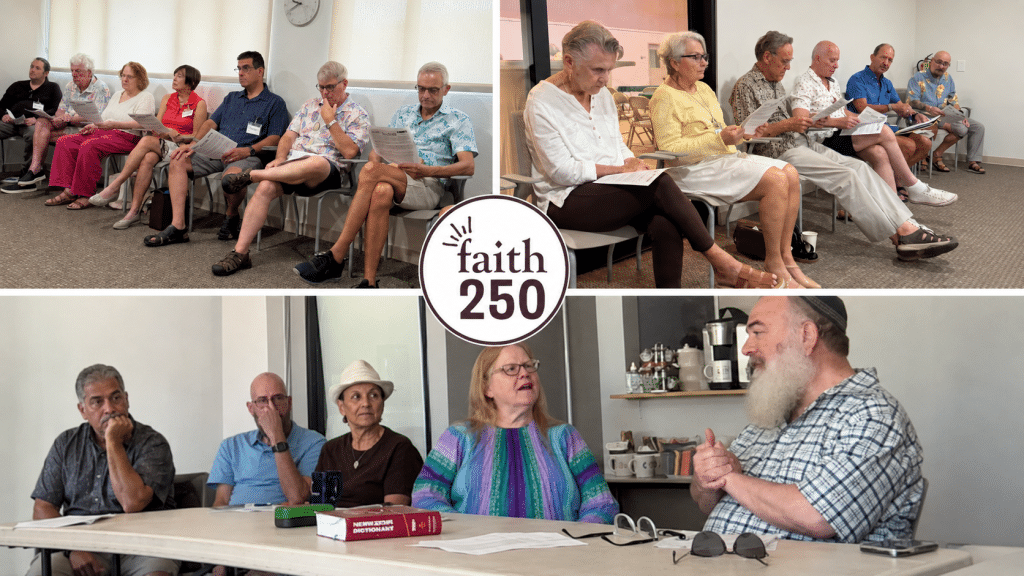
An interfaith study series bringing together several Coachella Valley congregations to examine foundational American history alongside sacred religious texts is concluding this month with a gathering at St. Paul in the Desert Episcopal Church.
Or Hamidbar, a local Jewish community led by Rabbi David Lazar, has participated in the discussions since late May as part of Faith250, a national initiative marking the upcoming 250th anniversary of the United States. The broader project encourages communities nationwide to pair civic documents with theological traditions to foster deeper civil dialogue.
Local reporting and journalism you can count on.
Subscribe to The Palm Springs Post
The Coachella Valley sessions have rotated among host congregations and drawn attendees from Jewish, United Methodist, Disciples of Christ, Baptist, Episcopal, Buddhist, Presbyterian, and Unitarian Universalist traditions, as well as participants unaffiliated with any religious group.
Lazar adapted the national framework to fit the desert’s summer schedule by collaborating directly with individual houses of worship.
“Around the country, it’s a big deal—hundreds of people come together and share a meal together and discuss these texts in open conversations,” Lazar said.
“I kind of changed the overall formula for Palm Springs to do it in each church and to emphasize their own faith tradition… It’s summer, and it’s just much easier to program directly with one particular clergy person I have strong relationships with.”
Lazar said these kind of conversations are not new for many in the local faith community. Recently a local group of Jews and Christians both locally and from across the country met to spend a year studying the Acts of the Apostles.
Another previous series, “From Holiness to Hatred and Back” examined texts from religious traditions, “that were created in holiness but have been weaponized for hatred,” he said.
The series has met at the Unitarian Universalist Church of the Desert in Rancho Mirage alongside the Rev. Ian W. Riddell, before moving to St. Paul in the Desert with the Rev. Dan Kline. Pastor Jane Voigts co-led a discussion at United Methodist Church of Palm Springs. The current August mini-course at St. Paul is co-facilitated by Lazar and the Rev. Frank Dunn.
As outlined by Faith250, the curriculum pairs national documents—such as the Declaration of Independence and Emma Lazarus’s poem “The New Colossus”—with biblical passages like 1 Samuel and the Sermon on the Mount, alongside historical immigration policy and methods of self-governance.
For many attendees, the sessions mark the first time they have engaged with foundational civic texts in adulthood.
Lazar said the conversations often turned to modern parallels and contradictions. Amidst ongoing targeting of immigrant communities, Lazar said participants couldn’t help but contrast the current administration’s hostility toward immigrants with the most famous lines of Lazarus’s poem:
“Give me your tired, your poor,
Your huddled masses yearning to breathe free,
The wretched refuse of your teeming shore,
Send these, the homeless, tempest-tossed to me,
I lift my lamp beside the golden door!’”
“That was the point, exactly,” he said.
Those readings also surfaced differing perspectives. “When African Americans are in the room… the first thing we heard about Emma Lazarus was, ‘You know, this doesn’t mean anything to me. My family didn’t go through Ellis Island,'” Lazar said.
Part of the discussion includes excerpts from Frederick Douglass’s, “What to the Slave is the Fourth of July?” speech, directly reckoning with the Declaration of Independence, another text the group studies.
Each session opens and closes with liturgy and music, pairing Episcopal prayers with chants from the ecumenical Taizé community sung in Hebrew, Latin, and English.
While the Faith250 series concludes this month, Lazar plans to continue community scriptural studies through Or Hamidbar, including an upcoming academic review of the Book of Jeremiah.
“This is where people are interested, and it’s my job as a rabbi to come to them and help facilitate that kind of study, meaningful study,” Lazar said. “That’s what this is really about: bridging the gaps.”
Author

Related Articles
Palm Springs prepares for strong El Niño with growing CERT ranks
Hundreds of residents have already received emergency training, and demand remains high as the city and volunteer groups brace for possible flooding and other severe weather.
Officials set turf closure schedule for a dozen city parks
Rotating maintenance closures will affect fields and grass areas at parks across the city from September through December to allow reseeding and irrigation work.
Advocates log dozens of Palm Springs immigration actions as local legal observers expand tracking
While federal arrest numbers reach record highs nationwide, local advocates told Palm Springs human rights officials that enforcement has remained constant since 2025 as community groups step up support.