
DAP Health: $30K of $700K meant for UBI program available when it assumed control this month
In a statement released Thursday, the healthcare organization says it is committed to completing the program without additional taxpayer funds but hopes an investigation turns up more.

A Palm Springs-based healthcare organization trying to pick up the pieces of a Universal Basic Income (UBI) program at the center of an investigation into alleged misappropriation of taxpayer money is hoping to clear the air about exactly what transpired and where the program is today.
In a statement released on its website Thursday, DAP Health, a nonprofit healthcare organization with a 40-year history in the community, said it assumed full responsibility for the UBI pilot program on July 12 amid concerns over its administration and has implemented changes it hopes will help bring about a successful conclusion.
Local reporting and journalism you can count on.
Subscribe to The Palm Springs Post
Hoping to secure a portion of millions of dollars in state funding that could be used for the program, the Palm Springs City Council unanimously approved an initial $200,000 payment to support the effort in March 2022. It split its vote in approving an additional $500,000 four months later.
On Thursday, DAP said in its statement that it was members of the council who approached the organization to help direct the program with Queer Works, a smaller, trans-led nonprofit led by CEO Jacob Rostovsky.
With city funds secured, DAP and Queer Works teamed to apply for the state funds, DAP wrote in its statement. However, when the state money wasn’t granted, DAP said its leadership was no longer needed.
“At the beginning of building a local UBI pilot program, the state of California announced it had $35 million in funding available for organizations with new ideas,” the statement reads. “The local pilot program needed a leading nonprofit like DAP Health … for successfully managing state funds.
“Those funds, however, proved elusive, and when they did not come to fruition, the pilot program no longer required DAP Health to be in the lead position, allowing the city of Palm Springs to grant local funding directly to Queer Works to execute the program.”
Distanced from project
As a smaller program rolled out, DAP said Thursday it proposed managing the finances for it. Ultimately, DAP said, Queer Works and the city chose to proceed without DAP’s financial oversight.
DAP said it remained supportive of the initiative offering healthcare services to the program’s participants, although its staff was not privy to financial details or how Queer Works allocated the funds.
“On October 5, 2022, Queer Works executed an amendment to its original (agreement) with the city of Palm Springs,” the online statement reads. “DAP Health was not included in the amendment and was not a signatory.”
Even with DAP Health’s official role in managing the program ending in February 2023, DAP said it recommended a payment system provided by Paycom called a “Vault Card,” where the monthly payments would be deposited and could be used like any other debit card.
After that offer, DAP wrote, “No other communication was received from Queer Works, no wires ever came to DAP Health, and the organization later learned Queer Works had chosen to manage participant payments internally.”
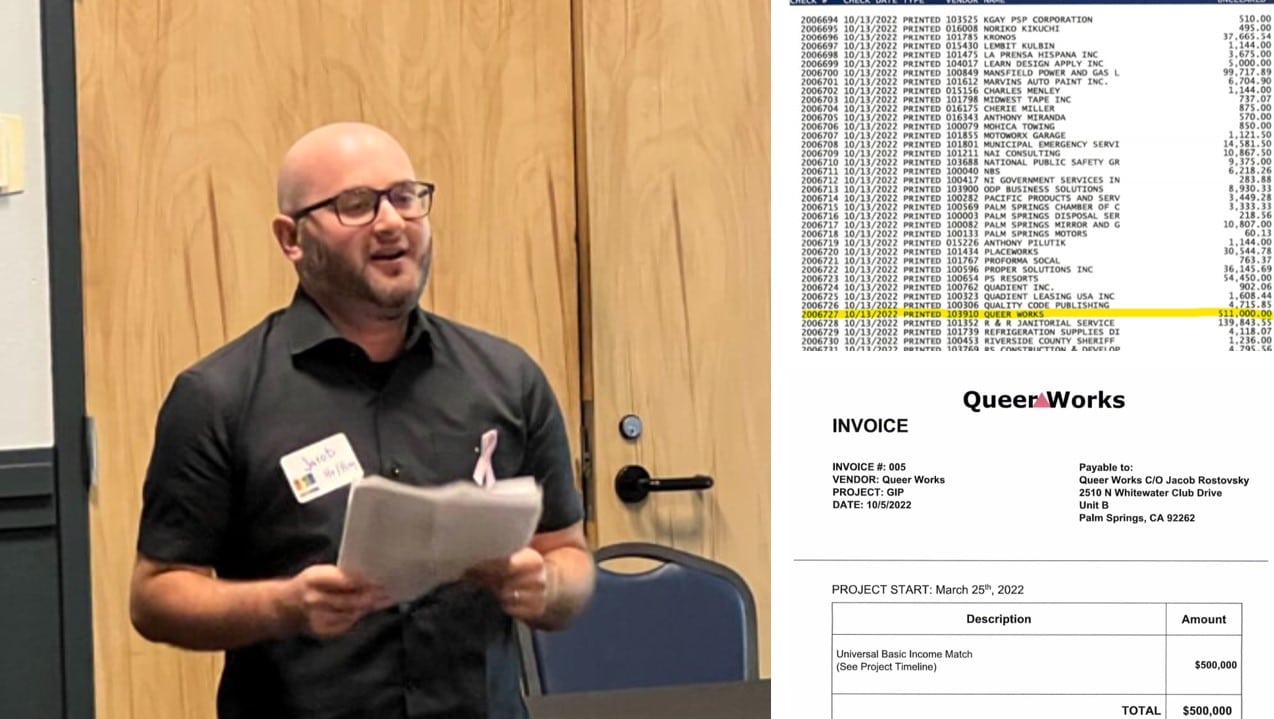
Documents obtained by The Post show Rostovsky billed for and received the entire $700,000 allotted by the City Council despite an understanding that most of the funds would be set aside for direct payments to program participants. That led to the city conducting an audit and eventually turning the matter over to the Riverside County District Attorney, whose office is currently conducting an investigation.
Looking back
The Post first reported the issue on July 19. On Tuesday, City Manager Scott Stiles released details of new measures and more rigorous vetting he will propose to elected officials in hopes of preventing similar lapses in accounting at City Hall.
On Wednesday, The Post confirmed that Riverside County officials have also turned to the District Attorney after finding “discrepancies in the invoices and documentation” after approving $1.6 million – and paying $632,000 – for Rostovsky to provide street outreach for unhoused people and rental assistance for victims of domestic violence under a program called The TransPower Project.
No evidence of The TransPower Project exists today, and its website domain has expired. The county could not confirm any work being done by Rostovsky under that project’s name and suggested a public records request might turn up additional information.
The goal of the Palm Springs UBI project was to provide 30 qualifying Palm Springs residents with $800 monthly payments for 18 months.
The UBI program was launched in 2023, though participants received their first payment six months late.
Of the $700,000 in program funding Rostovsky billed the city for and received without initial questions, DAP confirmed that $30,000 was available when it took charge earlier this month. The healthcare organization said it was committed to completing the program without requesting additional taxpayer funds.
“DAP Health is awaiting the findings of the Riverside County District Attorney to determine if any additional funds remain to complete the program.” the statement read. “We are committed to funding the completion using our own unrestricted general operating funds without asking for additional taxpayer dollars.”
Frustrated participants
As for program participants, including one who shared his story with The Post on July 22, DAP invited the remaining 14 participants to a virtual town hall to discuss the future of the project on Monday.
DAP said in its statement, “Through these discussions, DAP Health realized there were early signs that the UBI program was not working as intended. Participants reported delayed payments, unclear communication, and financial hardship due to unfulfilled promises.”
However, participants say they took their concerns to DAP Health and the city in the fall of last year after waiting months for payments.
In response, DAP said it is implementing several improvements to enhance the participant experience. These include offering monthly group conversations, providing direct access to the organization’s chief transformation officer for real-time support, and reviewing stipend schedules to ensure consistency.
“We are committed to improving the participant experience,” DAP wrote. “Our goal is to address past issues and ensure better communication and support for all participants moving forward.”
Currently, seven of the 14 remaining participants are receiving health care or social services through DAP. The organization is also working closely with Health Assessment and Research for Communities (HARC) to track the program’s impact and ensure its success.
“We believe DAP Health’s involvement in the Palm Springs UBI pilot program highlights its dedication to health equity, transparency, and community empowerment,” the statement read. “Through strategic collaboration and unwavering commitment, the organization aims to create a lasting impact on the lives of this program’s participants and the broader Palm Springs community.”
Author

Related Articles

Palm Springs City Council approves response to grand jury report on $700,000 grant oversight failure
During Wednesday’s council meeting, several members expressed concerns about the city’s response, particularly regarding a key finding about financial losses.
Grand jury: City lacked proper grant oversight when it lost over $700,000 to alleged fraud
In a response, the city acknowledged the grand jury’s findings and said it had already begun addressing the issues identified in the report.
Grand jury indicts Queer Works CEO on multiple fraud charges
In an announcement made Wednesday, Queer Works founder Jacob Rostovsky is accused of misusing over $840,000 in public funds intended for housing assistance and basic income payments.