
Potential noise, traffic congestion among issues addressed at community meeting on airport’s growth
Officials stressed a planned expansion would be phased over two decades with opportunities for public input, and that, “We have no plans to become a mega-airport.”

Palm Springs International Airport (PSP) officials unveiled an updated master plan for expansion at a community meeting Thursday night, addressing concerns about noise and traffic while outlining plans to double passenger capacity over the next 20 years.
The master plan, which is mandated by the federal government, was presented by airport leadership and consultants at the city’s convention center. Roughly 100 people in attendance heard about plans to modernize facilities while preserving the airport’s unique indoor-outdoor feel. Of particular interest was a scaled-back rental car center adjacent to the terminal and a future second facility to the south.
Local reporting and journalism you can count on.
Subscribe to The Palm Springs Post
“We want to make sure to preserve the uniqueness of the airport while also managing the growth,” said Airport Executive Director Harry Barrett.
The plan projects passenger numbers to increase from three million annually to over six million by 2042. Phase one improvements, which are expected to be complete by 2030, are estimated to cost $750 million and would see seven additional gates, expanded baggage claim, and construction of new rental car facilities.
Concerns among the dozen people who asked questions after a presentation by Barrett and others were familiar to those expressed in other communities undertaking airport expansions.
Several residents asked about increased aircraft noise. One attendee who lives near the airport said current noise levels are already disruptive.
“Noise is real for people who live near the airport as I do,” the resident said. “Right now we count six to eight takeoffs per hour at Sagewood Condominiums.”
Barrett said a noise study will be conducted as part of the required environmental review process. However, he noted that the federal threshold for noise mitigation measures does not currently extend beyond airport property.
Traffic congestion was another key concern. Ryan Hayes, one of the project consultants, said traffic analyses show most intersections can handle the increased volume, though one at Kirk Douglas Way and Ramon Road may need improvements.
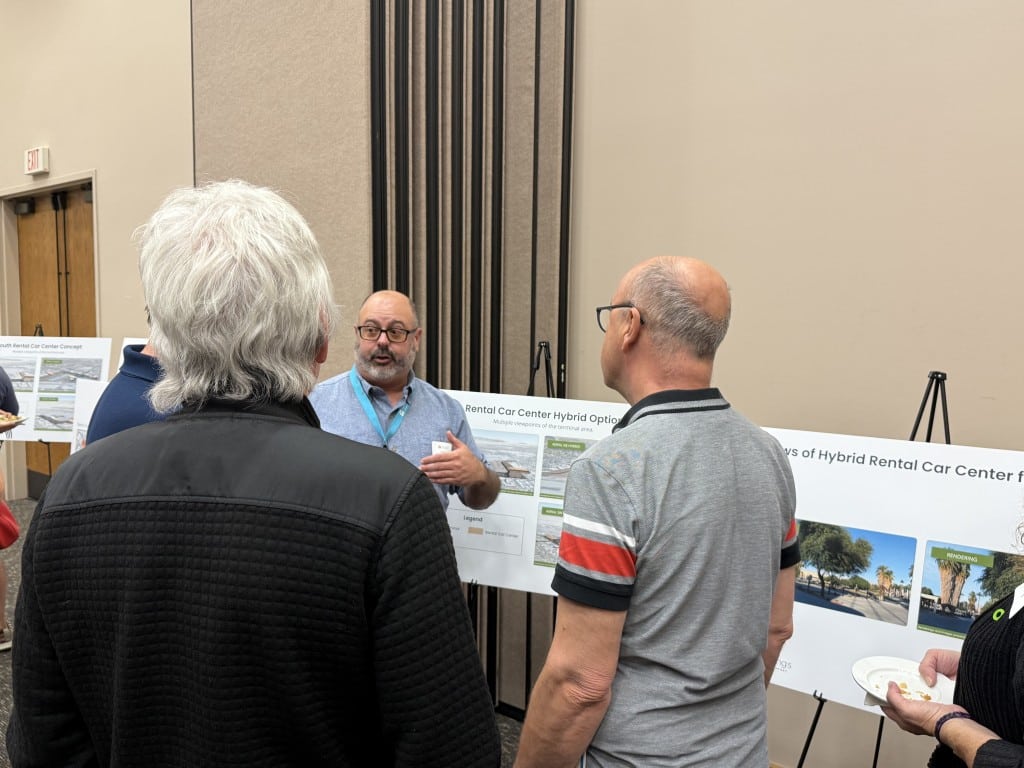
“We built a traffic model and analyzed adding all of this traffic. What it showed is these intersections are not going to fail,” Hayes said.
The plan aims to reduce congestion by moving rental car traffic off the main terminal loop road. Officials are also exploring improved public transit connections.
Palm Springs Mayor Jeffrey Bernstein emphasized the airport improvements are driven by federal requirements, not a city push for rapid growth. Barrett stressed that improvements would be funded through airport revenues and federal grants, not local taxes.
“This wasn’t like city council said, oh, we want to have a much bigger airport,” Bernstein told the audience. “This is federally mandated.”
He noted the projected doubling of passengers is based on observed trends over the past 20 years, when numbers grew from 1.5 million to over 3 million annually. He also addressed questions about whether the airport in Thermal could take more passengers, noting that Palm Springs officials have no say in those facilities and must focus only on planning for growth at PSP.
Some residents questioned whether such growth is desirable for the community, with one attendee cautioning against over-tourism, citing negative impacts in popular European destinations.
“Everything you’re planning and doing is for tourists and to the detriment of many of us who live here year-round,” she said.
Officials stressed the expansion would be phased over two decades, with opportunities for further community input. Before the meeting began, Barrett stressed, “We have no plans to become a mega-airport.”
Barrett said the improvements would be funded through airport revenues and federal grants, not local taxes.
While the master plan focuses on overall facility needs, Barrett said separate discussions are ongoing about leveraging the airport for broader economic development in fields like manufacturing and medical services.
The meeting was part of an extensive community outreach effort that has included over 30 presentations to various groups. Airport officials said they will continue to gather feedback as planning progresses.
Author

Related Articles

Airport Commission backs parking system overhaul amid cost, operational questions
Commissioners cite aging system and customer experience gains, while raising concerns about costs, staffing impacts and how parking reservations would work during peak demand
College of the Desert completes structural framework for Palm Springs Campus
The project now moves into the interior construction phase as a fall 2027 opening remains on track.
City: Bridge project faces minimum 2-year delay amid environmental lawsuit
An organization has filed suit challenging the city’s approval of a flood-control bridge design on South Palm Canyon Drive. The move will threaten federal funding and push back a project nearly two decades in the making.