
Plans for ‘soulless’ and ‘pseudo-modern’ new development ignite passion in city’s architecture community
A recent conversation about a proposed development on East Palm Canyon Drive opened up a larger conversation on flaws with the design and architecture of new developments in the city.
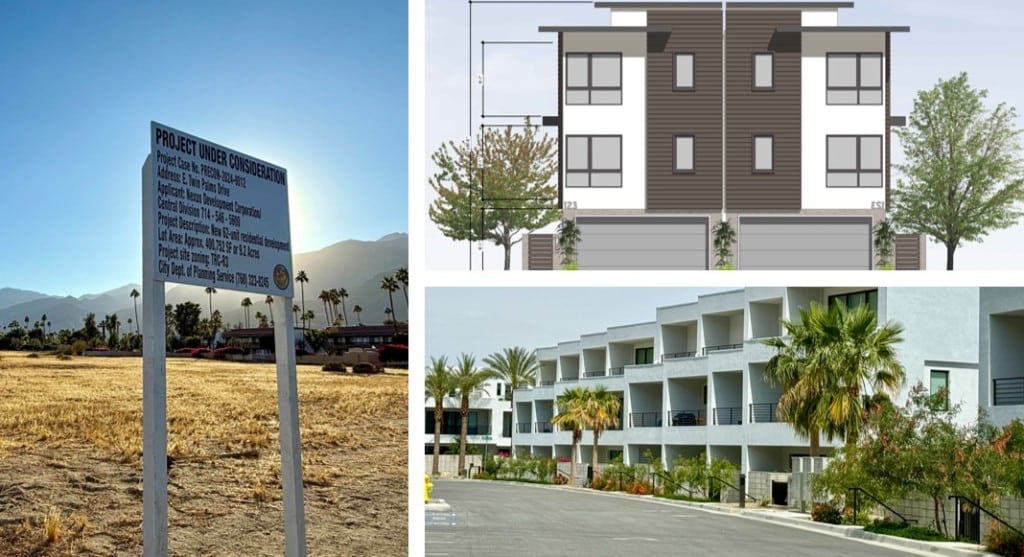
Palm Springs Planning Commission members and local architecture and design community members sharply criticized a proposed 62-unit residential development at a meeting last week, citing concerns about inadequate density, poor design, and failure to comply with zoning requirements.
What started out as a Planning Commission study session on one specific 62-unit project turned into an indictment of the project’s design and of the design of most of the major recently built developments in the city.
Local reporting and journalism you can count on.
Subscribe to The Palm Springs Post
The developer, Nexus Development Corporation, submitted a pre-application for a Planned Development District (PDD) in order to build 40 detached single-family homes and 22 duplexes on a nine-acre undeveloped lot along East Palm Canyon Drive in the Twin Palms neighborhood.
Planning staff noted the proposal presents multiple concerns, most obviously the fact that single-family residences are expressly prohibited in the R-3 zone where the site is located.
The project’s proposed density of approximately seven dwelling units per acre falls significantly below the 30 units per acre that current zoning allows. The maximum number of units zoned for that location is 264, and the developer proposes just 62 units.
The city’s housing element also singled out the lot in question as a location primed for more dense housing. That’s a problem because of the state’s No Net Loss law, which says if a city reduces capacity from a site and gets less housing out of it than assumed in the housing element, then that capacity needs to be offset somewhere else.
Planning Commission Chair Kathy Weremiuk said she was “uncomfortable” with a developer using a PDD to avoid the city’s zoning laws, adding, “I’m not comfortable ignoring the needs of the city in the housing element.”
The developer’s representative countered, saying, “To my knowledge, there’s no minimum density required, so that means nothing is precluded to one unit to the acre.” He said that after analyzing the market and considering the neighborhood, the demand for a low-density project would make more sense economically.
Several residents who attended the meeting agreed, saying they thought the project was actually too dense for their tastes.
Beyond the density concerns, others spoke up at the meeting about the proposed project’s aesthetics. Members of the architecture and design community came out in full force to oppose not only the proposed project but also disparage much of the design of recent developments built in the city.
“Will we maintain the city’s motto, Palm Springs, like no place else? Or will we become known as Palm Springs like anywhere else?”
— Dick Burkett, founder of the Palm Springs Architectural Alliance
The speakers, members of the architecture and design community like Chris Menrad, said the design of the buildings in the project echos much of what the city already has: “Mundane, pseudo-modern style. It’s seen everywhere in the country. It’s placeless, it’s soulless,” he said.
Dick Burkett, founder of the Palm Springs Architectural Alliance and former chair of the Historic Site Preservation Board, wondered, “Will we maintain the city’s motto, Palm Springs, like no place else? Or will we become known as Palm Springs like anywhere else?”
Tom Dolle, a Palm Springs Architectural Alliance member and former professor of graduate design at Pratt Institute in New York, said the development follows a well-established pattern in the city.
“Tracts of compact, two-to-three story single-family luxury homes in walled off suburban-style enclaves with yawning garage doors, private cocktail pools, and one to two million dollar price tags.”
He called the design “clumsy and overwrought” with “boxy forms” and “tacked-on midcentury references” that clash with other textures and colors.
Menrad agreed, likening many of the city’s new luxury condo developments to Minecraft, a video game famous for its LEGO-like blocks and buildings.
The developer acknowledged they had heard complaints about the design at a neighborhood outreach meeting they hosted in February. He said the designs are still early in the pre-application phase and they have since hired local architect Sean Lockyer from Studio AR&D to improve the look.
Commissioners largely agreed with residents who spoke up about the project’s design. Commissioner Scott Miller called the project “half-baked” and some elements “woefully inadequate.”
Vice Chair Lauri Aylaian called the project “Something that is fundamentally wrong for what the city needs going forward.”
The pre-application study session was a preliminary step required before the developer could submit a formal planned development district application. The commission took no formal action but provided guidance for the applicant to consider before returning with a revised proposal
Author

Related Articles
City boards weigh bike safety, airport upgrades, subcommittee votes and hillside remodel this week
Active Transportation, Human Rights, Sustainability, Airport and Architectural Review panels meet across four days on Ramon Road safety, Measure J seating funds and a Panorama Road home project.
Dream Hotel project falls further behind schedule as Palm Springs council reviews progress
The developer missed deadlines for a construction cost estimate and model room completion, but still plans to start construction by Oct. 1, city staff said.
Palm Springs City Manager Scott Stiles to retire Nov. 1
Stiles, who joined the city in March 2023, cited a public service career spanning more than four decades in an email sent to employees Tuesday morning.