
Palm Springs City Council approves new palm tree skirt removal policy
Officials will prioritize frond removal in high-traffic commercial areas, with exceptions for historic sites and habitat concerns raised by wildlife advocates.
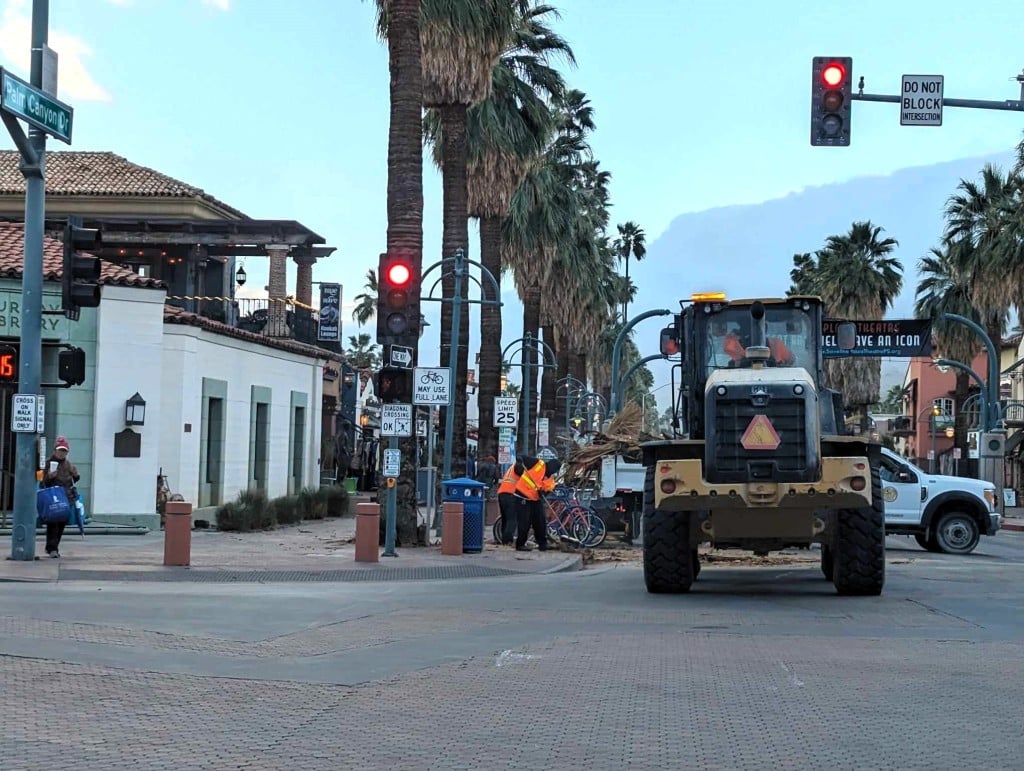
The Palm Springs City Council on Wednesday approved a makeover project for many of the city’s estimated 2,150 California fan palms, with some exceptions for trees in specific areas.
Palm Springs is home to thousands of palm trees of both the Mexican fan palm and California fan palm varieties. In 2007, the city’s General Plan amendment established a goal of phasing out the nonnative Mexican fan palms as they die out, replacing them with the California fan palms, which is the only palm tree native to the state.
Local reporting and journalism you can count on.
Subscribe to The Palm Springs Post
Two years later, the city council approved a new palm tree trimming policy for trees on city property or in the city’s right-of-way. The policy states that all palm trees of both species will have their fruit pods removed, but only the Mexican fan palms will have their dry palm fronds removed. The policy dictated that California fan palms remain in their natural condition with palm fronds left alone, and only removed in order to provide a minimum of 12 feet clearance between the fronds and the ground.
In March 2024, a mother and her two-month-old son were injured by falling palm fronds in front of the Welwood Murray Memorial Library, reigniting discussions over the city’s palm tree trimming policy. The city council was set to consider changing the policy that summer to remove dry palm fronds, but postponed the vote after receiving a number of public comments. City staff was directed to look into alternative safety measures, and returned this week with a recommendation that the city begin allowing the removal of dry palm fronds from California fan palms on city property.
Each individual frond can weigh over 20 pounds, and up to 50 fronds are added to each tree annually, according to a city staff report. These dry fronds form a tree skirt, which can weigh anywhere from 1,000 to over 4,000 pounds. Mayor Naomi Soto compared the tree skirts to “a Volkswagen Beetle 10 to 15 feet above you” on Wednesday.
City Attorney Jeff Ballinger said the city has received at least 11 claims from falling tree skirts between 2019 and 2026 so far, with one claim going to litigation and ending with a $100,000 settlement. The city’s contracted arborist said Wednesday that other cities in the Coachella Valley and elsewhere typically trim their palm tree skirts.
“If it was for wildlife and for the historic look and feel, I’d say we do nothing. It is solely a public safety issue,” said city councilmember Jeffrey Bernstein. “Obviously, we’ve had some accidents, and it’s probably a matter of time before we have something very serious, and none of us wants that on us.”
About 20 people spoke out against this proposal at Wednesday’s city council meeting, citing concerns over the loss of habitat for wildlife and the historic aesthetic of Palm Springs.
“These trees provide critical high value vertical habitat. The densely layered petticoat of fronds supports an intricate food web from microbes and beneficial insects to reptiles, small mammals and apex birds,” said Bettina Rosmarino, land acquisition director for Oswit Land Trust (OLT).
“Weaponizing a single, isolated incident from February 2024 to clearcut thousands of healthy avian habitats is a massive overreach,” Rosmarino added.
Jane Garrison, founder and executive director of OLT, asked the city to only focus on the pedestrian-heavy downtown area and appoint a committee to evaluate trees in that area to determine which should have their skirts removed.
The council ended up landing somewhere in the middle, directing staff to prioritize tree skirt removal in high pedestrian traffic commercial areas, with the exception of certain places such as designated historic sites, community gateway areas, unique city-landscaped areas and parks valued for their heritage character, along with other exceptions.
City staff will also work on signage and other deterrent strategies, such as removing benches directly underneath palm tree skirts, as additional ways to reduce public safety risks.
The rollout was already planned as a “tree by tree process,” according to Public Works Director David McAbee, with “every tree inspected individually from the ground and aloft before any trimming occurs.”
The palm trees on the city’s own logo are skirted, one resident pointed out on Wednesday. But the city staff report noted that skirtless trees aren’t incompatible with the city’s historic aesthetic, pointing to a photo of downtown Palm Springs in the 1960s with the city’s neat rows of California fan palms in “a fully trimmed condition.”
Author

Related Articles

Palm Springs week ahead: In-N-Out review, airport bond payoff and pickleball complex opening
Officials will weigh a $10.81 million early bond redemption and a new restaurant, while residents can attend the Demuth Park pickleball opening and weigh in on the mayor’s position and Ramon Road Bridge project.
Old Las Palmas property owners ask City Council to delay utility assessment hearing
Residents who spoke Wednesday evening cited six-figure assessments, short notice and unsettled costs. The council took no action, but staff said it could give owners more time.
Palm Springs police defend Flock camera program as residents raise privacy concerns
Police officials cited arrests and recovered vehicles, but speakers at Wednesday’s council meeting said the benefits don’t outweigh the risks. The $4.5 million state grant ends in December 2027.