
Palm Springs airport official details emergency prep gains as new earthquake study surfaces
A multi-agency training exercise and new disaster supplies were discussed Wednesday, days after a study found rising seismic stress near a Southern California fault junction.
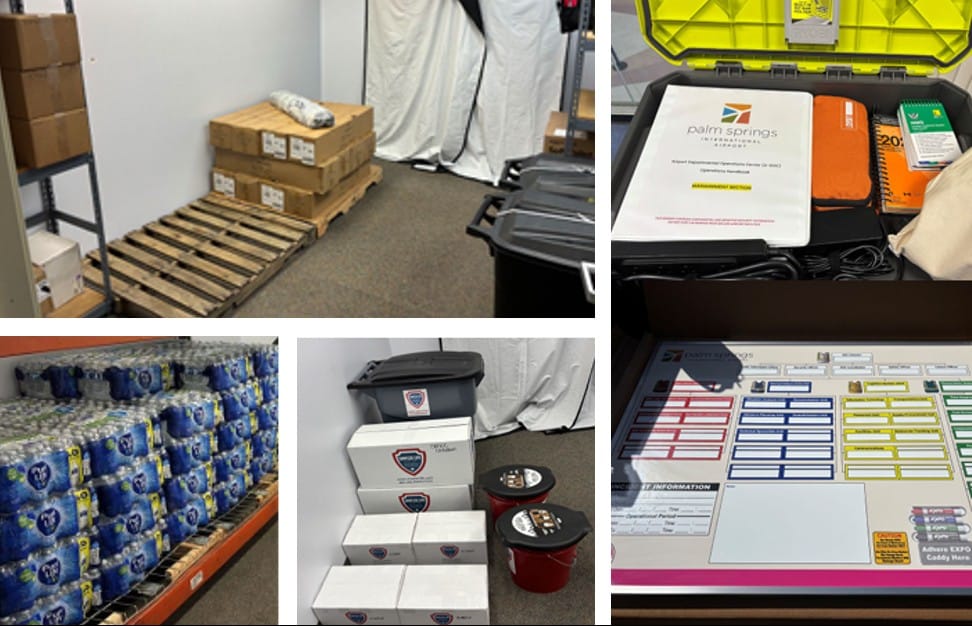
The Palm Springs Airport Commission on Wednesday reviewed a year of expanded emergency preparedness work, including a multi-agency disaster exercise and new equipment stockpiles, days after a study reported rising seismic stress along a fault junction about 50 miles from Los Angeles.
Tom Woodard, the emergency plan administrator at Palm Springs International Airport, presented the update during the commission’s regular meeting at the airport. He said he previously briefed commissioners on the airport’s seismic readiness in February, after a series of earthquakes in the region prompted questions from commissioners.
Local reporting and journalism you can count on.
Subscribe to The Palm Springs Post
Woodard said the cache can feed roughly half the airport’s staff for up to six days, stretching to about 10 days with rationing. He said the cache could also support about 100 people for three days, with rationing extending that further. The airport has also placed Stop the Bleed kits, used to treat severe traumatic injuries, at public-access defibrillator locations throughout the terminal.
Woodard said the airport has expanded its overnight sheltering capacity for staff to about 50 people, with plans to reach 100. He said the airport is partnering with the American Red Cross to train staff, airline employees and tenants in psychological first aid, and plans to revise its emergency plan, which he said has not been comprehensively updated since the early 2010s.
Commission Chair Kevin Corcoran connected the discussion to recent reporting on regional seismic activity.
“This may be very timely, because the LA Times said that the San Andreas fault is suffering 1,000-year pressure,” Corcoran said. “So it’s good that we’re on top of this stuff.”
Corcoran’s comment came after a study published this month in the Journal of Geophysical Research found that stress has built to levels matching some of the highest points reconstructed over the past 1,000 years at a fault junction near Cajon Pass.
The junction, about 75 miles from Palm Springs, is where the Mojave South and North San Bernardino segments of the San Andreas Fault meet the San Jacinto Bernardino segment of the San Jacinto Fault.
The study’s model estimated stress levels of 2.8 on the Mojave South segment, 1.8 on the North San Bernardino segment and 3.6 on the San Jacinto Bernardino segment, making the San Jacinto segment the most heavily loaded of the three. Researchers said the junction could function as what they called an “earthquake gate,” capable of halting a rupture or letting it spread between fault systems, which would affect the size and reach of a future earthquake.
The two fault systems have not produced a major earthquake in more than 100 years. According to the study, they have together hosted at least 36 earthquakes of magnitude 6.4 or larger over the past 1,000 years and account for about 90% of the regional tectonic plate movement in Southern California. The study did not predict when a future earthquake might occur.
Looking ahead, a full-scale mass casualty disaster exercise is planned for early 2027. Woodard said one airline has already begun preliminary discussions about serving as the event’s host carrier.
Author

Related Articles

Palm Springs council candidates weigh in on Flock cameras, stalled hotels, more at forum
Five candidates for three seats also addressed traffic safety and the library renovation at a forum hosted by Organized Neighborhoods of Palm Springs.
Palm Springs airport study finds economic impact tops $2.55 billion
Nearly 97% of the airport’s overall economic impact stayed within the Coachella Valley, the study found, and more than half occurred within the city of Palm Springs.
New Palm Springs airport escalators ready for final inspection, on track to open by month’s end
The Sonny Bono Concourse project aims to cut noise and improve reliability, with a ribbon-cutting celebration expected within weeks.