
Key stakeholders gather to help kickstart local Blue Zones effort, hoping to address health challenges
“For Blue Zones to be effective, it’s going to take all of us working together to improve the health and well-being of our community,” said Geoff Kors, executive director of the local effort.
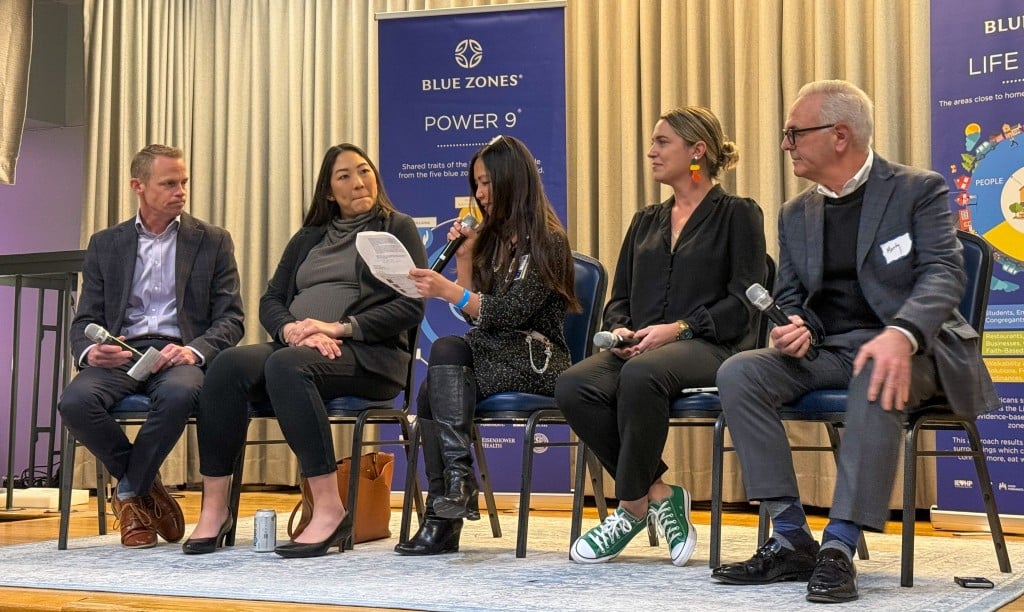
A diverse group of Palm Springs stakeholders came together Wednesday evening at the Mizell Center to learn about and engage with the newly launched Blue Zones Project, an initiative aimed at improving community well-being through policy changes, environmental improvements, and lifestyle interventions.
The meeting brought together city officials, healthcare leaders, educators, and community organizations to kickstart the project, which seeks to make healthy choices easier and more accessible for residents.
Local reporting and journalism you can count on.
Subscribe to The Palm Springs Post
“For Blue Zones to be effective, it’s going to take all of us working together to improve the health and well-being of our community,” said Geoff Kors, executive director of Blue Zones Project Palm Springs.
The project was explored in the city two years ago, when Kors was a member of the City Council. Ultimately it did not move forward. Now, under a public-private partnership sponsored by four major healthcare organizations — Inland Empire Health Plan (IEHP), Eisenhower Health, Kaiser Permanente, and Molina Health– it has drawn support from Riverside County Public Health and the city.
Why here, in a city that appears to have an active, healthy population living under blue skies and sunshine nearly year-round? According to data presented at the meeting, Palm Springs faces significant health challenges. Roughly 50% percent of residents don’t exercise enough, 80% are overweight or obese, and 67% lack sufficient fruit and vegetable intake.
“We’re spending more with worse results in healthcare,” Kors said, pointing to efforts at improving local residents’ health, many of which have been made by the healthcare companies. “How do we elevate all the good work that all of them are doing in our community?”
The Blue Zones Project is based on research into areas where people live longer, healthier lives, focuses on making healthy choices easy, accessible, and affordable through community-wide efforts. Critics have argued that it oversimplifies complex longevity factors, generalizes unique cultural practices, and prioritizes commercial goals over scientific rigor and systemic change.
Still, as Eisenhower Health President and CEO Marty Massiello shared, its recommendations appear to work. After Eisenhower management implemented Blue Zones principles at the hospital, he told the audience at Mizell, they noticed positive outcomes for employees.
“We decided to offer healthy choices in our cafeteria,” Massiello said. “We opened up our cardiac rehab gym to our employees 24 hours a day. …And the outcomes, honestly, were really incredible.”

Jacqueline Sun, director of Well-Being Services at Beach Cities Health District, reported significant health improvements 15 years after implementing the Blue Zones Project in the Redondo Beach community.
“We’ve had a 50% reduction in smoking in our community,” Sun said. “We’ve had, I think, 25% reduction in overweight and obesity, while numbers in the U.S. continue to escalate.”
The project in Palm Springs will focus on policy work, community engagement, and partnerships with local organizations and businesses. One of those roles has been filled, Kors said, with additional staff being sought .
Jaclyn Cheves, national team policy director for Blue Zones, encouraged stakeholders to volunteer and participate in sector groups to help shape the project’s direction.
“We need beautiful spaces where people linger and they want to walk and they want to bike,” Cheves said. “We need murals everywhere if you are an artist. So it needs to be innovative here.”
What happens next? Over the next month and a half, Kors said project leaders will gather feedback to narrow down priorities and develop a blueprint for Palm Springs’ Blue Zones Project, expected to be completed by May.
A community launch event is planned following the blueprint’s completion, likely before the weather heats up.
Kors emphasized the importance of stakeholder involvement in the project’s success.
“Four staff people aren’t going to result in changing people’s lifestyle behaviors to make healthy choices,” he said. “It’s going to take all of these different organizations to be partners.”
Author

Related Articles

Palm Springs airport unaffected as ICE agents deploy to U.S. airports amid TSA staffing crisis
PSP says no immigration agents are on site and security wait times remain under 15 minutes, even as airports nationwide struggle.

Airport Commission backs parking system overhaul amid cost, operational questions
Commissioners cite aging system and customer experience gains, while raising concerns about costs, staffing impacts and how parking reservations would work during peak demand
College of the Desert completes structural framework for Palm Springs Campus
The project now moves into the interior construction phase as a fall 2027 opening remains on track.