
Justice served, history made: New court solidifies tribal sovereignty
“The process didn’t officially start until 2016, but this has been a vision for generations. So, to see it actually up and running — this is a dream come true.” — Tribal Chairman Reid D. Milanovich

The Agua Caliente Band of Cahuilla Indians is known for its elegant resorts, beautiful golf courses, and world-class spas. But a nondescript, square building at the intersection of East Tahquitz Canyon Way and Avenida Caballeros may hold as much or more meaning to tribal members as any of their others.
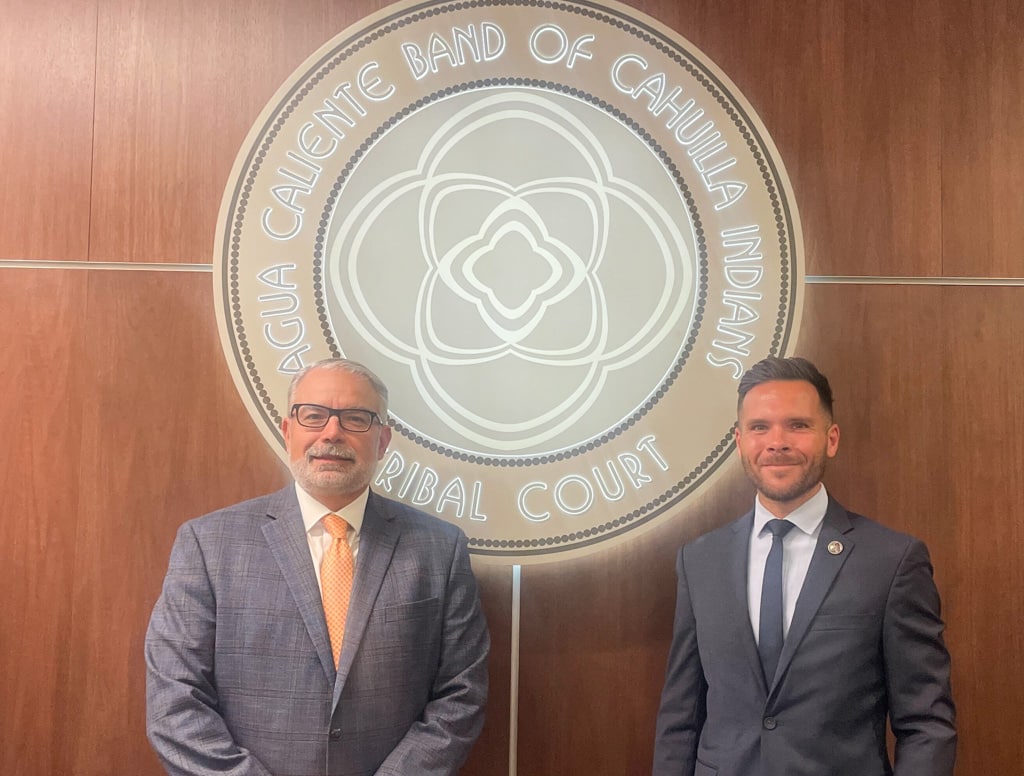
For Tribal Chairman Reid D. Milanovich, the opening of the Agua Caliente Tribal Court, housed in the building, is a full-circle moment. As a child, he remembers when the tribe could barely afford a few offices to conduct business in a building across the street from where the court now stands.
Local reporting and journalism you can count on.
Subscribe to The Palm Springs Post
Now, three decades later, the tribe owns that entire building—as well as the state-of-the-art court facility. Not only does it represent the growth and success of the tribe, it serves as a cornerstone of its journey to sovereignty and the realization of a multi-generational vision.
“This is huge. This is something that I’ve grown up hearing about—a tribal court,” said Milanovich. “The process didn’t officially start until 2016, but this has been a vision for generations. So, to see it actually up and running — this is a dream come true.”
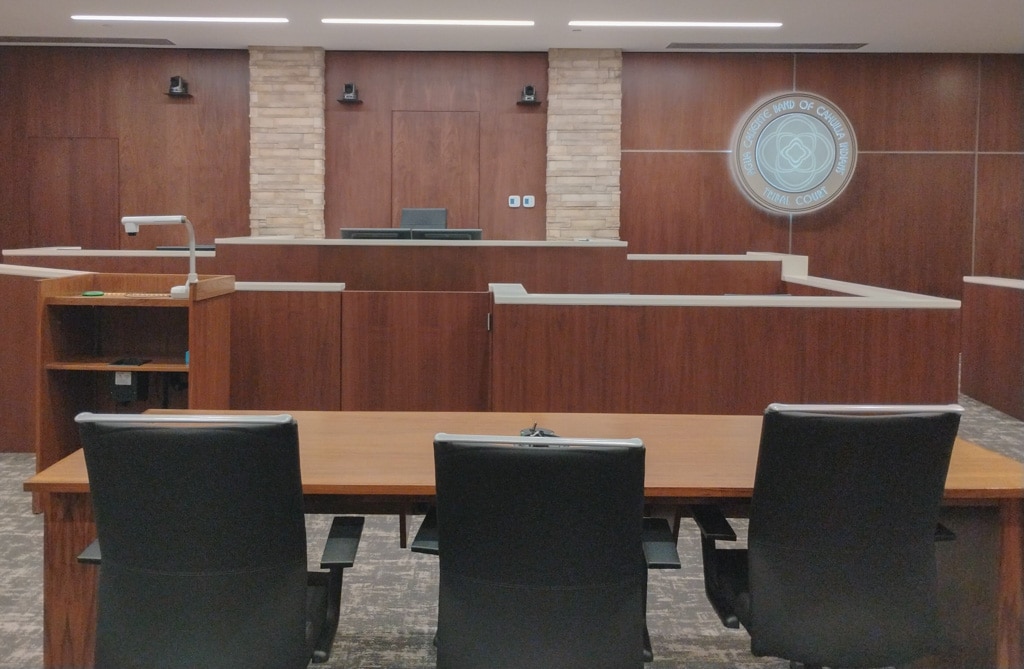
The tribal court, which opened in October 2024, marks a historic step in the Agua Caliente Band of Cahuilla Indians’ ability to exercise jurisdiction over matters on tribal lands.
Looking back
The development of the court began around 2018 with a tribal court needs assessment funded by federal grant money to gather feedback from tribal members about their interest in establishing a court system and what they wanted it to focus on.
John T. Plata, general counsel for the tribe, explains that the Indian Child Welfare Act emerged as a top priority for members.
“One of the abilities of tribes to exercise jurisdiction over their families and children that are tribal members is super important,” said Plata. “That’s one of the number one things members wanted to do was handle their ICWA issues inside their own tribal court and not leave it to the county whose system is overburdened and understaffed.”
The court currently handles only civil matters, as criminal jurisdiction remains with the state of California. In addition to Indian Child Welfare cases, the court can address family law issues such as adoptions and guardianships, tort claims from injuries at tribal facilities, unlawful detainer cases on reservation land, and contract disputes.
The court also provides a venue for disputes related to tribal agencies like the Agua Caliente Water Authority and for tax issues involving businesses operating on tribal land.
Preparation for the court included codifying tribal law, creating a judiciary ordinance, establishing rules of court, and clarifying the jurisdiction of the tribe. The process paused during the COVID-19 pandemic before restarting in 2022.
In developing their court system, tribal officials consulted with other tribes to learn from their experiences.
“We worked with them on how their tribal court works, what doesn’t work, and we just kind of feed off of each other in order to have the best tribal court that we can,” Milanovich said.
Similar to other courts
The court’s judge comes from the Inter-Tribal Court of Southern California and has experience working with tribes in San Diego and Northern California. The court administrator previously worked in tribal courts in Arizona.
For attorneys wishing to practice in the tribal court, the admission process mirrors that of state and federal courts. Lawyers licensed in any state or another tribal court can apply for admission to the Agua Caliente bar by paying a fee and completing an application before being sworn in by the judge.
Court procedures also follow familiar patterns, making the experience accessible to practicing attorneys.
“Anybody practicing law in this court will be familiar with how the judge interacts and the procedure,” Plata said “The only thing different will be that the judge will be making decisions based on tribal law.”
The establishment of the court represents a significant restructuring of tribal governance. Historically, the Tribal Council functioned as the legislative, executive, and judiciary branches. Now, the judiciary operates as a separate, independent branch.
“The Tribal Council still acts as the executive branch and legislative branches, typically, but we now have a judiciary branch to make decisions, and it’s distinct and independent,” Plata said. “There’s lots of process to insulate the court from any meddling.”
The court’s jurisdiction extends to both tribal members and non-members who have connections to the reservation, such as those living, working, or conducting business on tribal lands.
“We don’t want to be completely different from state and city law. We want to be able to mirror a little bit, but still have it more uniform to what we as a tribe want and still offer fair justice,” said Milanovich.
“I think one of the main things is when so many people come to this area, come to the reservation, they don’t quite understand there’s a tribe here — and that this is us asserting our jurisdiction as part of our sovereign right to be able to do this.”
Tribal leaders emphasize transparency in the court’s operations, with tribal laws and codes available online for public access.
‘Making it transparent’
“We want to make it simple for them to fully understand the tribal law and what it means to be within our tribal court,” Milanovich said.
“Creating an expectation that there is a place where you can look to see what the tribal law is… We’re just kind of setting the expectation and making it transparent so everybody can see what tribal law is. And it’s not something that people should be afraid of or be uncertain about,” added Plata.
For Milanovich, the court represents the culmination of decades of effort by tribal leaders.
“This is a milestone for our tribe,” he says. “So many past leaders worked on this, and you see so many of their struggles and their efforts over decades and decades, and so we are using the fruits of their labor to develop what we have today.”
The tribe plans to grow the court’s scope gradually as it further asserts its sovereignty and jurisdiction.
Author

Related Articles

Palm Springs council candidates weigh in on Flock cameras, stalled hotels, more at forum
Five candidates for three seats also addressed traffic safety and the library renovation at a forum hosted by Organized Neighborhoods of Palm Springs.

Palm Springs airport study finds economic impact tops $2.55 billion
Nearly 97% of the airport’s overall economic impact stayed within the Coachella Valley, the study found, and more than half occurred within the city of Palm Springs.

New Palm Springs airport escalators ready for final inspection, on track to open by month’s end
The Sonny Bono Concourse project aims to cut noise and improve reliability, with a ribbon-cutting celebration expected within weeks.