
Palm Springs catering deal returns after tense council debate
The revised Oak View Group contract removes some disputed language, but critics say questions remain over local business protections, labor policy, financial risk and contract oversight.
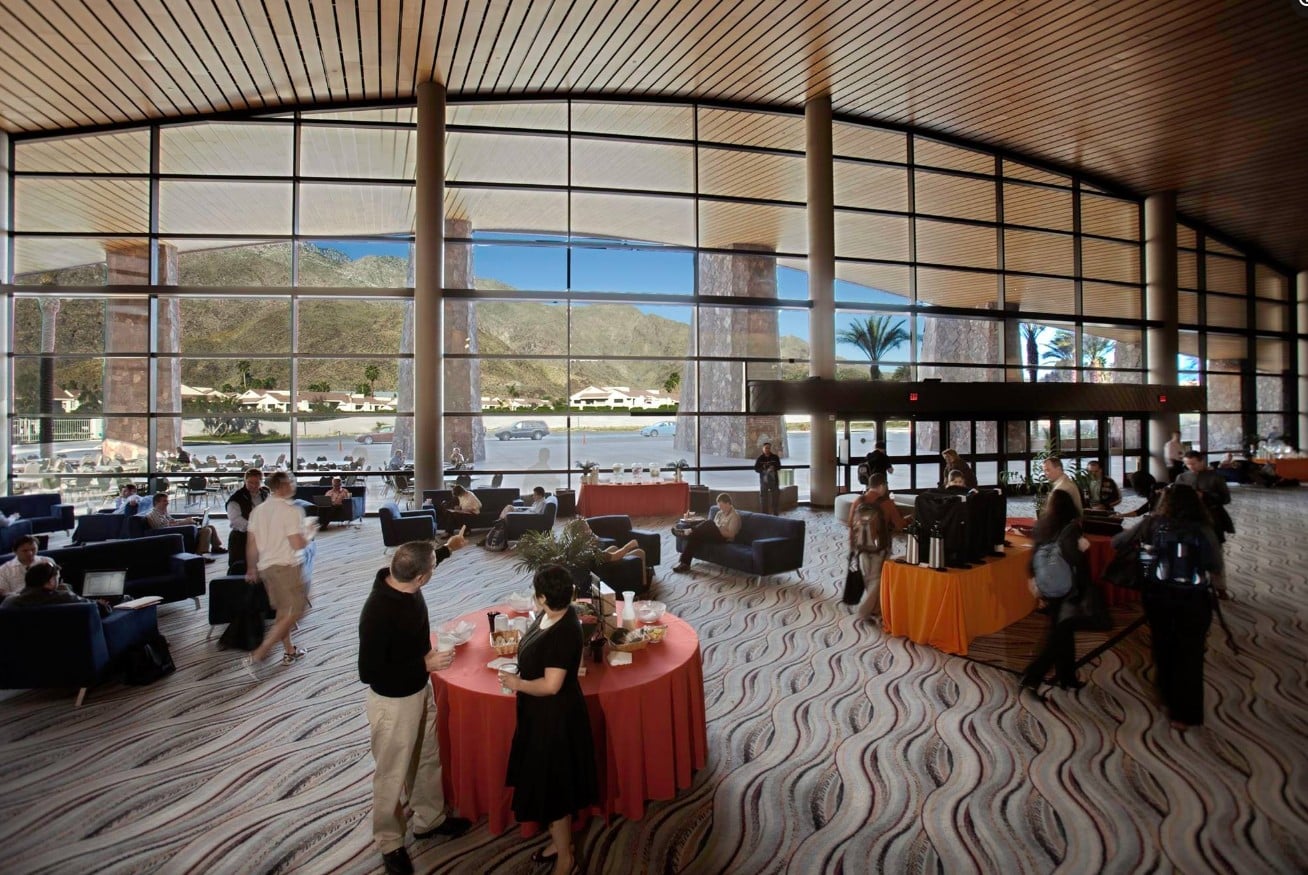
The Palm Springs City Council will hold a special meeting Tuesday evening at 5 p.m. to revisit a proposed food and beverage contract for the city’s convention center, just days after councilmembers postponed a decision amid concerns about local business participation, contract oversight and the city’s financial exposure.
Staff is again recommending approval of a five-year agreement with Ovations Fanfare L.P., doing business as OVG Hospitality — a subsidiary of Oak View Group (OVG) — to operate food and beverage services at the Palm Springs Convention Center.
Local reporting and journalism you can count on.
Subscribe to The Palm Springs Post
OVG, a venue management, hospitality, sponsorships, booking and commercial real estate company, manages both the convention center and the Historic Plaza Theatre in Palm Springs, as well as Acrisure Arena in Palm Desert.
The revised contract follows a lengthy June 24 discussion in which the council declined to approve the deal as presented and instead directed city staff to temporarily extend the existing agreement with Savoury’s Good Earth Cuisine, Inc., the longtime incumbent caterer, while exploring whether Savoury’s and OVG could work together in some form during a transition.
Savoury’s contract had been set to expire Tuesday. City Manager Scott Stiles warned at the time that without action, the convention center could be left without a food and beverage provider, with significant events scheduled later this year.
The new staff report says the city held discussions with Savoury’s and OVG between June 25 and Monday, with City Attorney firm Best Best & Krieger facilitating continued negotiations. The report does not recommend a longer Savoury’s extension or present a specific Savoury-OVG partnership. Instead, it brings back the OVG contract with several revisions aimed at addressing concerns raised last week.
At the heart of the debate is a major change in how food and beverage service at the convention center would be structured.
Under the current Savoury’s agreement, the caterer operates under a commission-based concession model, absorbing operating costs and remitting a share of gross receipts. Under the proposed OVG agreement, the city would become what the staff report describes as the “economic principal” of the operation: revenues and direct operating costs would run through a city-controlled account, the city would retain net profit subject to defined splits, and OVG would be paid through a management fee and commission.
Supporters of the model say it gives the city more upside, more transparency and a larger role in the convention center’s food and beverage operation as the facility undergoes a $135 million renovation. Staff’s report says the management-fee model is projected to return $17.3 million over five years, compared with $13.6 million under a commission deal, and includes a $2.5 million investment from OVG. The comparison tables were provided by Chris Morgan, OVG Hospitality’s regional vice president, according to the report.
Critics counter that the model also shifts more risk to the city. Because Palm Springs would fund operating costs and retain profits only after expenses, opponents argue the city could be exposed if revenue falls short, costs rise or the convention center renovation disrupts business during the early years of the agreement.
The revised contract attempts to address some of the concerns that stalled the deal last week.
One change would require OVG to use local products and vendors “whenever reasonable” from the Greater Coachella Valley and to feature “Local Brands” that reflect Palm Springs’ diversity and culture. The local brands could include restaurants, food trucks or other products, and could be operated by their own management teams inside the convention center to preserve their identity.
But the specific requirements would not be finalized before Tuesday’s vote. The city and OVG would instead negotiate a future Exhibit A-1 within 30 days of the contract’s effective date, including objective requirements measured by percentage of annual gross receipts and a monetary remedy intended to encourage compliance. That exhibit would later return to the City Council for consideration.
Another revision would create a future framework for local and community nonprofit groups to provide food and beverage at the convention center up to a certain dollar threshold per event. Those thresholds also would be negotiated within 30 days and returned to the council later.
The revised agreement also includes exceptions for the Palm Springs International Film Society’s International Film Awards & Gala in 2027 and 2028, allowing third-party food service for those events. Alcohol service, however, would remain under OVG’s exclusive control.
The revised agreement also appears to soften one of the alcohol-pricing concerns raised before the June 24 meeting. Earlier language stating that final alcohol-pricing decisions would rest solely with the contractor has been removed, according to the revised contract language. The remaining provision requires OVG to consult with the facilities general manager before implementing alcohol price changes.
Still, some critics say alcohol remains a key area to watch because OVG would be paid partly through a commission on gross sales while also controlling purchasing for one of the convention center’s highest-margin revenue sources. They argue the contract should more clearly require arm’s-length pricing for purchases from any OVG-affiliated supplier.
Councilmember Ron deHarte raised several of those concerns before the June 24 meeting. In a June 22 email to Palm Springs business leaders and stakeholders, deHarte argued the proposed OVG contract gave the company too much control over alcohol pricing, lacked enforceable local-business requirements, created oversight concerns because OVG already manages the convention center, and allowed too little time for a transition.
At the June 24 meeting, deHarte drove the push to reject the contract as presented, arguing the city’s procurement process had effectively shut out local businesses. He said Savoury’s and other local operators did not submit bids, in part because the request for proposals signaled that smaller businesses could not realistically compete.
“We really did a disservice to our small business community when we wrote the RFP that didn’t give the impression that they could participate,” deHarte said.
The RFP was issued March 19, with proposals due April 15. Three proposals were submitted, but two were deemed nonresponsive for failing to acknowledge all addenda and provide required forms. That left OVG as the sole qualified bidder.
DeHarte also said councilmembers had not been given an opportunity to review the RFP before it was issued or before contract negotiations began. Stiles acknowledged during the June 24 meeting that parts of the process could have been handled better and said staff could begin discussions with Savoury’s the next morning.
Behind the scenes, some community critics have raised broader objections to the contract structure, saying the issue is not simply whether OVG uses local vendors. One opponent argued the deal would move the city from a lower-risk landlord role into the position of financial owner of the food and beverage operation, giving Palm Springs more potential upside but also exposing it to operating costs and possible losses.
That concern is partly reflected in the staff report’s own description of the change. Staff says the proposed agreement “repositions the City from passive royalty recipient to operator-in-economic-substance.”
The revised contract adds a conditional minimum guarantee. If annual gross receipts reach at least $5.6 million, OVG would be required to ensure the city receives at least $750,000 that year. If actual commissions and other payments fall below that amount, OVG would make up the difference within 45 days of the end of the accounting year. If gross receipts fall below $5.6 million, the guarantee would not apply, and the parties would negotiate a reset for the following year.
“We really did a disservice to our small business community when we wrote the RFP that didn’t give the impression that they could participate.”
— Councilmember Ron deHarte, during a June 24 Palm Springs City Council meeting
The staff report says the fee deal also includes city-use events at cost, community and nonprofit use exceptions, a reserve fund and a larger capital investment than a commission model. By contrast, staff says a commission model would include no city-use events at cost, no community or nonprofit exceptions, no reserve fund and no minimum annual guarantee.
Oversight remains another point of concern. OVG already holds the convention center management contract, and the proposed food and beverage contract would go to one of its subsidiaries. Critics have argued that having the same corporate family manage the building and run food and beverage could weaken independent oversight, especially around cost allocation, service standards and purchasing.
The revised staff report does not directly address that structural concern, though it emphasizes that revenue and direct operating costs would flow through a city-controlled account.
Critics also point to early-termination language they say remains unchanged in the revised agreement. Under that provision, if the agreement ends early, the city could be required to repay OVG’s unamortized capital contribution with interest, including in circumstances involving a contractor breach, default or bankruptcy. Opponents argue the clause should be narrowed so the city is not required to make that payment if the contractor is responsible for the default.
The labor language in the agreement could also draw attention. The revised contract removes the names of two unions that had appeared in an earlier version of the labor-harmony clause, but keeps the broader framework requiring labor agreements that limit disruptive labor actions at the convention center, including strikes, picketing, lockouts and boycotts.
Some opponents say the issue is less about unions themselves than about process. They argue a labor-harmony clause in a food-and-beverage contract represents a significant labor-policy decision for the city’s hospitality industry and should be debated openly, especially after councilmembers questioned at the June 24 meeting who added the language and why.
Tuesday’s meeting will give the council a second chance to decide whether the revised agreement has enough safeguards to move forward.
Author

Related Articles

Old Las Palmas property owners ask City Council to delay utility assessment hearing
Residents who spoke Wednesday evening cited six-figure assessments, short notice and unsettled costs. The council took no action, but staff said it could give owners more time.
Palm Springs police defend Flock camera program as residents raise privacy concerns
Police officials cited arrests and recovered vehicles, but speakers at Wednesday’s council meeting said the benefits don’t outweigh the risks. The $4.5 million state grant ends in December 2027.

Commission approves live entertainment permit for one-man science and music show downtown
Planning commissioners on Tuesday signed off on a conditional use permit for a building that will house Patrick Olson’s “The Art of Science,” which is expected to open in December or January.