
City’s first tree ordinance moves closer to reality
The ordinance establishes protections for larger trees and replacement requirements, with a vote expected in September.
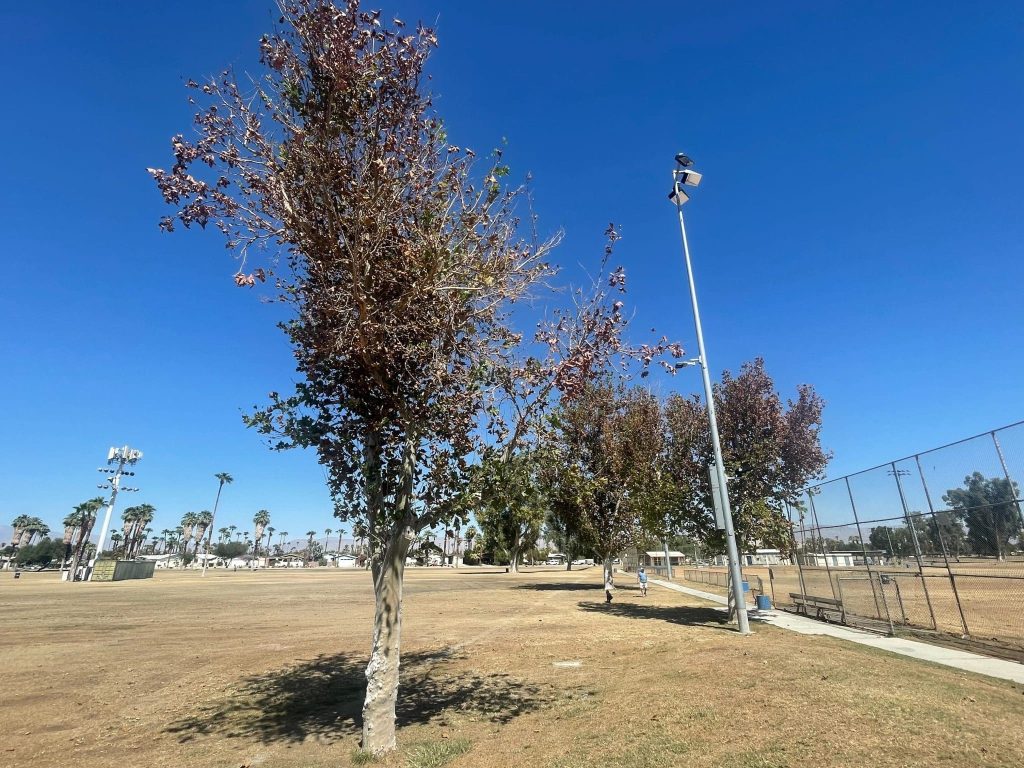
Palm Springs is advancing its first comprehensive tree ordinance after more than a year of work to consolidate and clarify its rules.
At Tuesday’s Sustainability Commission meeting, commissioners read the latest draft of the ordinance and gave feedback in anticipation of voting to approve the ordinance come September.
Local reporting and journalism you can count on.
Subscribe to The Palm Springs Post
The ordinance establishes “protected tree” designation for trees with a diameter of 12 inches or more, requiring a 2-to-1 replacement ratio when they must be removed. For smaller trees, the replacement ratio remains 1-to-1, establishes criteria for tree removal, and introduces recommended species for replacement trees.
The new rules will affect municipal sites, businesses, apartment complexes, and homeowner associations that file landscaping plans with city planners, but individual houses are exempt. The measure would affect roughly 3,800 city-managed shade trees and approximately 8,000 trees total when palm trees are included.
One commissioner said, in light of the fires over the weekend, he hoped the ordinance made it clear that there are provisions for tree removal that don’t necessitate replacement. He said the city has an overabundance of palm trees and Palo Verde trees that might need removal if they present a fire risk.
Lindsey-Paige McCloy, the city’s director of sustainability, clarified that the ordinance does identify instances for removal that include tree roots damaging sidewalks or when trees are in violation of the fire department’s vegetation management rules.
In addition, the Sustainability Department is working on a list of about 100 approved tree species for replacements, featuring both native varieties and others adapted to the desert region along with a manual for proper tree care addressing what McCloy described as widespread problems with tree maintenance.
“We are seeing a lot of trees that are being improperly pruned, and they’re dying off in the summer,” Christian Wheeler, the city’s climate and sustainability specialist said during an interview last week. The manual clarifies that tree topping and other harmful pruning practices are illegal in the city.
“We’re trying to balance working with people and educating, versus going in and handing out citations,” Wheeler noted.
The ordinance does not include strict requirements for shade coverage or urban canopy expansion, which Wheeler suggested might be addressed through zoning code updates currently in progress.
“It’s not necessarily intended to push the growth. It’s really more to maintain the canopy, and slowly grow it,” Wheeler said.
The city is also developing an interactive website with GIS mapping to display the city’s tree inventory, showing residents where different tree species are located and their condition.
A related heat and shade transportation study is also underway, which will examine more specific ways the city can enhance shade coverage as part of broader climate mitigation efforts.
Staff plans to bring the ordinance back to the Sustainability Commission for a vote in September, with City Council consideration targeted for October. The timeline aims to have educational materials available before the next tree care season begins.
Author

Related Articles
City, tribal leaders postpone June meeting on warehouse development
The delay will give the developer more time to respond to public comments and review technical issues tied to the proposed 2.85 million-square-foot project.

American Reproductive Centers breaks ground on new Palm Springs facility nearly one year after bombing
The groundbreaking marks a turning point for the fertility clinic that was destroyed in a May 2025 bombing, with construction targeting an ambitious Dec. 31 completion and a goal of full operations by 2027.
Commission approves self-storage facility near airport even as city weighs limits on new facilities
A 92,400-square-foot, two-story building with outdoor RV parking won approval Tuesday, while a consulting team examines possible caps and location rules for future projects.