
Airport expansion timeline comes into focus as officials weigh costs, demand
A new rental car center and international arrivals facility could be completed by the end of 2027, but funding constraints and shifting projections loom.
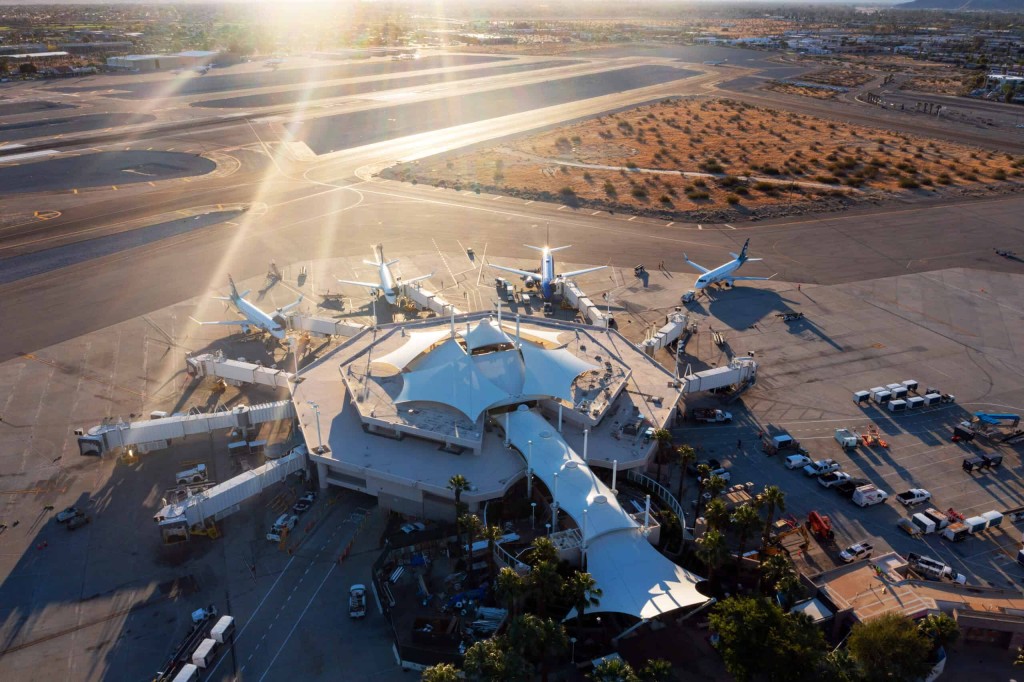
Palm Springs International Airport is targeting completion of a new rental car center and international arrivals facility by Dec. 31, 2027 — a more specific and near-term deadline than officials had previously disclosed publicly — as part of a broad capital expansion program now moving into an active phase.
The timeline positions the airport to handle international arrivals ahead of the 2028 Los Angeles Olympics, which officials have cited as a key driver of urgency.
Local reporting and journalism you can count on.
Subscribe to The Palm Springs Post
The target emerged from capital development materials reviewed Monday by the airport’s Budget and Finance Committee, which also examined the airport’s fiscal year 2026-27 budget and long-term capital plan.
The materials outline a four-step sequence for what the airport calls its North Complex Expansion. The first step — a $2.2 million airport administration building at 550 South Paseo Dorotea — is already underway, with the city closing on the property earlier this month.
That move would free up space in the main terminal for relocating USO and U.S. Customs and Border Protection facilities. Demolition of Hangar 1 would then clear the way for a roughly $15 million auxiliary rental car facility, followed by construction of an international arrivals facility estimated at about $8 million.
Behind the expansion plans, airport officials are also grappling with financial constraints — though those limits are typical for airports operating as enterprise systems in partnership with airlines.
At Monday’s meeting, consultants and staff outlined roughly $350 million in funding capacity through 2031, much of it already committed to required infrastructure projects. Airports like Palm Springs intentionally phase projects based on demand and available funding, a strategy aimed at avoiding overbuilding or shifting excess costs onto airlines and travelers.
At the same time, new internal costs — including pension obligations, energy expenses and administrative charges — could add roughly $7 million annually to the airport’s operating budget, potentially reducing funds available for capital projects.
Those pressures, combined with airline approval requirements for major projects, are shaping internal discussions about what is achievable and when.
“There’s an element of, what are we telling the public, and what’s realistic?” Airport Commission Chair Kevin Corcoran said during the meeting, highlighting the tension between long-term plans and funding realities.
The airport’s expansion plans also come as passenger trends show a more nuanced picture than early-year data alone suggests.
The airport’s master plan had forecast roughly four million passengers annually by 2027. Early 2026 data showed a 2.3% decline compared to the same period last year, following a record 3.3 million passengers in 2025.
But officials say that dip reflects short-term comparisons rather than a shift in demand. January was heavily impacted by weather, February set an all-time monthly record, and March was down slightly, about 1.7% year over year.
Looking ahead, the airport is projecting roughly 7% seat growth for the summer months of June through August, continuing a broader shift toward more year-round demand. Last year’s record passenger numbers were driven largely by summer and shoulder-season travel rather than peak winter months.
That evolving demand picture has added urgency to calls for clearer public messaging.
At an April 15 Airport Commission meeting, Corcoran said the airport needs to “be more honest with the public and set realistic expectations about what can be achieved here.”
Officials have emphasized that construction decisions will be guided by actual demand rather than projections alone.
“We’re consciously building when we need to build,” staff told the committee.
A broader picture of the airport’s plans emerged at an April 6 community meeting at the Plaza Theatre, where officials outlined a “now, next, later” framework for development.
Near-term projects include escalator replacements in the Sonny Bono Concourse this summer, with completion expected by early fall, and a $93 million baggage handling system modernization project — $58 million of it federally funded — scheduled for completion in December 2028.
Restroom upgrades are also in permitting, with plans to add about nine stalls in the Bono Concourse and new family restrooms in the courtyard, with completion targeted for early to mid-2028.

Longer-term plans call for a new North Concourse with additional gates, expanded baggage claim and a permanent international arrivals facility, with those projects tentatively slated for the early 2030s and beyond.
Airport officials have stressed those later-phase projects would move forward only if passenger demand supports them.
On the air service side, the airport added five new nonstop routes this season — Newark on United, Charlotte on American, Austin on both Delta and Southwest, and Santa Rosa on Alaska — bringing the total to 32 seasonal nonstop destinations and connections to more than 300 cities worldwide.
Meanwhile, the airport is also preparing for a leadership transition.
Executive Director Harry Barrett Jr. will leave next month to take a position overseeing multiple airports in Sacramento. Deputy Director of Aviation, Marketing & Air Service Daniel Meier is also departing for a role at Tulsa International Airport.
City Manager Scott Stiles said Assistant Director of Aviation Victoria Carpenter will serve as interim director while the city conducts what he described as an “aggressive national recruitment” for a permanent replacement.
“No slowing down, no not making decisions — we’re full speed ahead,” Stiles said.
Barrett, speaking at the April 6 community meeting, expressed confidence in the airport staff he is leaving behind.
“The team is strong,” he said. “I am perfectly fine with stepping away understanding that the team in place today is able to handle any challenge and move forward.”
Author

Related Articles
Palm Springs Homeless Navigation Center wins two national architecture awards
The American Institute of Architects honored the facility with a 2026 Architecture Award and a Housing Award in the Specialized Housing category.

Palm Springs council candidates weigh in on Flock cameras, stalled hotels, more at forum
Five candidates for three seats also addressed traffic safety and the library renovation at a forum hosted by Organized Neighborhoods of Palm Springs.
Palm Springs airport study finds economic impact tops $2.55 billion
Nearly 97% of the airport’s overall economic impact stayed within the Coachella Valley, the study found, and more than half occurred within the city of Palm Springs.