
Agua Caliente tribe tells story of discrimination, resilience in new exhibit on Section 14
A new museum display that opens to the public Saturday chronicles decades of struggle against government discrimination and the tribe’s fight for survival on its ancestral lands.
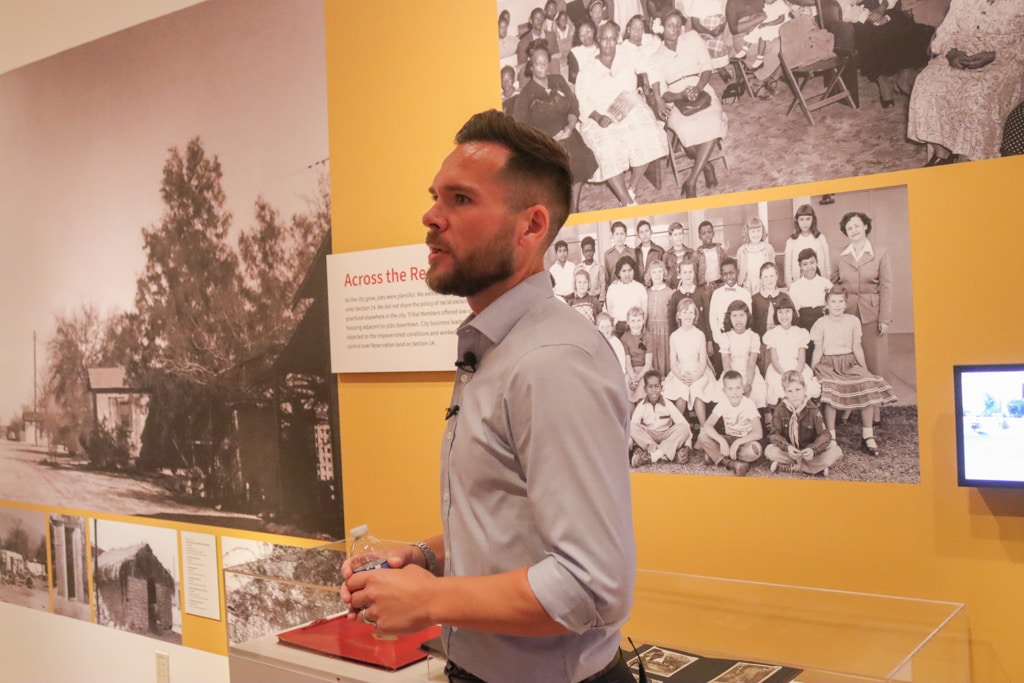
The Agua Caliente Band of Cahuilla Indians opened a new museum exhibition Friday that tells their own story of Section 14 for the first time, revealing decades of what they describe as government discrimination and legal robbery, as well as the tribe’s fight for survival on their ancestral land in the heart of Palm Springs.
“Section 14 The Untold Story,” which opens to the public Saturday at the Agua Caliente Cultural Museum at 140 North Indian Canyon Dr., uses official government documents, tribal elder interviews and archival footage to expose how federal and local authorities systematically denied basic services to tribal members while attempting to terminate the tribe entirely through corrupt programs.
Local reporting and journalism you can count on.
Subscribe to The Palm Springs Post
“It’s important because it’s a part of our history,” said Tribal Chairman Reid D. Milanovich during a tour of the exhibit Friday morning. “It’s very important to the tribe to share accounts, stories of life back then and what happened. There was so much that is untold regarding Section 14.”
The exhibition centers on the one square mile of reservation land established by President Ulysses S. Grant in 1876 that sits in downtown Palm Springs, stretching from East Alejo to East Ramon between Indian Canyon Drive and South Sunrise Way. The area includes the ancient hot mineral springs that remain the spiritual heart of the Agua Caliente people.
The story that plays out along the walls of the exhibit reveals that during a decades-long period in the early to mid-1900s — an era of intense racial discrimination — tribal leadership welcomed African Americans, Asian Americans and Latino Americans to live on Section 14, as non-whites were discouraged from residing in other parts of Palm Springs.
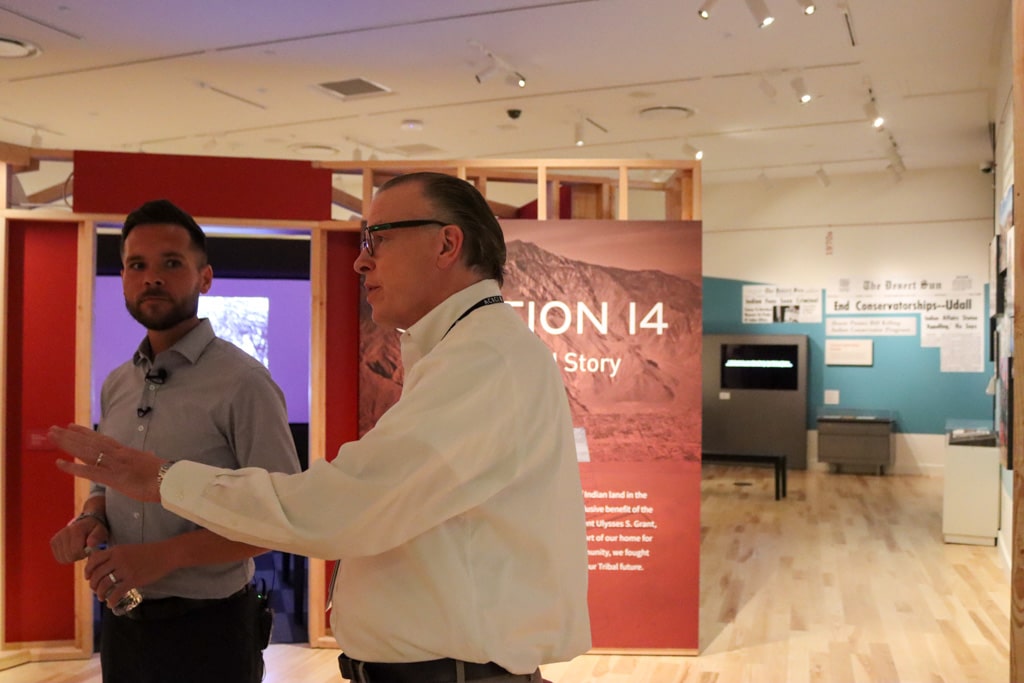
Many of these residents were later forced to leave Section 14 in the 1950s and 1960s. Some of them, and their descendants, were involved in a claim against the city that resulted in a reparations agreement in 2024 in which Palm Springs approved a $5.9 million direct cash settlement, along with $20 million for housing programs and $1 million for small business support.
During the Friday tour Milanovich said the city of Palm Springs prevented essential services from being provided on Section 14 for decades, forcing tribal members to live without running water, electricity or sewer systems.
“I remember growing up and my dad talking about how he grew up on Section 14 with a house that had dirt floors,” Milanovich said, pointing to photographs of makeshift homes from the 1950s and 1960s. “That was just the reality of life back then.”
Among the most disturbing revelations documented in the exhibit is the federal conservatorship program that assigned guardians to oversee tribal members’ daily affairs.
“What the conservatorship program was was a corrupt system that was essentially a legal robbery of Indians,” Milanovich said. “Conservators were charging much more. They were stealing the funds from tribal members.”
The exhibit includes photographs showing tribal members, including children, meeting with their assigned conservators who controlled their business decisions and required permission for basic purchases like refrigerators or washing machines. The program officially ended by an act of Congress in 1972 following a federal investigation in 1968.
The federal government also attempted to terminate the tribe entirely through a land allotment process that divided reservation sections among individual tribal members, knowing most would be forced to sell their land due to financial hardship.
“The tribe is much stronger than that,” Milanovich said. “The leadership, the membership at that time, they held on very tightly to their lands.”
One of the exhibition’s success stories highlights the all-women Tribal Council, which included Milanovich’s grandmother Laverne, who traveled to Washington D.C. to lobby for extended lease terms. Their efforts increased maximum lease periods from five years to 99 years, enabling major business development including the iconic Spa Hotel built in 1962.
“Without the 99 year lease, that would not be possible,” Milanovich said.
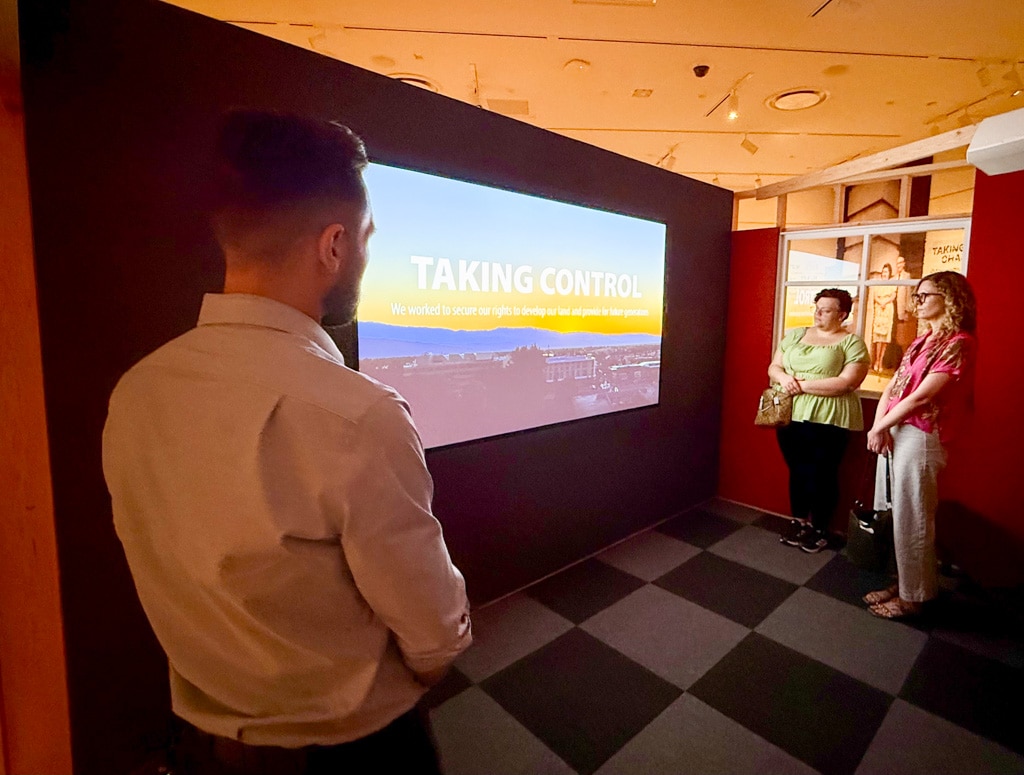
Museum Executive Director Steven Karr said the exhibition was developed over more than a year through collaboration between the Tribal Council and membership.
For example, a 16-minute film at the center of the exhibition features tribal elders sharing personal experiences, including former councilwoman Millie Brown and others who rarely appear on camera. Milanovich said hearing these firsthand accounts was emotional even for tribal members who grew up hearing different versions of the stories.
The exhibition emphasizes the tribe’s continuing sovereignty over Section 14, which today includes an award-winning spa, a casino, and the cultural museum. Milanovich said the exhibition serves not only to educate the public but to ensure future tribal generations understand their history.
“I’m going to be 42 years old later this year and there are some things that I’m still learning about,” Milanovich told visitors Friday. “We are taking that step to continue on and make sure that our next generation tribal membership, they don’t forget where they come from.”
Details: The exhibition will remain open for one year at the Agua Caliente Cultural Museum, located at 140 N. Indian Canyon Drive. The museum is open Tuesday through Sunday from 10 a.m. to 5 p.m. and closed Mondays.
Author
Related Articles

Palm Springs LGBTQ+ book festival announces full lineup, adds Ty Herndon as headliner
Pride on the Page’s 5th annual event is free this year for the first time, with Grammy-nominated country singer Ty Herndon discussing his memoir at the evening program on Nov. 14.
Palm Springs preservation group steps in to help revive a piece of Palm Desert history
The Palm Springs Preservation Foundation has offered to fund conceptual design work for a recreation of a historic Palm Desert entry sign designed by noted desert architect William F. Cody.
Nearly 1,000 neighborhood signs now mark Palm Springs streets as program nears full coverage
Palm Springs neighborhoods are adding custom colors and logos to city intersections, backed by a Measure J grant and ONE-PS’s push for 100% citywide representation.