
Council approves Racquet Club Road lane reduction, despite fire response concerns
Buffered bike lanes and a center turn lane are part of the $3.45 million reconfiguration; officials said they will explore signal pre-emption technology to offset potential increases in emergency response times.
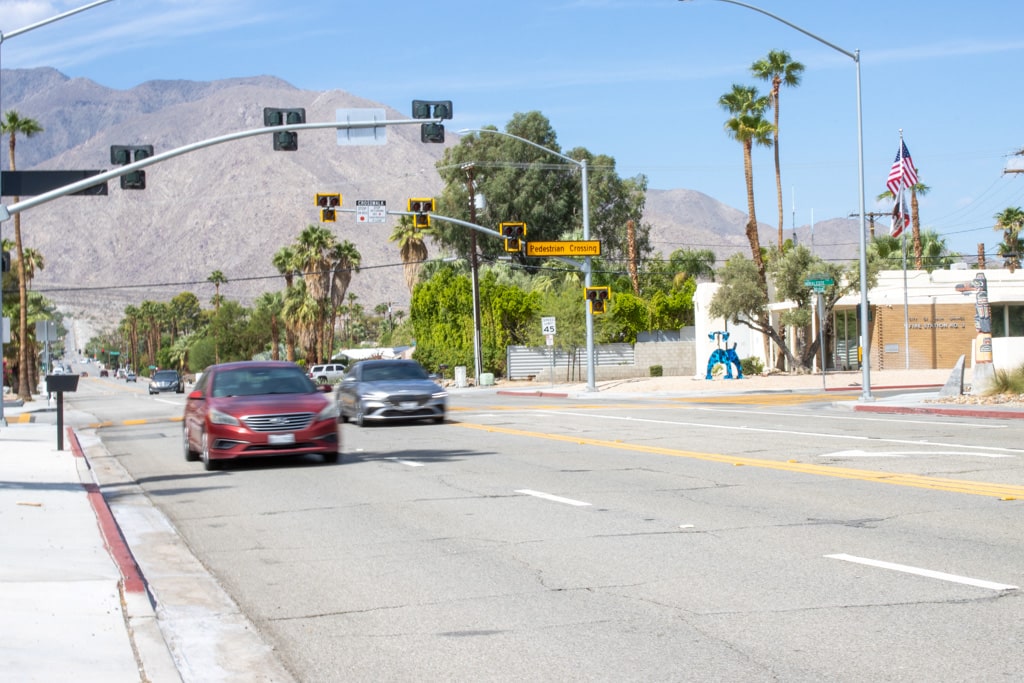
The Palm Springs City Council voted Wednesday to approve construction documents and authorize staff to solicit bids for a reconfiguration of Racquet Club Road that would reduce the corridor from four travel lanes to two, adding a center turn lane and buffered bike lanes.
The project carries an estimated construction cost of $3.45 million and will be funded through a combination of SB 821 bicycle and pedestrian grant funds, Measure A, Measure J, and capital funds already allocated for the purpose. The Riverside County Transportation Commission approved $727,986 in SB 821 grant funding for the project in June.
Local reporting and journalism you can count on.
Subscribe to The Palm Springs Post
The reconfiguration would convert the existing four-lane roadway to a three-lane configuration with one travel lane in each direction and a center two-way left turn lane. Class II bike lanes with a striped buffer would be added on both sides of the road, with curbside parking retained where feasible. Additional work includes pavement rehabilitation, upgraded signing and striping, Americans with Disabilities Act improvements, sidewalk gap closures, and enhanced pedestrian crossing treatments.
The project originated from the city’s December 2021 Palm Springs Pedestrian Master Plan, which identified 37 locations for potential pedestrian safety enhancements. Between September 2024 and September 2025, the city held four in-person and online community meetings and collected more than 200 comments. Of those, 125 focused on traffic calming concerns including noise, trucks, speeding, and pedestrian and bicycle safety. Thirty comments opposed bike lanes, lane reductions, or traffic calming measures.
The council’s approval came after extended discussion centering on fire department response times. A fire response study commissioned at the Palm Springs Fire Department’s request found that the reconfiguration would increase emergency response times by between 2.7 and 63 seconds for the area served by Fire Station No. 3, with the higher end representing a worst-case scenario projected through the year 2040.
Fire Chief Paul Alvarado told the council that Station 3 already serves a large geographic area and that its response times are already above the department’s desired targets. He said modernization of the station alone would not resolve those concerns, and that additional personnel and apparatus would ultimately be needed.
City Manager Scott Stiles acknowledged the tension between pedestrian safety goals and fire response times, and said the city would explore mitigation measures including traffic signal pre-emption technology for emergency vehicles and improved truck route signage.
“Nobody wants to say slow down our fire trucks,” Stiles said. “We want them there as quickly as possible.”
Councilmember Grace Garner said the safety case for the lane reduction was clear, pointing to pedestrian deaths in the city and the collision history on the corridor.
“We have a lot of pedestrian fatalities in our city,” Garner said. “It’s really crucial to do something to minimize those.”
Councilmember Jeffrey Bernstein said he supported moving forward but that the concerns raised — including fire response times and the potential for diverted traffic into residential neighborhoods — would need continued attention.
“This is not making a decision and then walking away from it,” Bernstein said. “We have to make sure that we address each and every issue — now, and in the public comment leading up to this, and in the meetings.”
Under the project’s tentative schedule, bids are due June 11, with a contract award expected at the July 8 city council meeting.
Author

Related Articles

Parks and Recreation Commission approves operating rules for expanded Demuth Park pickleball complex
Guidelines establish reservations, open play, court etiquette and tournament rules ahead of the facility’s anticipated August opening.
Palm Springs panels to consider condo development, Escena subdivision plans and new recreation rules this week
Parks and Recreation commissioners will vote on swim center air quality rules as planning commissioners weigh a 16-unit condo project near Amado Road and Sunrise Way.
Palm Springs seeks public input on next police chief
City officials say a new survey will help identify the leadership qualities residents want in a successor to retiring Police Chief Andy Mills.