
Palm Springs City Council approves installation of license plate reader cameras, addressing privacy concerns
The cameras will be mounted at the entrances and exits of the city and record license plates, vehicle colors, and other features to aid in the identification of vehicles involved in suspected crimes.
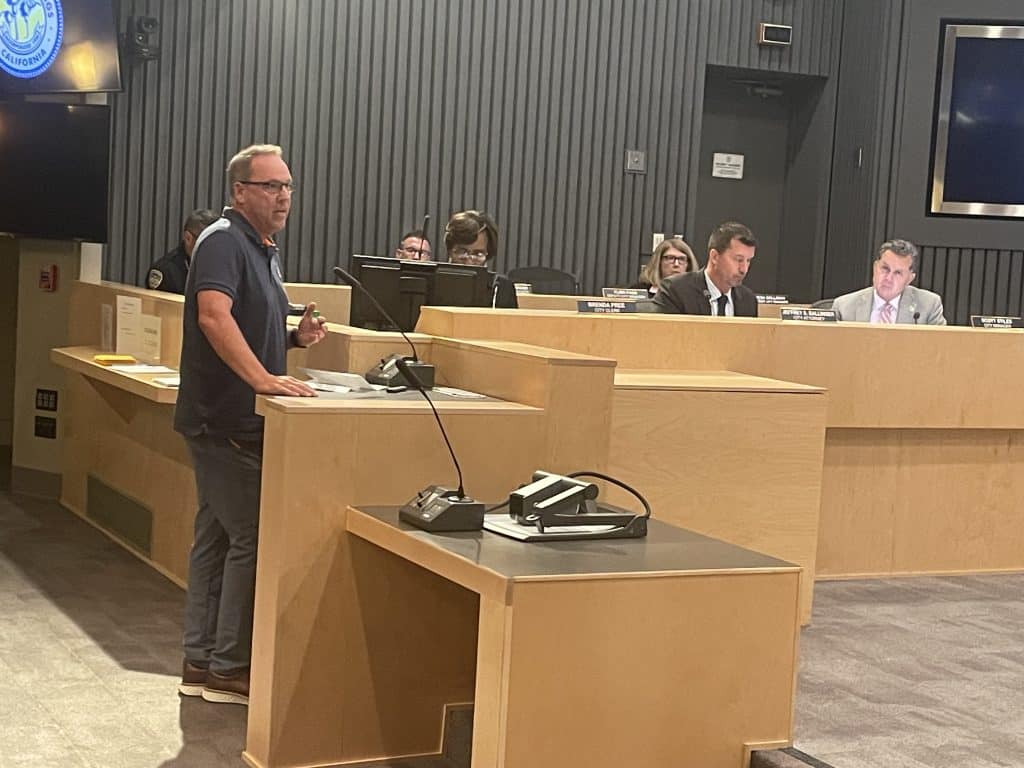
Following an hour of discussion Thursday evening, the Palm Springs City Council voted 4-1 to approve the installation of 15 license plate reader (LPR) cameras throughout the city. Mayor Grace Garner was the lone no-vote.
The cameras, made by Flock Safety, will be mounted at the entrances and exits of the city at an estimated cost of $50,000. They will record license plates, vehicle colors, and other features to aid in the identification of vehicles involved in suspected crimes. The cameras will not be used for speed enforcement and do not use facial recognition or predictive policing.
Local reporting and journalism you can count on.
Subscribe to The Palm Springs Post
During the meeting, 10 people spoke on the issue, with four supporting the technology’s use and six advocating against it.
Among those favoring the cameras was Jason Kravetz, a retired police officer with first-hand experience using the technology in Laguna Beach.
“At first, we were a little leery about it,” said Kravetz. “But they literally changed how we policed in the community. It not only helped us solve crimes, it helped us pre-deploy our resources.”
Mohammad Tajsar, a senior staff attorney at the ACLU Southern California, raised concerns about the cameras, calling them “uniquely invasive” and likely to harm poor people, immigrants, and people of color in the city.
“It collects highly precise location information which research shows is easy to associate with individuals and thereby giving the government unique power to monitor and track individual’s movements, even if they’ve done nothing wrong,” Tajsar said.
Councilmembers were scheduled to vote on the issue at their last meeting on Sept. 26. But following questions raised by members of the public, they requested more information from Flock Safety before making a decision.
Since then, Councilmember Christy Holstege and Mayor Pro Tem Jeffrey Bernstein said they met with Flock Safety and the ACLU for about an hour each.
Holstege said that after conversations with Flock, city staff, and attorneys, several important changes were made in the final rules outlining how the cameras can be used in the city. Among the changes was restricting artificial intelligence to allow Flock to use only anonymized data to identify vehicles.
Holstege pointed out that one of the ACLU’s concerns was that in the original policy, the chief of police had too much leeway in deciding whether to share Flock data with other law enforcement agencies in the state. She said language has since been tightened to require a court order or a subpoena to access the data.
“We will not get involved in immigration enforcement in any way. We will also not get involved in anything to do with reproductive rights or gender-affirming care.”
— Police Chief Andy Mills
Another big concern was that other agencies could use Flock data in specific enforcement types.
PSPD Chief Andy Mills assured councilmembers, “We will not get involved in immigration enforcement in any way. We will also not get involved in anything to do with reproductive rights or gender-affirming care. We cannot use that data to enforce any of that or give it to other people who would.”
Garner was particularly concerned about homeowners associations and other private entities buying and setting up their own Flock cameras. Right now, HOAs can designate one of their own members to monitor Flock cameras under their control, and they can decide whether or not to share the information with the police.
“This makes me deeply uncomfortable,” Garner said. “Especially being a renter who has no voice on any HOA that I’ve lived in so far.”
Garner and Mayor Pro Tem Jeffrey Bernstein both supported Holstege’s request to create regulations for Flock cameras’ private uses.
“I’m worried about domestic violence, and I’m concerned about victims being kept under surveillance,” Holstege said. “These HOA cameras give me a little heartburn for that reason, and as an elected official who gets death threats.”
While there are documented cases of Flock cameras being used to stalk partners illegally, PSPD officials said they have safeguards in place to prevent that, including regular audits of searches and a framework in place to report abuses of the system.
Editor’s note: An earlier version of this story stated that Mayor Grace Garner and Councilmember Christy Holstege had met with Flock Safety and the ACLU. In fact, it was Mayor Pro Tem Jeffrey Bernstein and Holstege who met with them.
Author

Related Articles
Palm Springs police to launch free wellness call program next month
PSPD Connect, backed by a city councilmember, the police chief and the Blue Zones Project, will offer regular phone check-ins to residents who may benefit from added support.

Palm Springs police step up enforcement of disabled parking spaces, including on private lots
Drivers who park illegally in reserved spaces face fines of $250 to $1,000 and possible towing, and the department is offering businesses help with required signage.

Palm Springs bids emotional farewell to Chief Andy Mills, honors wife Cathy as new chief steps in
Hundreds packed the Palm Springs Convention Center Thursday evening for a retirement send-off that doubled as a tribute to Cathy Mills and a first public moment for incoming Chief Kyle Stjerne.