
Tree protection ordinance inching closer to consideration by City Council
The new rules will affect municipal sites, businesses, apartment complexes, and homeowner associations that file landscaping plans with city planners, but individual houses are exempt.
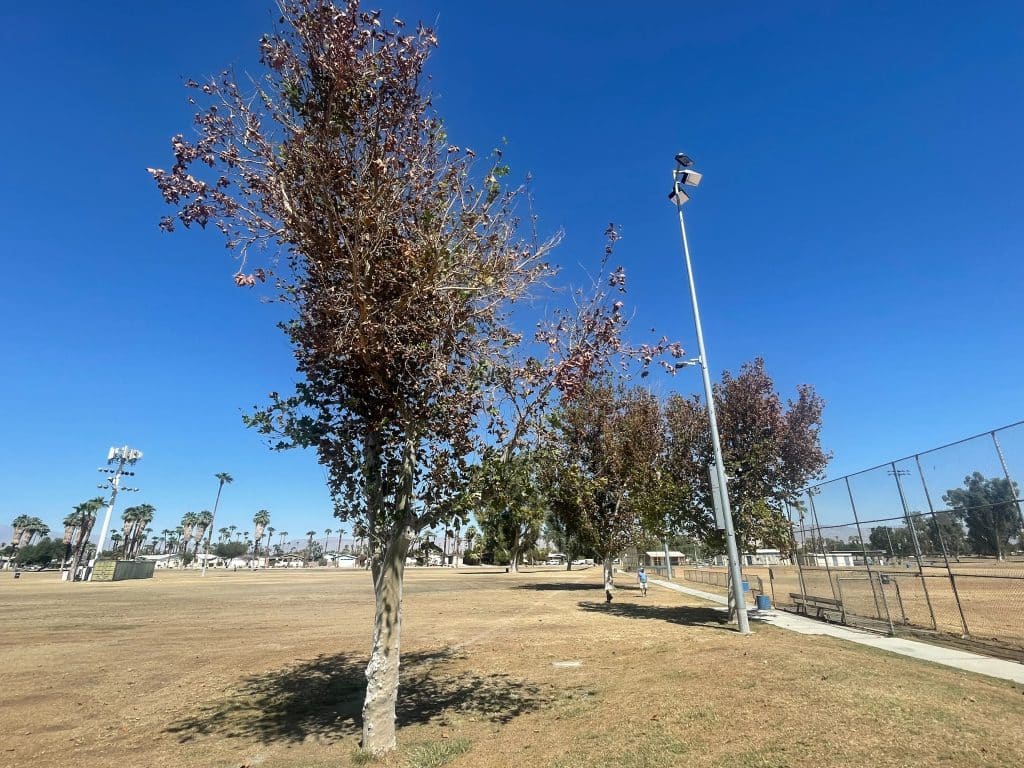
A proposed tree protection ordinance that would establish removal criteria and replacement requirements for trees in Palm Springs moved closer to completion Tuesday as city staff reported the measure is nearing final submission to the City Council.
Sustainability Specialist Christian Wheeler told the Sustainability Commission during its Tuesday meeting that the ordinance is awaiting final departmental approvals before being published. The fire department signed off on the proposal Tuesday, and city staff is waiting for one more meeting with code enforcement before releasing the full ordinance text.
Local reporting and journalism you can count on.
Subscribe to The Palm Springs Post
“We’re describing this as management of public and private trees,” Wheeler said. “It’s going to be in addition to the Palm Springs Municipal Code, and it’s going to be added to title 11, which is peace, morals and safety.”
The ordinance would apply to city properties and commercial properties including businesses, homeowners associations and multi-family properties that submit approved landscape plans to the planning department. Single-family homes would not be covered by the replacement requirements.
Under the proposal, protected trees are defined as those with a trunk diameter of 12 inches or more measured at chest height. The ordinance would also allow the city manager to designate trees of substantial cultural or ecological importance as protected regardless of size.
Wheeler said the measure would affect roughly 3,800 city-managed shade trees and approximately 8,000 trees total when palm trees are included.
Trees could be removed under specific criteria including when they are unsuitable for the planting area, negatively impact public right-of-way visibility, are necessary for site development, are diseased or dead, or when other tree species would be more appropriate for the location.
The replacement requirements call for a two-to-one ratio for protected trees, meaning two trees must be planted for every protected tree removed. All other trees would require one-to-one replacement. Palm trees would only need to be replaced with the same species at a one-to-one ratio.
City staff has developed a recommended species list containing approximately 115 different trees suitable for Palm Springs’ desert climate. The list includes information on foliage type, maximum height and width, growth rate, infrastructure compatibility and water requirements ranging from very low to moderate.
Wheeler said the city is also creating an urban forestry website and technical manual to support the ordinance. When officially launched, the website will include an inventory dashboard showing the location and details of city-maintained trees, volunteer opportunities and resources on tree care and wildlife protection.
Wheeler said city staff expects to present the completed ordinance to the City Council sometime in the fall. The commission had previously discussed the tree protection measure during its January meeting as part of broader efforts to preserve Palm Springs’ urban forest amid climate challenges.
Author

Related Articles
City leaders, public thank retiring city manager and fire chief, list their accomplishments
Council members and residents praised Scott Stiles and Paul Alvarado Wednesday for storm response and public service. Both men gave the credit to their staffs and the community.

Temporary dog park approved for Victoria Park; Demuth Park project progressing
Parks commissioners backed a pop-up pilot with Blue Zones Palm Springs that will open Dec. 11 and run through about the end of January, with a resident survey to gauge interest in a permanent site.
This week at City Hall: Planning Commission to weigh delivery hub; City Council postpones underground utility hearings
A proposed warehouse on 19th Avenue, a pop-up dog park and a canceled public hearing on a nearly $10.1 million utility project top meeting agendas this week.