
Residents push back on five-story developments near neighborhoods at community meeting
Homeowners worried about property values as city proposes allowing taller buildings near single-family neighborhoods to address workforce housing crisis.
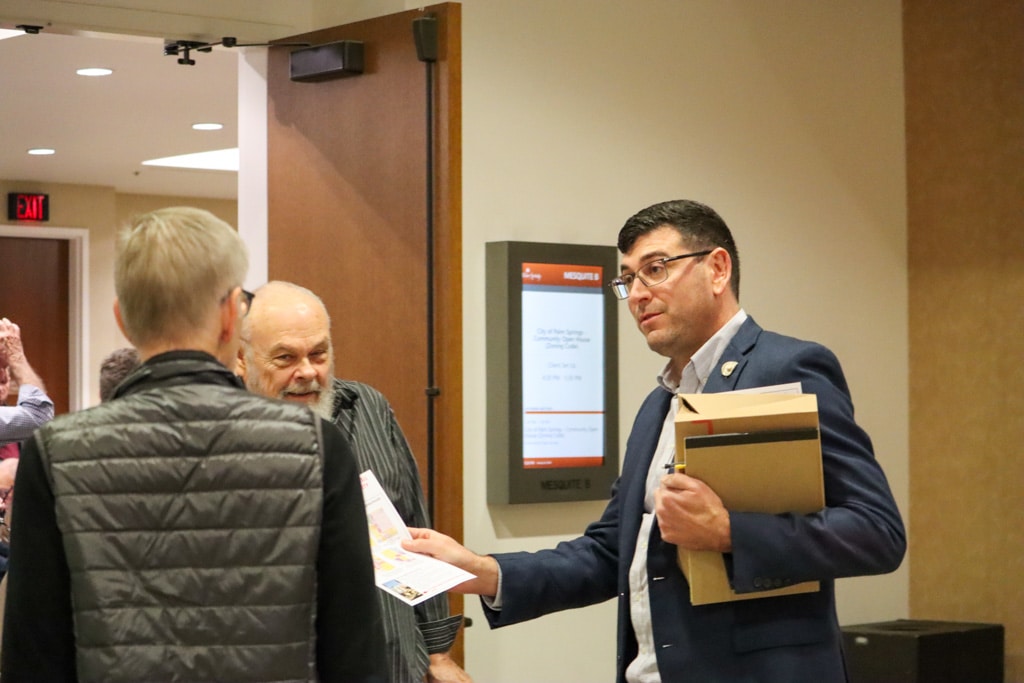
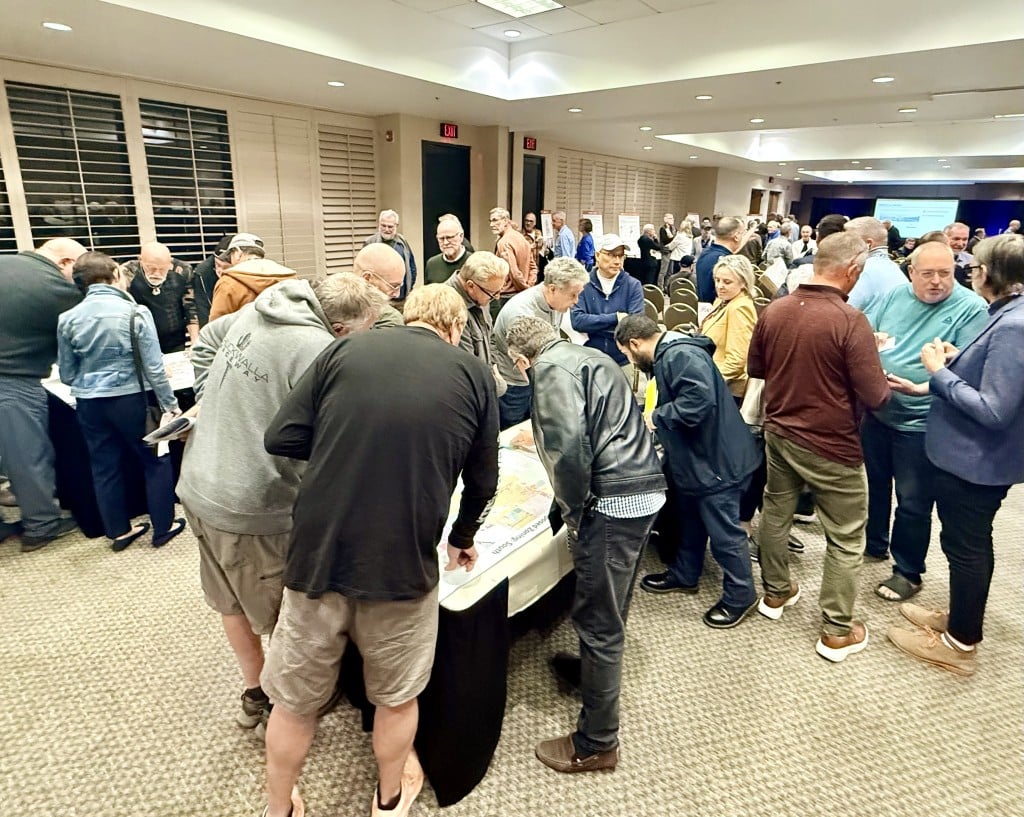
Roughly 60 residents filled a room at the Palm Springs Convention Center Monday evening to hear about and discuss proposed zoning changes that could bring five-story buildings to commercial corridors near single-family neighborhoods, with residents voicing concerns over property values and building heights, sometimes in heated exchanges with city officials.
The meeting, the fourth in what has so far been an 18-month process to update the city’s zoning code, saw sharp criticism from homeowners worried about developments encroaching on residential areas, particularly a possible five-story zone at the corner of Tahquitz Canyon and Sunrise ways.
Local reporting and journalism you can count on.
Subscribe to The Palm Springs Post
“What about those people whose home value dropped significantly when they’re behind a five-story building?” one resident asked Director of Planning Services Chris Hadwin during the question and answer session. “If we lose a half a million dollar in equity, what’s the city going to do, give us an apartment that was more affordable?”
Hadwin acknowledged the concern but said the city cannot compensate residents for lost property value.
“No, the city unfortunately can’t compensate you for lost property value,” Hadwin said. “I think that’s part of cities growing. I think there’s different research available that would suggest property values don’t necessarily go down, but I understand the concern.”
The city is updating its zoning code for the first time since 1988 to address what officials described as a workforce housing crisis. Data presented at the meeting showed housing costs in Palm Springs have risen 83% in five years while wages increased only 30%, and that 84% of people who work in the city cannot afford to live here.
“These are real people serving our community who can’t afford to be part of the community,” Hadwin said during his presentation. “This means that the people who work here don’t shop here, they don’t eat here, don’t participate in the community, and that weakens our local economy.”
The city must plan for 1,700 additional housing units by the end of 2029 to meet state requirements under the regional housing needs allocation, having completed only 848 of the required 2,600 units so far. And although Palm Springs is the largest city by land mass in the Coachella Valley, three-quarters of its land cannot be developed due to steep hillsides, sensitive desert areas, or being under tribal control.
Confusion over state housing law requirements dominated much of the discussion. Hadwin explained that earlier versions of the zoning maps showed five-story buildings at certain locations based on guidance that state law already allows such heights within half a mile of high-frequency transit stops.
“At one point, we understood from our conversations with folks that under certain state law, without us even changing our zoning code, five story buildings would be allowed at that corner,” Hadwin said in reference to one section of the city. “We’re now hearing that’s not necessarily the case, and so we’re still working through that with the state and with the city attorney’s office.”
The shifting interpretation involved whether different bus lines traveling in different directions could be combined to meet the state’s definition of a high-frequency transit stop requiring service every 20 minutes.
One resident suggested the city consider transitional zoning, placing townhomes between taller buildings and single-family neighborhoods as a buffer.
“I don’t want a seven story building right up against my backyard,” the resident said, referencing Miami’s approach to zoning transitions.
Colin Scarff of Code Studio, the city’s consultant on the project, responded positively to the suggestion.
“We could definitely look at that,” Scarff said, citing the Tahquitz Canyon and Sunrise intersection as an example where office buildings might serve as a three-story transition to five-story development at corners.
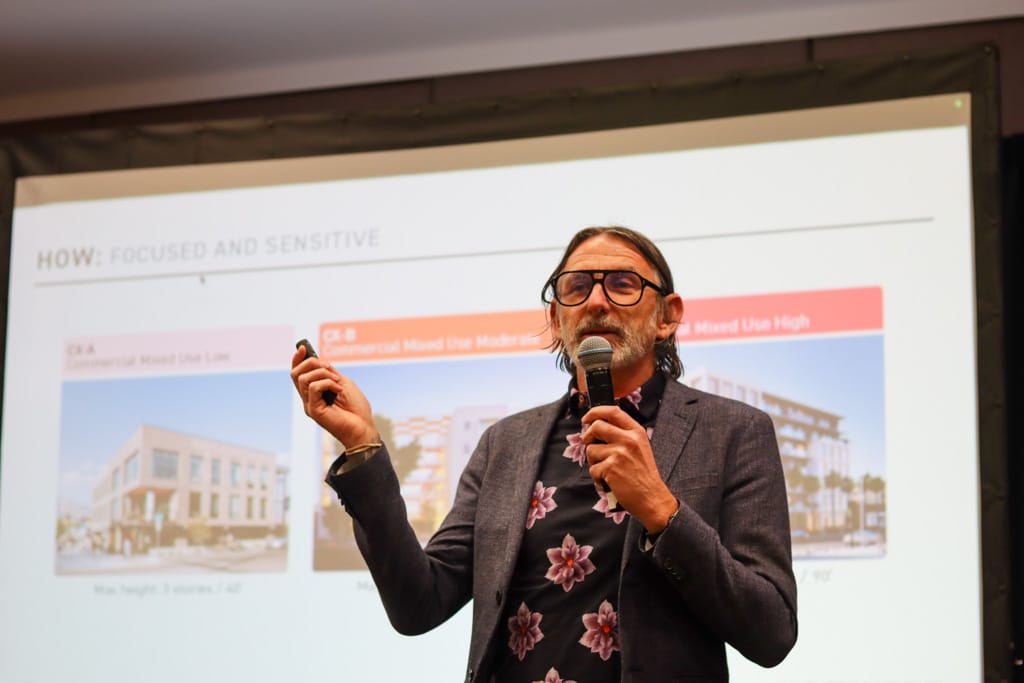
The proposed zoning changes would direct growth to commercial corridors representing less than 1% of the city’s land base, areas that already have infrastructure and currently allow height through a conditional use permit process.
Hadwin emphasized the city remains in the consultation phase with no decisions made by the Planning Commission or City Council.
“We really are here to hear your feedback so we can continue to shape and refine this proposal as we move forward,” he said.
The next public meeting is scheduled for Wednesday, Feb. 4 from 2 p.m. to 3:30 p.m. via Zoom. More information on that meeting, as well as the latest draft zoning maps, is available at the Zone Palm Springs website here.
Author

Related Articles
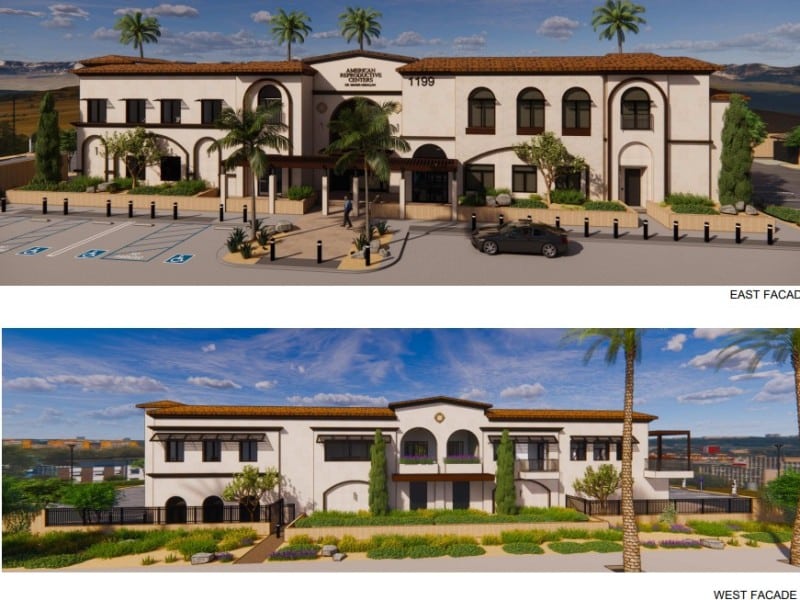
American Reproductive Center rebuilding plans move forward with security, design conditions
Planning Commission approves the project unanimously but calls for more contemporary architecture and better pedestrian access along Palm Canyon Drive.
Planning Commission to review rebuilding plan for American Reproductive Center site
The proposed 19,347-square-foot, two-story medical office building would replace a facility destroyed in a 2025 bombing.
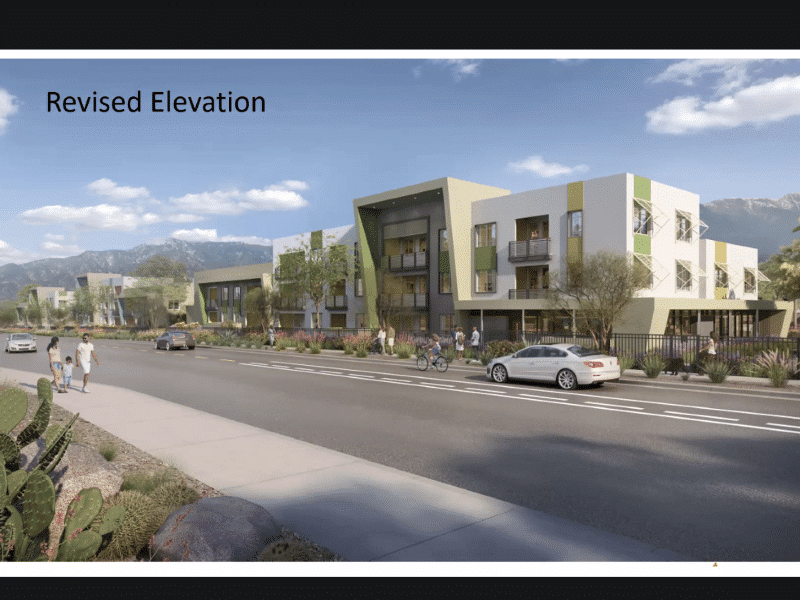
Architectural committee approves design for 82-unit apartment complex on San Rafael Drive
On Wednesday, neighbors renewed privacy concerns over the project, but the ARC added conditions requiring tree relocation along the southern property line.