
Palm Springs police defend Flock camera program as residents raise privacy concerns
Police officials cited arrests and recovered vehicles, but speakers at Wednesday’s council meeting said the benefits don’t outweigh the risks. The $4.5 million state grant ends in December 2027.
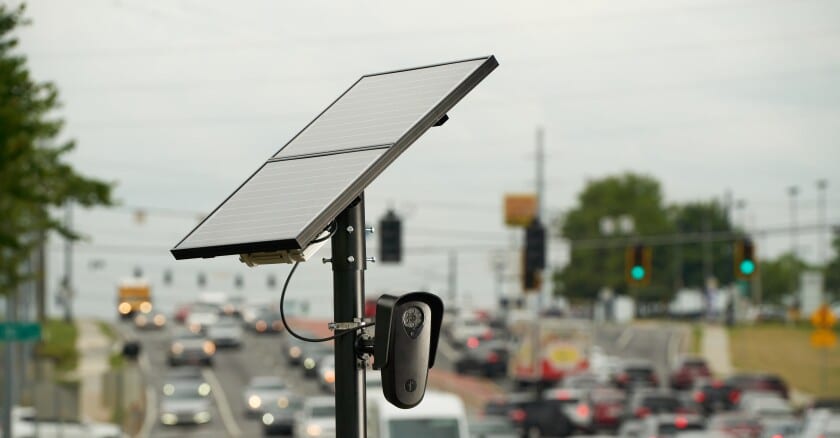
Representatives of the Palm Springs Police Department said Wednesday night they’re committed to safeguards and transparency surrounding the department’s use of Flock license plate-reading cameras. But several residents argued that the cameras’ potential public safety benefits do not outweigh privacy concerns, echoing a national debate over the technology.
The department provided the City Council with an update on how the cameras are used during Wednesday’s meeting. The agenda item was a “receive and file,” meaning the council could not take action on the program but could ask questions and provide direction to staff.
Local reporting and journalism you can count on.
Subscribe to The Palm Springs Post
The city’s public safety camera program currently includes:
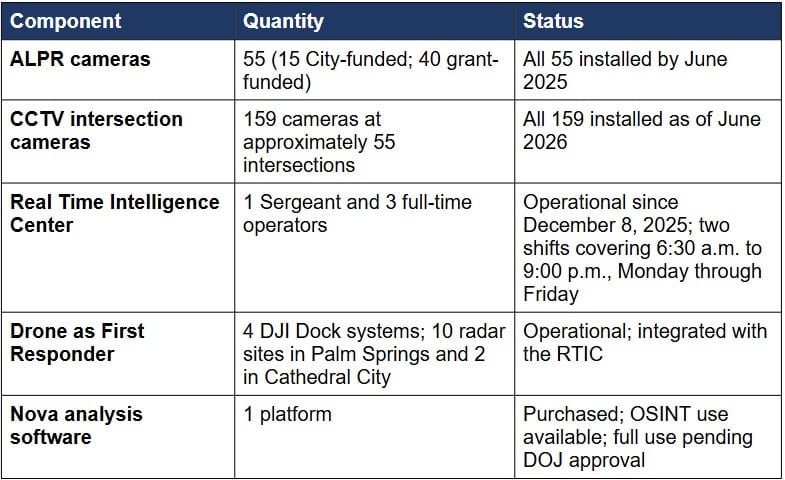
- 55 license plate reader cameras on public roads that alert staff when a plate matches a stolen, wanted or missing-person vehicle.
- 169 closed-circuit television (CCTV) cameras providing live and recorded video at approximately 55 intersections, along with seven additional cameras on a mobile security trailer.
- One real-time intelligence center, where dedicated staff review alerts and video.
- Four drone docks, used to keep a vehicle or scene in view.
According to the department, the cameras cover about 1% of the city’s intersections and are not equipped with facial recognition, although the department has access to facial recognition technology through other databases.
License plate information is deleted after 30 days unless it is part of an investigation. Data is shared with 26 other California police agencies that have signed agreements with Palm Springs.
The City Council approved the first 15 license plate reader cameras and $45,000 in city funding in October 2023. A state grant funded another 40 cameras in July 2024, all of which were installed by June 2025.
By June 2026, the 169 CCTV cameras and drone network were also in place. The department previously had a CCTV network, but many cameras were broken or out of service, meaning the new cameras largely represented an expansion of the city’s surveillance network compared to recent years.
Between March 10 and Sept. 30 of this year, public safety cameras provided some form of support in 138 arrests, according to information presented by the department Wednesday. Between July 2025 and June 2026, the cameras also helped recover 36 stolen vehicles and more than $365,000 in stolen property.
“When a vehicle is stolen, a burglary occurs, a child goes missing or is abducted, we often have limited information. We often have seconds to take meaningful action, and we’re trying to make meaningful progress and get investigative leads so that we can continue to let the people of our agency really do what they do best, which is good, solid police work,” said Police Chief Kyle Stjerne.
“This program helps us leverage that in a few important ways. We can turn that limited information into actionable leads by identifying vehicles connected to criminal activity, determining direction of travel, which areas are these people associated with this activity going. . . Locating wanted or missing at-risk people, preserving evidence when it exists so that we have a better likelihood of successfully prosecuting criminal activity, and giving responding officers better information before they arrive,” Stjerne continued.
But several public commenters questioned whether those benefits outweighed the potential loss of privacy.
“I have a lot of friends and neighbors who support these cameras, the defense is they solve crime, there’s no right to privacy in a public street, and that all of what the camera records is place and time. . . . I think if we grant all of that, even though I think we have some reason to question the last bit, it isn’t enough for me,” said Phillip Hodges, who identified himself as a data scientist.
“If you give me enough observations of place and time, I can tell where you sleep because every night your car passes the same camera last, and every morning it passes it first. I can tell you go to (Alcoholics Anonymous), because every Thursday at 7 your car passes the church and comes back an hour later. I can tell you drove past the Planned Parenthood at 2 on a Tuesday and came back at 4,” Hodges continued.
Joshua Hendrick, who tracks surveillance technology in the Coachella Valley, said his public records request for the program’s regular compliance audits has gone unfulfilled. He questioned whether the audits were being performed as promised and where the records are kept.
The department produces an audit report every 30 days for review by the police chief. The audits verify that active accounts are authorized and tied to current positions, that searches have specific and legitimate purposes, and that prohibited searches — including those related to immigration enforcement and abortion investigations — have not occurred.
In response to council questions about whether the audits would be made public, Stjerne said they contain confidential information and that the department is working with the city attorney “to find out what we can and can’t release.”

The department also plans to return to the council soon with a proposal that would make intentional misuse of the program a misdemeanor in Palm Springs.
“We hope we have demonstrated. . . our willingness to continue this conversation, so that we continue to look for the best ways to govern and utilize this technology. We hope that we’ve demonstrated we have been willing to, when we identify something that is suboptimal or not ideal, we change it. When something needs to be amended to make it better, make it safer, make it more in line with community values, if it’s reasonable, we do it,” Stjerne said.
Department staff also directed the public to the city’s “ALPR transparency portal” for more information. The portal, hosted on Flock’s website, requires visitors to scroll past a list of recent positive news coverage about Flock in cities outside Palm Springs before reaching data about the technology’s use locally.
Councilmembers asked a wide range of questions about what information would be shared with the public, the city’s contract with Flock, how and when data is shared with other police departments, and what access Flock has to CCTV footage stored on the company’s servers.
The council directed the department to ensure the city’s contracts and policies align with its privacy priorities, particularly protections against data being used for immigration enforcement, abortion investigations and other prohibited purposes.
Councilmembers also requested updated budget estimates, a breakdown of which parts of the program are considered critical, and clarification from Flock about how the company uses the city’s data and what access it has to CCTV footage.
Regardless of any immediate changes, Palm Springs faces major decisions about the program’s future over the next year.
The $4.5 million state grant ends in December 2027, meaning the city must decide whether to maintain a similar funding commitment or scale back the program.
All 224 CCTV and license plate reader cameras are owned by Flock, with the police department technically leasing them from the surveillance technology company. That means if the city wants to keep some elements of the camera program but switch to another vendor, the cameras would have to be replaced.
Author

Related Articles

Palm Springs police to launch free wellness call program next month
PSPD Connect, backed by a city councilmember, the police chief and the Blue Zones Project, will offer regular phone check-ins to residents who may benefit from added support.

Palm Springs police step up enforcement of disabled parking spaces, including on private lots
Drivers who park illegally in reserved spaces face fines of $250 to $1,000 and possible towing, and the department is offering businesses help with required signage.

Palm Springs bids emotional farewell to Chief Andy Mills, honors wife Cathy as new chief steps in
Hundreds packed the Palm Springs Convention Center Thursday evening for a retirement send-off that doubled as a tribute to Cathy Mills and a first public moment for incoming Chief Kyle Stjerne.