
Palm Springs commission reviews plans for a minimalist amphitheater in Downtown Park
Consultants presented four design options ranging from $1 million to $4 million for Downtown Park’s amphitheater, commissioners favored the less costly options.
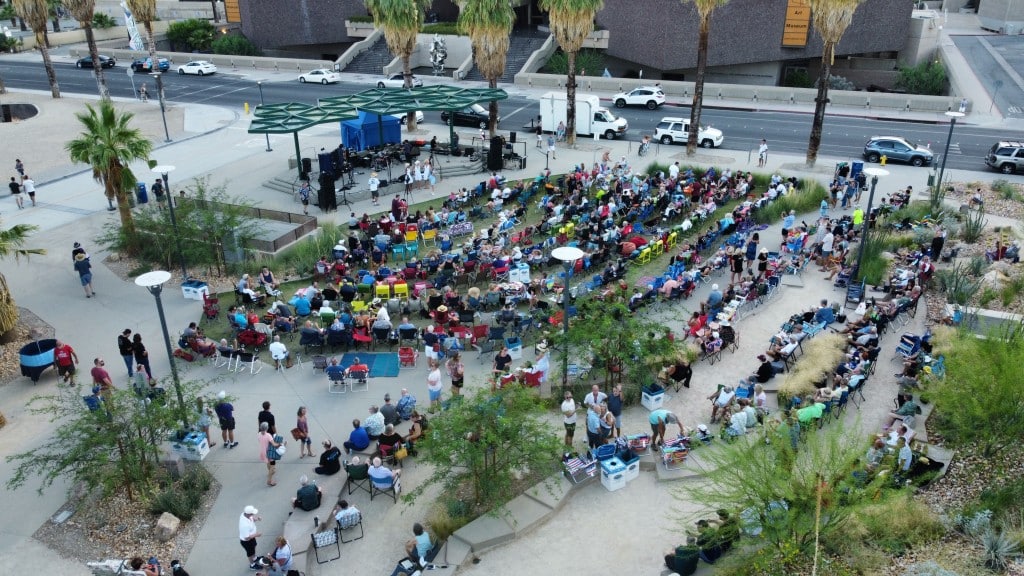
The Palm Springs Parks and Recreation Commission on Monday reviewed four preliminary design concepts for expanding the Downtown Park amphitheater, with commissioners signaling support for the most modest option while raising concerns about cost, scale, and the city’s ability to fund any of the proposals.
Parks and Recreation Director Nick Gonzalez told the commission the city council approved a Measure J-funded project in 2024 to explore ways to expand and improve the amphitheater, with approximately $754,000 allocated for the work.
Local reporting and journalism you can count on.
Subscribe to The Palm Springs Post
The city hired MIG Landscape Architects to develop the concepts, and Oscar Johnson with MIG walked commissioners through four options Monday evening, ranging from minimal improvements to a complete reconfiguration of the stage and surrounding space. The existing layout has room for about 644 people on both the lawn and the retaining wall.
Option A, the least costly at an estimated $1 million to $1.5 million, would add a new custom retaining seatwall, increasing capacity by 162 seats, add posts for audio-visual equipment, and include a small green room adjacent to the existing stage. Option B, estimated at $1.5 million to $2 million, would replace the existing stage with a larger 30-by-50-foot structure while adding 147 seats.
Option C, estimated between $1.7 million and $2.5 million, would relocate the stage across Museum Way and increase capacity by 461 seats. Option D, the most radical redesign at $3 million to $4 million, would flip the current orientation, moving the st move the stage entirely off the underground parking structure and add 626 seats.
Johnson said all cost estimates reflect prevailing wage and a 20% contingency.
Several commissioners pushed back on the higher-cost options, particularly those involving moving the stage or removing trees. “I just don’t see the city investing over $3 million on a new stage in a new park, when we have old parks that need way more,” one commissioner said.
Commissioner Jody Diaz echoed that sentiment, saying the park’s appeal lies in its scale. “If you start to change it too much, you’re going to change the whole concept of the intimacy,” the Diaz said. “I would say either option A or B personally.”
Commissioner Meredith Fine said she goes to every concert in the park, and stressed the need for more seats, adding that she has to get to the park several hours before the concert starts to claim a spot with chair.
“Every year it’s getting busier and busier and busier because I think people love the concept of going downtown and having a free concert in the park,” she said. She estimated an increase of 150 to 300 seats should be sufficient.
Gonzalez acknowledged that all four options exceed the Measure J allocation and said staff will need to identify additional funding sources. “It will be up to staff to figure out how we come up and shore up the funding for that,” he said, “whether it’s going back and asking Measure J for money, or looking for grants and other sources of funding to help shore up the difference in costs.”
Commissioners also expressed concern about the park’s infrastructure limitations. Gonzalez noted that the current setup causes the city to lose rental revenue from outside event organizers. “When other organizers want to utilize the space, they already indicate that the stage is too small,” he said, “and so we kind of do lose business in the form of park rentals for that area.”
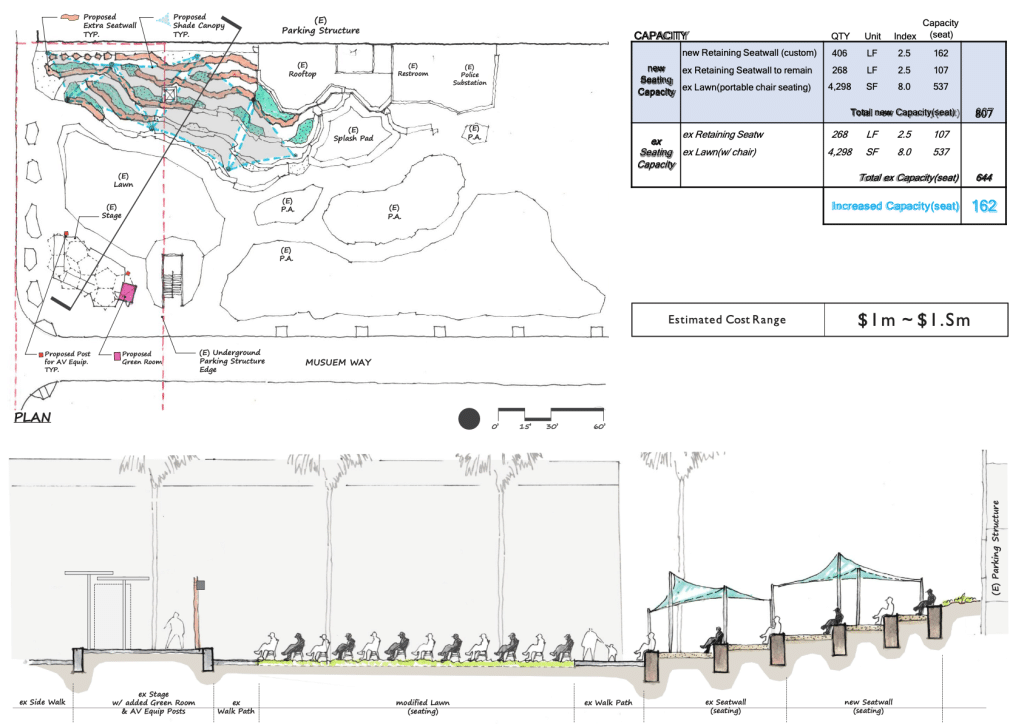
They also didn’t feel the need for shade structures, considering that the outdoor concerts in the park are held when the temperature is more mild, “If you’re gonna have a daytime event, you’re not gonna do it in the dead of summer,” one commissioner said.
Several commissioners said they did not support a large green room, though Gonzalez clarified that the space was intended to serve a dual purpose. “We’ve classified that as green room or storage,” he said. “Storage is really key, and that would allow us to have a secure space on site, which we don’t currently have.”
Johnson said the firm will take the commission’s feedback and refine the concepts accordingly. Gonzalez summarized the commission’s direction as favoring an approach similar to Option A — with upgraded audio-visual infrastructure, additional seating of roughly 200 or more, a storage space rather than a dedicated green room, no shade canopies, and preservation of the park’s existing trees and intimate character.
No vote was taken, as the item was presented as a discussion to gather commissioner feedback before design concepts are further developed.
Author

Related Articles
Commission approves live entertainment permit for one-man science and music show downtown
Planning commissioners on Tuesday signed off on a conditional use permit for a building that will house Patrick Olson’s “The Art of Science,” which is expected to open in December or January.
Preservation board delays decision on latest Orchid Tree hotel plans, sends four items back for restudy
Members want four staff-recommended changes restudied, including the location of a pool cabana, a step city planners said will add time to the Orchid Tree Resort & Spa schedule.
Planning Commission approves 16-unit townhome project at Sunrise Way and Amado Road after July delay
City staff noted that some of the commission’s earlier requests conflicted with state housing laws, though the developer did add a walkway so pool cleaners and landscapers can reach backyards.