
Palm Springs City Council to take up downtown parking fixes as study finds garages underused
An analysis shows ample parking capacity but operational and wayfinding issues, prompting staff to recommend enforcement, signage and policy changes.

The Palm Springs City Council will review recommendations and give direction on improving downtown parking management at its Wednesday, Jan. 28 meeting, following a study that found the area has ample parking capacity but faces operational and perception challenges.
A comprehensive parking study conducted by Dixon Resources Unlimited in 2024 found that Downtown Palm Springs’ two public parking garages remain largely underused, while drivers compete for limited on-street spaces. The imbalance creates the perception of a parking shortage where none exists.
Local reporting and journalism you can count on.
Subscribe to The Palm Springs Post
The study, which last came before the council in February 2025, was commissioned by Palm Springs Resorts. It analyzed approximately 2,286 parking spaces in the downtown core during the off-peak season in January and May. Researchers found an average occupancy rate of 29% across all parking facilities, with the Downtown Parking Garage on Museum Way operating at just 15% capacity during data collection periods.
By comparison, on-street parking along Palm Canyon Drive and Indian Canyon Drive averaged 47% occupancy, with some blocks reaching 95% on weekends. The disparity suggests drivers favor convenient curbside parking over available garage spaces located nearby.
“The Downtown district in Palm Springs provides a welcoming and bustling atmosphere to visitors in a well-known, vibrant community,” the report states. “… In general, the public parking lots appeared to reach their capacity, while the two parking garages within the study area appeared underutilized.”
The study documented 359 on-street parking spaces and 1,927 off-street parking spaces across nine public parking facilities within the downtown area bounded by Alejo Road, Palm Canyon Drive, Baristo Road and Indian Canyon Drive.
Researchers also found that most vehicles parked for short periods, challenging assumptions that long-term parkers monopolize downtown spaces. Data showed 92% of observed vehicles parked for three hours or less, with 78% staying under two hours on both collection days. No vehicles were observed staying longer than nine hours.
“Most cars observed were short-term parkers, with 92% parked within one collection period (0-3 hours),” the report notes. “The prevalence of short-term parking was especially true on the weekend (Saturday) with 94% parking in the 0–3-hour time interval.”
While overall supply was sufficient, the study identified operational issues that discourage use of existing facilities. Researchers cited a lack of uniform signage and wayfinding throughout the study area, creating confusion for both residents and visitors. Time limits varied widely, ranging from three minutes to unlimited parking, with some signage obscured by parked vehicles or lacking clear directions to nearby garages.
Additional concerns included faded striping in surface lots, narrow curb cut-outs with 20-minute limits that pose safety risks, and limited visible enforcement that does not encourage compliance with posted restrictions.
Conditions inside the Downtown Parking Garage also contributed to underuse. Inspectors documented trash, graffiti, chipping paint, open chain-link fencing that limits access to certain areas, and tripping hazards caused by jutted-out curbs and mis-marked steps. At the south parking garage on Baristo Road, evaluators found inoperable elevators, insufficient lighting and no clearly defined pedestrian pathways from adjacent sidewalks.
In response, city staff from the departments of Economic Development, Special Program Compliance and Public Works developed a phased strategy organized into short-, mid- and long-term actions.
Short-term measures planned within 12 months include standardizing on-street time limits, strengthening visible parking enforcement, improving basic wayfinding to off-street facilities, addressing minor safety and maintenance issues in existing garages, and completing a structural analysis of the Belardo parking structure.
Mid-term improvements, targeted for one to three years, include establishing an employee parking permit or incentive program, adopting a no-reparking ordinance, making targeted capital improvements to enhance the garage user experience, and engaging the Convention Center urban design consultant to design permanent wayfinding signage and identify appropriate locations.
The Department of Special Program Compliance recommends implementing the employee parking permit program and no-reparking ordinance at the same time to avoid unintended impacts on downtown workers.
“It would benefit the downtown community by offering a solution for employee parking where implementation of a no-reparking ordinance by itself may impact employee parking, leaving downtown employees without appropriate parking solutions,” the staff report states.
No-reparking ordinances typically prohibit drivers from moving their vehicles and returning to park in the same area within a set time frame, often ranging from 12 to 24 hours.
Long-term strategies extending beyond three years include exploring demand-based pricing during special events, developing advanced parking management systems and other mobility solutions as downtown visitation increases, budgeting for permanent wayfinding signage, and continuing targeted capital improvements to parking garages.
In general, the public parking lots appeared to reach their capacity, while the two parking garages within the study area appeared underutilized.”
— Dixon Resources Unlimited 2024 parking study
Public Works plans to install interim wayfinding signage while coordinating with the Convention Center design consultant on permanent designs that align with broader downtown connectivity plans. The department is also working with a structural engineering firm to assess the Belardo parking structure and develop repair recommendations.
From an economic development standpoint, staff emphasized that the central issue is not the number of parking spaces, but how effectively they are used.
“The efficiency, visibility, and perceived convenience of existing parking assets” remain the primary challenge, according to the staff report, which notes that improving operations could maximize existing infrastructure without expanding supply.
The study also included four community meetings, drawing approximately 41 participants across virtual and in-person sessions. Attendees expressed interest in employee parking permits, digital signage directing visitors to off-street facilities, and concerns about future parking demand tied to the Plaza Theatre, which reopened in December with approximately 700 seats.
No immediate budget appropriations are requested. Cost estimates for signage, maintenance and enforcement improvements will be developed following City Council direction.
Author

Related Articles
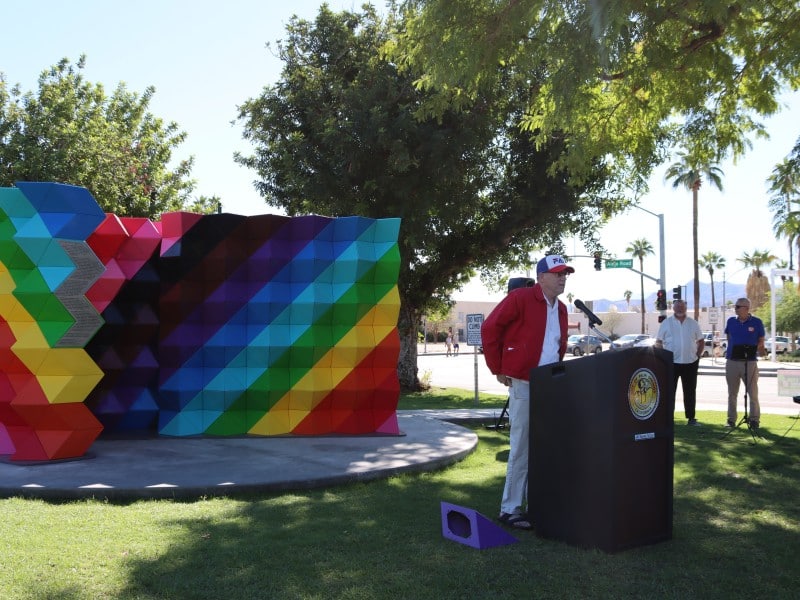
Palm Springs art commission approves up to $50,000 for sculpture repairs, adds time capsule to inventory
The Pride Monument was vandalized with the words, “hate, hatred, hated” according to the chair of the Public Arts Commission.
Palm Springs parks commission approves golf fee increase, redesigned Ruth Hardy Park workout pad
Resident rates at Tahquitz Creek’s two city-owned courses would rise about 9%, or $1 to $6 per round. The revised workout pad design heads next to the City Council.
Palm Springs council advances removal of cannabis lounge event provision
Council members said the subsection was unnecessary because the zoning code already governs special events and directed staff to return with an ordinance removing it.