
Nearly 1,000 neighborhood signs now mark Palm Springs streets as program nears full coverage
Palm Springs neighborhoods are adding custom colors and logos to city intersections, backed by a Measure J grant and ONE-PS’s push for 100% citywide representation.
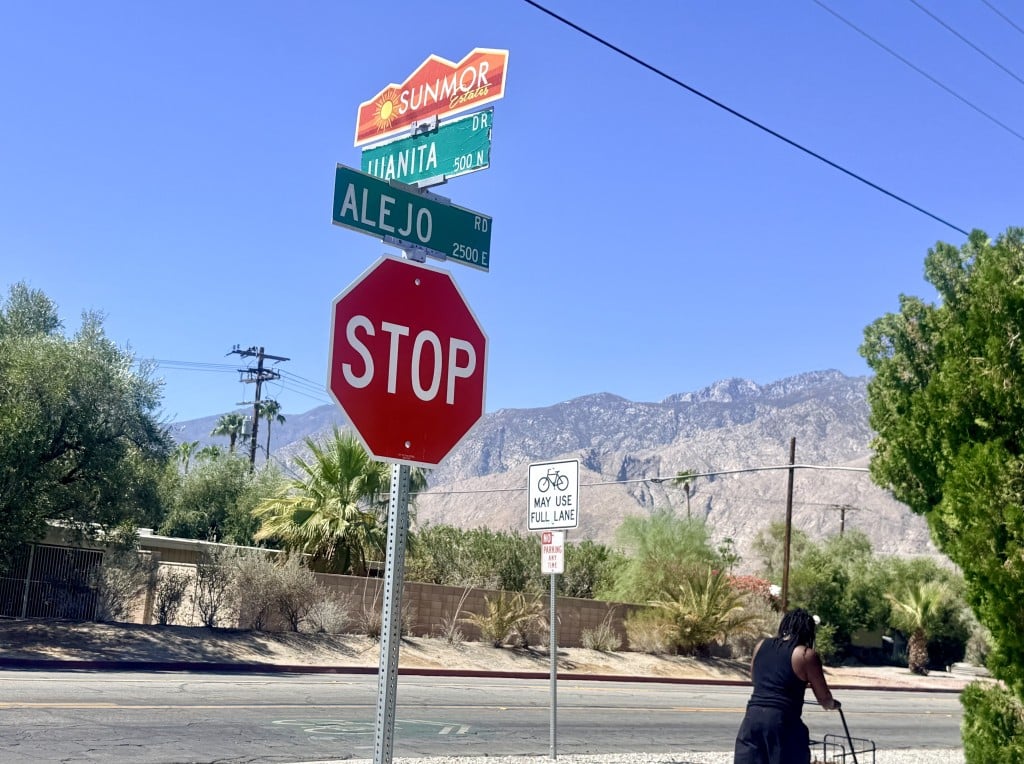
Installation of neighborhood identification blade signs is nearing completion across Palm Springs, with close to 1,000 signs now in place throughout the city.
Chris Ruetz, chair of Organized Neighborhoods of Palm Springs (ONE-PS), said the count reflects years of work placing the signs on traffic signal poles and existing street signs citywide.
Local reporting and journalism you can count on.
Subscribe to The Palm Springs Post
For a city of just over 44,000 full-time residents, Palm Springs has an abundance of distinct civic identities, with 52 officially recognized neighborhoods, each with its own borders, history, and architectural identity.
“The whole idea is, well, everybody should be in a neighborhood, whether its active or not,” Ruetz said. “I think that there’s just a lot of value in community.”
The blade sign program dates to December 2008, when the Palm Springs City Council adopted a resolution establishing a neighborhood organization identification street sign program.
The program attaches signs bearing the name of officially recognized neighborhood organizations to existing street signs. It was developed by the Palm Springs Neighborhood Involvement Committee, now known as ONE-PS.
Of the city’s 52 neighborhoods, 46 officially have blade signs. Six neighborhoods do not yet have official signs, though the city has created placeholder designs for them.
Usually neighborhoods come together to agree on a design that fits in the city’s guidelines and submits it for approval to ensure safety and legibility.
Roughly 125 of the signs have been installed specifically on traffic signal poles at major intersections throughout the city, funded through a $44,600 grant from Measure J, the city’s supplemental sales tax measure. ONE-PS applied for the grant in 2024, and Measure J approved the funding in April 2025.
Ruetz shouldered much of the project, driving up and down nearly every street in the city, using voice memos to take notes on his phone and mapping out where the new blade signs should go.
“I wanted to make sure that whatever direction you’re driving, you can look up at the light, whether it’s red, yellow, or green, and you’ll also see what neighborhood it is,” Ruetz said.
The custom designs, cut along an asymmetrical silhouette that mimics the contours of the San Jacinto Mountains, range widely in aesthetic. Ruetz’s home district of Movie Colony East sports purple with yellow lettering and stars, while others embrace poolside desert whimsy.
“Oasis del Sol catches my eye because it’s so colorful — it’s a very appealing sky blue and has a swimmer doing a swan dive,” Ruetz said. “I like Old Las Palmas because it’s very bold and regal, but Oasis del Sol just looks like Palm Springs because it’s fun, cute, and colorful.”
Beyond mid-century aesthetic charm, Ruetz notes the visual markers serve a practical purpose in a town where historical celebrity enclaves, gated HOAs, and newer subdivisions blur together. Ruetz said the neighborhood names are often used in real estate listings and tourism guides.
Signs have not yet been installed at intersections along Gene Autry Trail and Vista Chino because those traffic signal poles fall within Caltrans’ jurisdiction, requiring a separate approval process. The city is working to determine the steps needed to pursue installation at those locations.
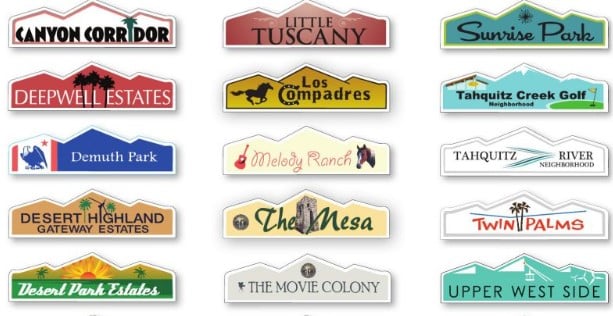
Denise Goolsby, manager of the city’s office of neighborhoods, said 43 additional blade signs still need to be installed along Highway 111.
“We will be reaching out to Caltrans to find out the process for requesting installation of these signs on traffic signals within their right-of-way,” Goolsby said.
“If I could take it on the road and go to other towns and say, ‘You need to have a ONE-PS,’ I would,” Ruetz said. “It’s hometown USA, and maybe it’s a small-town thing, but I just think every town should have a structure similar to this. You have more of an opportunity for people to have meaningful engagement and connection if you have defined areas.”
Author

Related Articles
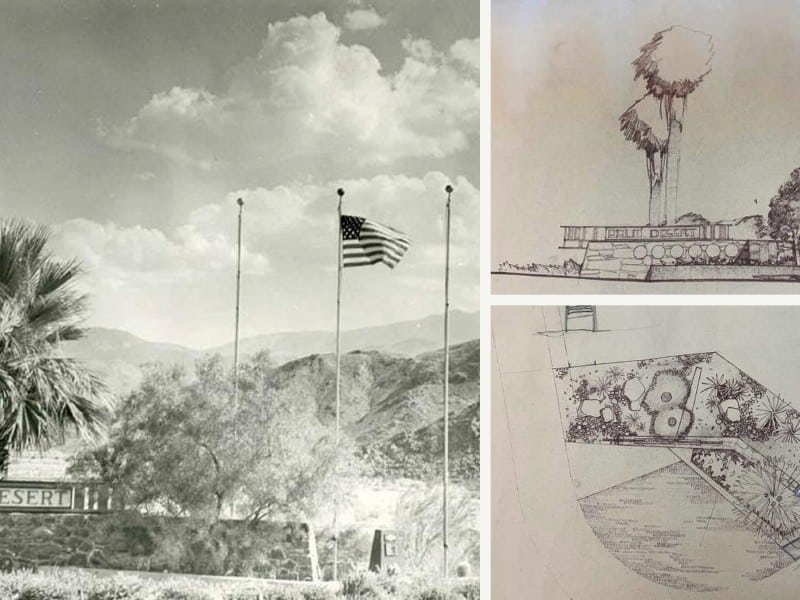
Palm Springs preservation group steps in to help revive a piece of Palm Desert history
The Palm Springs Preservation Foundation has offered to fund conceptual design work for a recreation of a historic Palm Desert entry sign designed by noted desert architect William F. Cody.

Local performance venues launching fall season built around participation
The Cultural Center, Palm Canyon Theatre and CVRep are preparing fall programs that range from film screenings and musicals to acting, singing and comedy-writing classes.
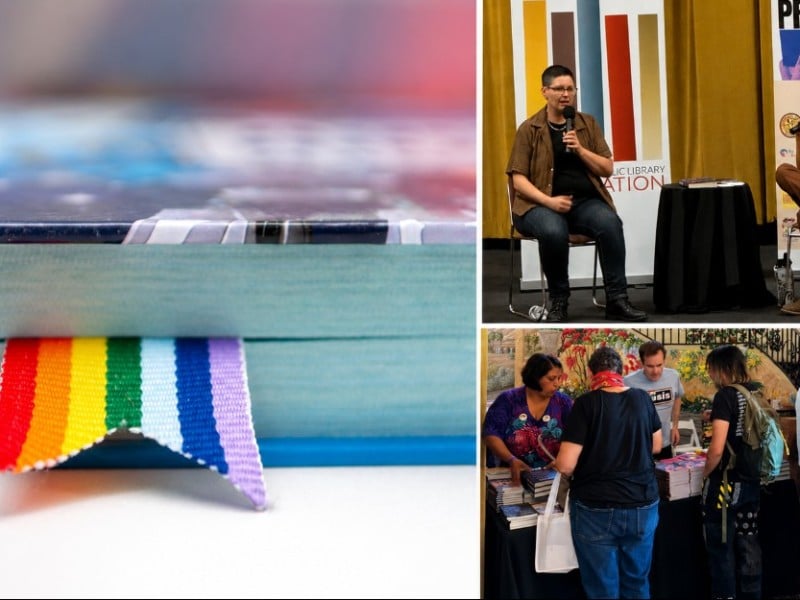
5th annual Pride on the Page festival returning to Palm Springs, free to all
The Palm Springs Public Library Foundation says the daylong celebration of LGBTQ+ authors will mark its anniversary with a free evening reception for the first time.