
Momentum building for Human Rights Commission to reevaluate its Community Service Awards program
Even before concerns were raised by community members over some of the awards handed out on Feb. 12, Commission members had moved to consider refining the selection process.

As additional concerns surface about the process by which the Palm Springs Human Rights Commission (HRC) decides who will receive annual awards, it’s also becoming clear that Commission members had previously acknowledged work was needed to improve the process.
At its December 2023 meeting, HRC Vice Chair David Vignolo called for a potential update of the award selection process, stating that it was not specifically focused on the current year’s recipients. Prior to Vignolo’s comments, the full HRC had just approved moving forward with contacting community members chosen for this year’s Community Service Awards.
Local reporting and journalism you can count on.
Subscribe to The Palm Springs Post
“(I)n the next 11 months or 10 months, the Commission might want to consider reviewing the criteria used for determining recipients of the Community Service Awards … and maybe make improvements to it or changes to it,” Vignolo said. “I don’t know who developed the criteria. I know it’s been in use during my terms on this Commission, but we may want to just revisit it and see if we want to make any changes to either the criteria or the process used.”
The current HRC process involves soliciting nominations, which are then assessed by a three-member executive committee. The committee’s recommendations go through an initial approval phase by the entire HRC, followed by a final approval after nominees have been contacted. This year, that committee consisted of Vignolo, HRC Chair Hugo Loyola, and HRC Commissioner Beverly Greer.
However, as previously reported by The Post, the list of honorees approved initially in December — and given final approval in January — changed by the time the awards were handed out on Feb. 12. The move appears to have happened behind the scenes after complaints about one of the honorees were received by Loyola. It did not receive a vote by the full Commission, an apparent violation of state meeting laws.
Concerns over the process by which the awards are determined are also at the center of an email exchange provided to The Post last week. In that exchange, dated Feb. 7, a member of the community objected to how the awards were determined, claiming that lack of vetting of one person scheduled to receive an award this year would be “a huge mistake, and the city will be the laughing stock of the valley.”
At the December meeting, Greer suggested the HRC have a more focused and effective way to choose its award recipients.
“I think that would be a suitable topic for ad hoc committee to look at with commissioners that would be particularly interested in that area,” Greer said. “We did find the process to be kind of too open-ended for when we were reviewing these, being new to the review process, and I think the three of us felt that it did need to be either more directed or some way that would also enhance the value of the award itself.”
The discussion on the awards criteria comes at a time when the Commission is actively seeking to increase its visibility and engagement with city council activities. Earlier in the December meeting, HRC members deliberated on whether it should play a role in reviewing funding requests from organizations before they are considered by the Palm Springs City Council.
The idea was generally well-received, with commissioners noting that while there is no current statutory requirement for such a review process, it could be beneficial for ensuring that funded projects align with human rights objectives.
Author

Related Articles
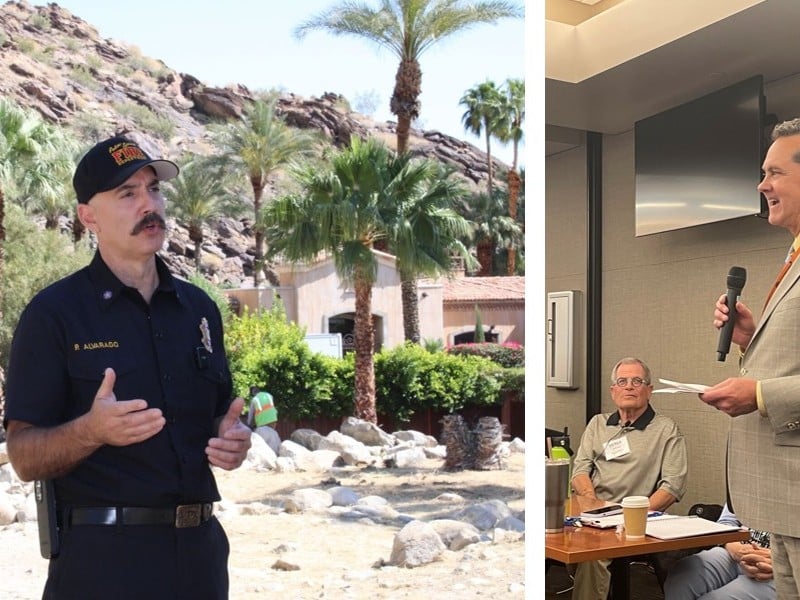
City leaders, public thank retiring city manager and fire chief, list their accomplishments
Council members and residents praised Scott Stiles and Paul Alvarado Wednesday for storm response and public service. Both men gave the credit to their staffs and the community.

Temporary dog park approved for Victoria Park; Demuth Park project progressing
Parks commissioners backed a pop-up pilot with Blue Zones Palm Springs that will open Dec. 11 and run through about the end of January, with a resident survey to gauge interest in a permanent site.
This week at City Hall: Planning Commission to weigh delivery hub; City Council postpones underground utility hearings
A proposed warehouse on 19th Avenue, a pop-up dog park and a canceled public hearing on a nearly $10.1 million utility project top meeting agendas this week.