
Human Rights Commission seeks to overhaul awards process after past controversies
Commissioners this week debated simplifying criteria, improving vetting, and maintaining control of the recognition program at their monthly meeting.
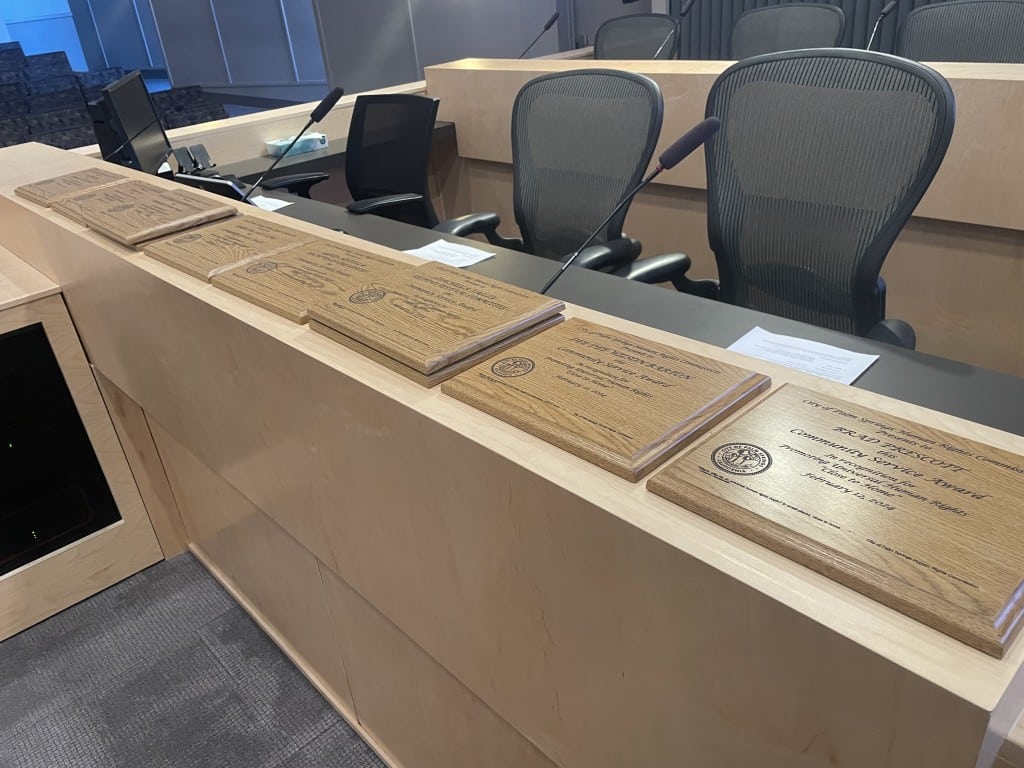
After a nine-month hiatus prompted by past controversies, the Palm Springs Human Rights Commission is moving forward with efforts to overhaul its community service award program.
At its regular meeting Monday evening, commissioners discussed simplifying the nomination and selection criteria, strengthening vetting procedures, and clarifying who should present the awards — all in an effort to avoid the missteps that led to the commission’s temporary shutdown.
Local reporting and journalism you can count on.
Subscribe to The Palm Springs Post
“It was a mess,” Commissioner Michael Horne said of the previous process. “The community came down on the commission, not the council. We sort of imploded.”
Horne is referring to last year’s Community Service Award selection process, when some HRC members, behind closed doors, decided to rescind a Community Service Award that the entire commission had earlier approved, triggering concerns of a Brown Act violation.
Because the Human Rights Commission is the only advisory body in the city that gives out awards, its members decide the process without formal direction or guidance from the city. There was some discussion over the City Council taking over the awarding process, but Commissioner Scott Nevins said the fact that it’s a Human Rights Commission award is significant for recipients.
One of the central questions was how nominations would be evaluated. Chair Hugo Loyola proposed a simplified scoring system based on three core criteria: mission and purpose, community impact, and future vision.
“I thought about three particular areas that I’d like to see in a nomination criteria,” Loyola said. “One being the mission and purpose… a second area would be community impact… and then what is the future vision?”
Under his suggestion, each nomination would receive a score of one to five in each category, with top scorers forwarded to the City Council for recognition.
The issue of vetting, particularly around nominees’ social media presence, surfaced as a major concern. Vice Chair David Vignolo warned that failing to address this could lead to more problems.
“It doesn’t really address the question of vetting in social media, and that was the big problem last time,” Vignolo said. “Until we figure out a way to do that … we’re setting ourselves up for possible failure again.”
Several ideas for improved vetting were floated, including having the city’s Office of Communications, Media Relations and Neighborhoods screen for problematic content.
Commissioner Beverly Greer suggested background checks similar to those used by nonprofits, though she acknowledged the potential cost and privacy concerns.
“Most jobs these days require you to go through a background check,” Greer said. “Would that be unreasonable to ask people if they wanted to stand for this award?”
Nevins noted that process should be simplified.
“If we need to look at social media we could do that as a group,” he said. “I think there’s a way to do that that keeps this a very clear playing field, very nonpartisan and fair.”
Left unsaid, however, was what specific kind of social media activity or comments would be considered disqualifying, or what would trigger the commission to look into an applicant’s social media presence.
The commission agreed to continue refining the proposal, staff and commissioners will incorporate feedback and present a revised version at the next meeting.
“The goal is to make it as simple as possible,” Loyola said. “Simple, clear, transparent process.”
Final recommendations are expected to be presented to the city council for approval before the updated awards program is launched.
The commission’s next meeting is scheduled for June 9.
Author

Related Articles
City leaders, public thank retiring city manager and fire chief, list their accomplishments
Council members and residents praised Scott Stiles and Paul Alvarado Wednesday for storm response and public service. Both men gave the credit to their staffs and the community.

Temporary dog park approved for Victoria Park; Demuth Park project progressing
Parks commissioners backed a pop-up pilot with Blue Zones Palm Springs that will open Dec. 11 and run through about the end of January, with a resident survey to gauge interest in a permanent site.
This week at City Hall: Planning Commission to weigh delivery hub; City Council postpones underground utility hearings
A proposed warehouse on 19th Avenue, a pop-up dog park and a canceled public hearing on a nearly $10.1 million utility project top meeting agendas this week.