
Historic site board backs demolition of a portion of Town and Country Center to make way for new Palm Springs fire station
The board greenlit the removal of two vacant buildings on North Indian Canyon Drive for a new Fire Station No. 1., though final plans have not yet been approved.
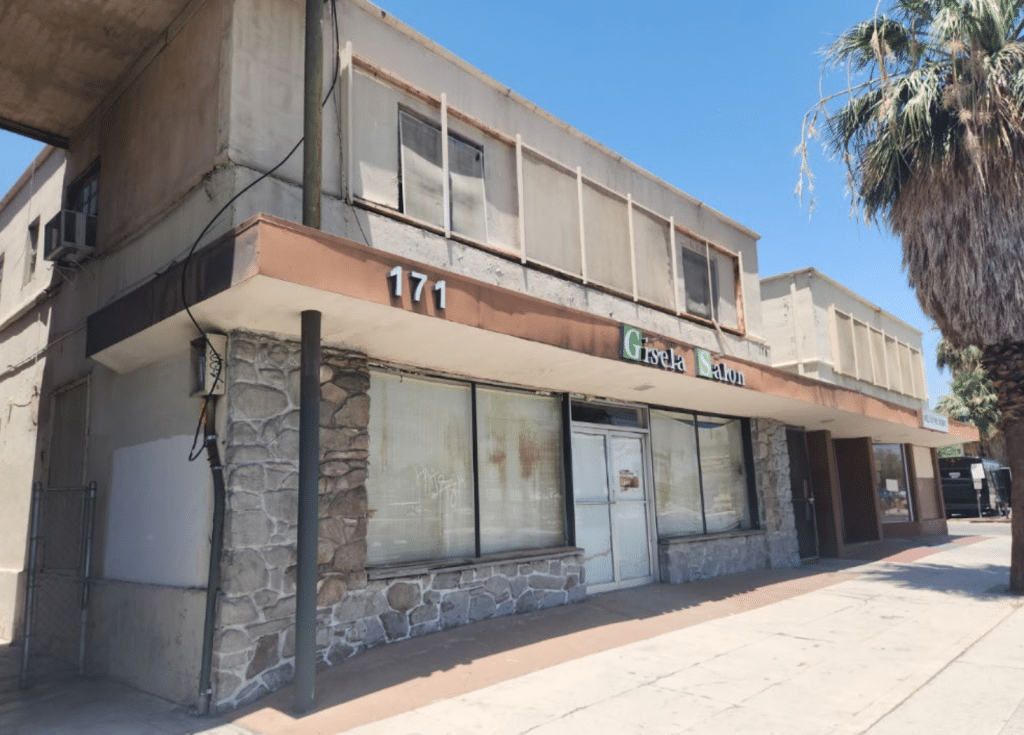
The Palm Springs Historic Site Preservation Board voted unanimously Tuesday to approve a certificate of appropriateness allowing the city to demolish two buildings at the Town and Country Center so a new fire station can be built on the site.
The buildings, located at 171 and 181 North Indian Canyon Drive, sit within the Town and Country Center, which the City Council designated a Class 1 historic site in 2016. The request was submitted by the City of Palm Springs, which is purchasing a portion of the property.
Local reporting and journalism you can count on.
Subscribe to The Palm Springs Post
The application is tied to a City Council vote to purchase a portion of the site, which includes the center’s courtyard space and a vacant lot to the north, for the fire station project.
City planning staff said the two buildings do not carry the same architectural significance as the center’s principal structures, which were designed by architects including Paul R. Williams and A. Quincy Jones.
Staff recommended approval with several conditions, including immediate repairs to prevent further deterioration, archival documentation of character-defining features attached to building 171, a shoring and stabilization plan before a demolition permit is issued, and a future preservation and restoration plan for the adjacent building at 169 North Indian Canyon Drive.
The building at 171 North Indian Canyon Drive holds architectural significance primarily for its physical connection to the rest of the Town and Country Center rather than for its own design, according to the staff report. The building’s arcade canopy and cantilevered overhang extend across and terminate at building 169.
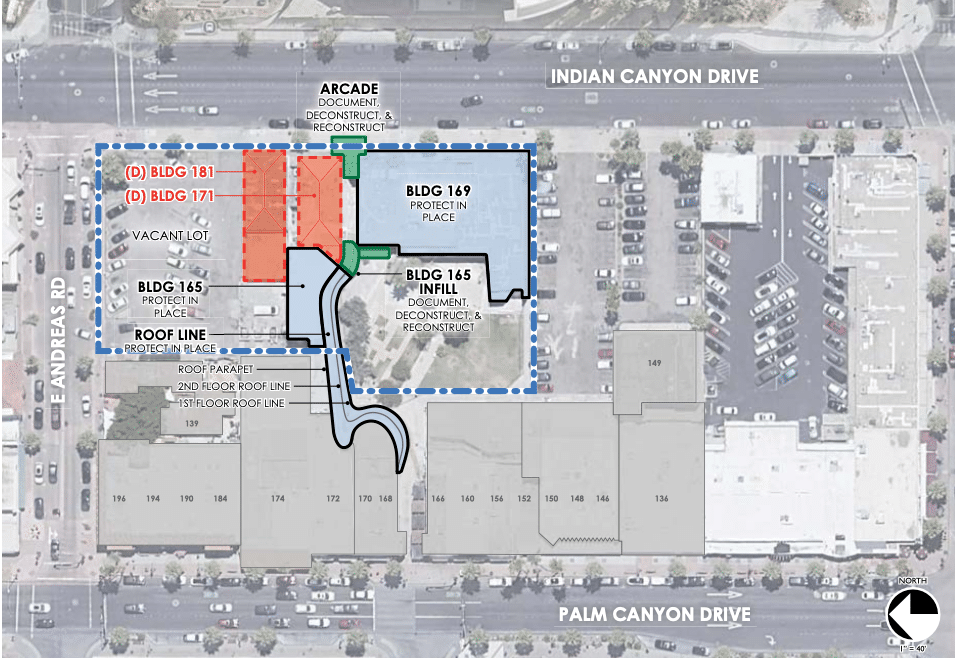
Because those architectural elements are physically attached to a building being demolished, the city will be required to document them in detail before removal. Staff also said any future design for the new fire station will need to return to the board for review because the site remains part of a Class 1 historic resource.
City staff told the board that closing escrow on the property, along with issuing requests for proposals for an architect and contractor, still needs to happen before construction begins, adding the process is expected to take about two years.
One board member said the demolition was justified because the center’s most significant building would remain protected. “I believe the heart of town and country would still be preserved, and that for me is primarily that 169 building,” the board member said, adding that “preservation and public safety have to…be considered, and the city needs a new fire station.”
The Town and Country Center, completed in 1948, was designated a Class 1 historic site in 2016 for meeting Criteria 1, 3, 4 and 5 under the city’s historic preservation ordinance, reflecting both its role in a broader pattern of events — the city’s shift toward a tourist economy and the introduction of a new, more minimalist and Modern architectural style — and the caliber of the architects behind it.
The nomination application for the site from 2016 described the center as an outstanding example of commercial design within the context of midcentury desert modernism, built around a central landscaped courtyard that served as the complex’s focal point, bordered by a large glassy semicircular element and an angled exterior staircase leading to the Town and Country Restaurant.
Character-defining features documented in the report include the courtyard configuration itself, the building facades’ expansive glass and horizontal massing, and distinctive architectural elements such as the semicircular glazed pavilion, the exterior stairs and planter feature, and the terrazzo flooring and concrete construction found in some of the complex’s buildings.
“As one of the last remaining examples of pre-1950 Modern commercial buildings downtown, the Town & Country Center serves as a reminder of this important stylistic transition in the city’s overall growth during this pivotal decade,” the nomination notes. “It not only heralded what was to become the dominant aesthetic associated with commercial architecture in the city, its distinctive Modern aesthetic became synonymous with the city’s leisure identity and eventually a resort attraction unto itself.”
The board’s approval followed discussion about the timeline for repairing and restoring the building at 169 North Indian Canyon Drive, with staff citing competing demands from other city projects, including the convention center, library, and swim center, as reasons a specific restoration timetable could not yet be committed to.
Author

Related Articles

Palm Springs bids emotional farewell to Chief Andy Mills, honors wife Cathy as new chief steps in
Hundreds packed the Palm Springs Convention Center Thursday evening for a retirement send-off that doubled as a tribute to Cathy Mills and a first public moment for incoming Chief Kyle Stjerne.

Palm Springs names deputy chief Stjerne as next police chief
Deputy Chief Kyle Stjerne will take over Sept. 6, succeeding retiring Chief Andy Mills.

Palm Springs officials ask to revisit Flock camera policy amid public pushback
After years of expanding the city’s surveillance network, the Palm Springs City Council is asking police for a public update on how the technology is being used and what safeguards are in place.