
City to consider lowering taxes, capping number of dispensaries as it looks to assist local cannabis businesses
Palm Springs has permitted more than 30 cannabis retailers to operate in the city, with more currently in the permit process. The result is roughly one dispensary per every 1,600 residents.
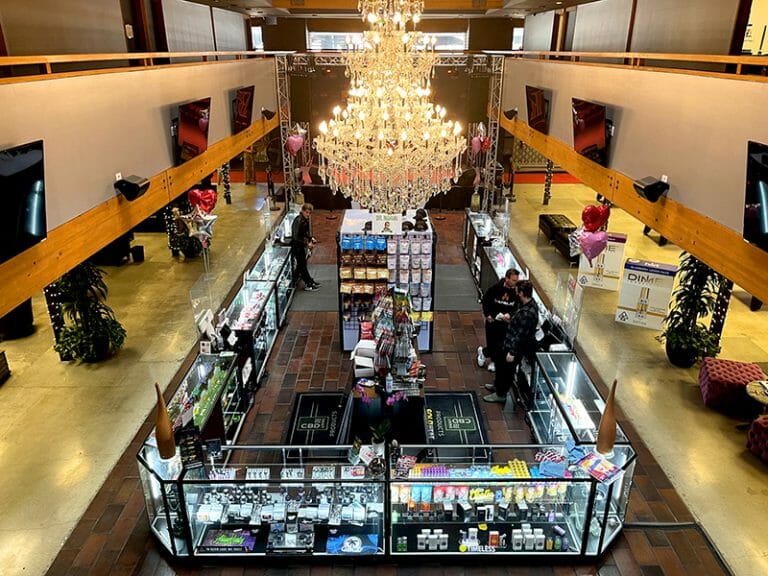
Looking to address issues surrounding the retail cannabis industry in the city, the Palm Springs City Council is set to consider new rules this week that would lower taxes and limit the number of dispensaries here.
The moves come in response to concerns expressed by some city cannabis retailers that high taxes, too many local competitors, and overregulation at all levels of state government are driving consumers to the black market. It also comes at a time when data shows tax revenue from legal marijuana sales in sales continuing to drop. It follows a moratorium placed on issuing new city cannabis licenses last October.
Local reporting and journalism you can count on.
Subscribe to The Palm Springs Post
Among the changes councilmembers will consider at their Feb. 8 meeting are a reduction in the local retail tax on cannabis products from 10% to 5% and capping the number of retail dispensaries at 25. Staff also recommends reimplementing a 2% local distribution tax, which was suspended in 2019.
At issue is that Palm Springs has permitted more than 30 cannabis retailers to operate in the city, 27 of which are currently operational, and more are in the permit process. The result is roughly one dispensary per every 1,600 residents, one of the highest saturation levels in the state.
In a report issued ahead of the meeting, city staff outlined both the problem and possible solutions, noting that when retail marijuana sales were legalized in California, city leaders here “opted to let the market dictate the number of cannabis business entities that could be supported in the city,” and that the move “resulted in significant oversaturation of retail cannabis businesses in the city and threatens the viability of the industry as a whole.”
In fiscal year 2020/2021, retail cannabis tax revenue in Palm Springs was $4.4 million. In the 2021/2022 fiscal year, that number was $4.1 million. Current projections show that revenue was expected to decline to $3.2 million in the 2024/2025 budget. Moving to a 5% retail tax would decrease retail tax revenue to $1.5 million, but the increased volume due to the lower tax could minimize that loss.
Cutting the retail cannabis tax rate in half would not be unprecedented. Most Coachella Valley cities with retail cannabis outlets, and many throughout the state, have implemented similar tax reductions.
A cap on the number of retail cannabis licenses would also not be uncommon. In considering how to arrive at the cap — which would require some attrition — city staff looked at regulations in 10 other cities in the state, including seven in the Coachella Valley. They found regulations based on everything from population to identified areas and separation of use.
For example:
- Indio and Los Angeles issue permits based on population size or density. Indio allows one cannabis retailer per 17,500 residents, while Los Angeles issues one license per 10,000 residents.
- San Diego caps retail cannabis outlets at four per council district, while Chula Vista permits up to three licenses per district.
- San Jose and San Francisco focus on the proximity and clustering of cannabis businesses. San Jose, for example, restricts its grouping to four cannabis uses within a 1,000-foot radius.
Author

Related Articles
Palm Springs committee begrudgingly moves In-N-Out plans forward
The Architectural Review Committee voted 3-2 to approve the project, with the condition that In-N-Out completes the full list of 18 conditions from a prior meeting.
Measure J commission OKs more money for airport seating; stadium repairs expected to top budget
If the City Council signs off, new furniture for gates 1 through 10 would be installed by the end of May, while a feasibility study continues at the stadium.
Palm Springs week ahead: In-N-Out review, airport bond payoff and pickleball complex opening
Officials will weigh a $10.81 million early bond redemption and a new restaurant, while residents can attend the Demuth Park pickleball opening and weigh in on the mayor’s position and Ramon Road Bridge project.