
Section 14 group keeps up pressure through billboards; city continues to work on possible reparations package
The ‘Know Before You Go’ campaign aims to shed light on evictions and housing destruction that occurred more than 60 years ago on tribal land.
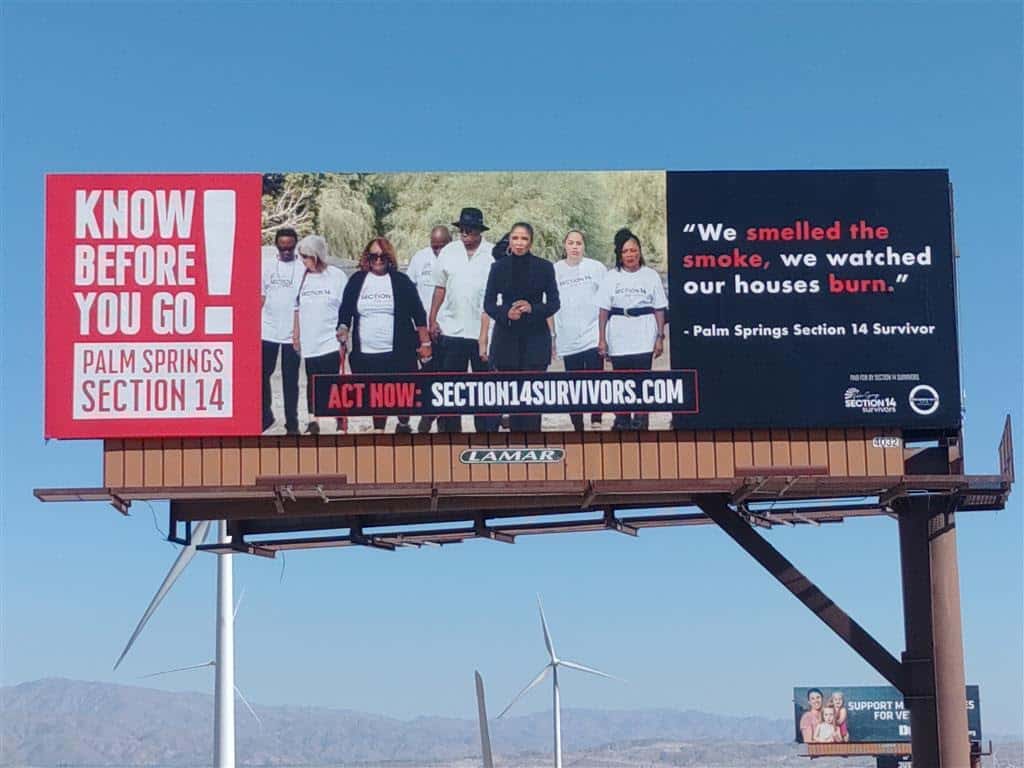
Despite the recent launch of a highly visible campaign aimed at keeping the pressure on city leaders to make amends for events in the past, the city and the organization behind the effort are no closer to a resolution.
The “Know Before You Go” billboard campaign, paid for by the Palm Springs Section 14 Survivors group, was launched in October to coincide with the annual “snowbird season,” which sees thousands of tourists and retirees flock to the desert.
Local reporting and journalism you can count on.
Subscribe to The Palm Springs Post
While it is not known whether the signage is achieving the desired result, the billboards were strategically placed along major routes into the city and aim to shed light on evictions and home destruction that occurred from the late 1950s to the mid-1960s on tribal land.
It was then that city leaders and some fire department personnel helped clear homes from a neighborhood of mostly Black and Latino community members to make way for spas, a convention center, and luxury hotels. Construction of the tourist attractions was made possible after 99-year land leases on tribal land were approved by the federal government.
The city formally apologized in September 2021 for its part in the evictions, and the City Council asked staff to develop proposals for possible economic investments that could act as reparations. The city also removed a statue of Frank Bogert — Palm Springs mayor at the time of the evictions — from the front of City Hall.
To date, there has been no formal offer from the city to a claim filed by attorneys representing the Section 14 group. In that claim, an economist working for the group estimated damages could total millions and possibly billions of dollars.
In April, the city looked at hiring outside help to work on a proposed reparations package. But a vote on approving a $500,000 contract fell short, sending city staff back to the drawing board.
In a letter sent earlier this month, the Section 14 group’s attorneys said negotiations between the city and the group had “reached a standstill.”
“As the City of Palm Springs continues profiting from the results of the destructive acts they committed decades ago, the Survivors of Section 14 have yet to see any sort of financial restitution,” a group representative wrote. “In 2021, city officials issued an apology for the city’s role in the neighborhood’s destruction, but they have yet to develop any tangible remedy for the families they displaced or their descendants.”
In speaking with The Post last week, however, City Manager Scott Stiles said he and elected leaders remain committed to providing reparations, including some that take the form of housing assistance.
Last year, the city asked for bids to help build housing on vacant lots in the Desert Highland Gateway Estates neighborhood, home to most of the city’s Black residents. It also hopes to buy back 119 acres off Tramview Road and Indian Canyon Drive that it gave to College of The Desert in 2010, hoping a satellite campus would be built.
“We’re trying to stay focused on what we can do in the Desert Highlands Gateway Estates neighborhood that can generate more opportunities,” Stiles said when asked about the status of reparations. Among the efforts would be an attempt to attract housing and retail development.
Author

Related Articles
City leaders, public thank retiring city manager and fire chief, list their accomplishments
Council members and residents praised Scott Stiles and Paul Alvarado Wednesday for storm response and public service. Both men gave the credit to their staffs and the community.

Temporary dog park approved for Victoria Park; Demuth Park project progressing
Parks commissioners backed a pop-up pilot with Blue Zones Palm Springs that will open Dec. 11 and run through about the end of January, with a resident survey to gauge interest in a permanent site.
This week at City Hall: Planning Commission to weigh delivery hub; City Council postpones underground utility hearings
A proposed warehouse on 19th Avenue, a pop-up dog park and a canceled public hearing on a nearly $10.1 million utility project top meeting agendas this week.