
‘We love Canada’: Palm Springs fighting to send a message as diplomatic tensions build
As U.S.-Canada relations sour, local business owners, tourism officials and government leaders are launching efforts to convince visitors from north of the border not to give up on the city.

Palm Springs city leaders, tourism officials, and business owners are confronting the challenges they could face if Canadian snowbirds stop flying south for the winter.
In December, then-President-Elect Donald Trump first floated the idea of adding the nation of Canada to the United States, making it the 51st state.
Local reporting and journalism you can count on.
Subscribe to The Palm Springs Post
Since his inauguration, he has repeatedly reinforced this threat and followed through on his promise of a blanket 25% tariff on all goods out of Canada except for energy and other goods under the North American Free Trade Agreement, which includes a 10% tariff.
Canadian visitors to Palm Springs, well-known as friendly and genial, did not take Trump’s actions lightly. In conversations with locals, whether poolside at their traditional winter homes or at gatherings in the community, they’ve let it be known that despite their love of the city, they don’t plan on returning.
Back home, their fellow citizens have gone as far as booing the U.S. National Anthem at hockey games after weeks of increasingly aggressive threats from the U.S. President.
Travel to the U.S. from Canada has become fraught. Canadians report being detained for days by Immigration and Customs Enforcement (ICE), and immigration lawyers are warning of increased scrutiny at the border, especially for Canadians with Middle Eastern backgrounds.
Some even recommend travelers bring a burner phone or log out of social media accounts on any devices before heading to the border after the French government said a French scientist was denied entry because their phone contained text messages that expressed their personal opinion about the president.
With all the bad blood, Canadians are vowing to skip out on vacationing in the U.S. and selling their second homes in the Sun Belt.
Budget airline Flair Airlines dropped several routes from Vancouver to the U.S., including summer routes at Palm Springs International Airport. Early data from RV parks in Canada suggest Canadians are opting to stay local and planning summer vacations within Canada rather than the U.S.
A local realtor, Sheri Dettman, told Fast Company that sales and inquiries from Canadians looking to sell their second homes in the Coachella Valley have skyrocketed.
In response, Palm Springs city officials, tourism leaders, and business owners are keeping their eyes glued to the headlines and noticing warning signs of a drop-off in Canadian tourism.
“Canadian traffic on the website’s down a little over 20%,” said Randy Garner from the Palm Springs Bureau of Tourism during a meeting of downtown business owners earlier this week. “I’ve talked to a number of hotels, and they are getting cancellations for reservations, so it’s definitely hitting the hotels.”
Though international tourists to the valley make up just 3.2% of all visitors, they tend to stay longer and spend more, according to a 2023 economic report.
The most recent local study specifically on Canadians was conducted in 2017. In it, analysts said 94% of Canadians stayed overnight or longer, and they spent about 93% more per visit than other visitors. Canadians’ average length of stay was about eight days compared to three days for other travelers.
Local businesses and others in the hotel industry say they are noticing a slowdown, and they’re trying to counter the hostile national narrative.
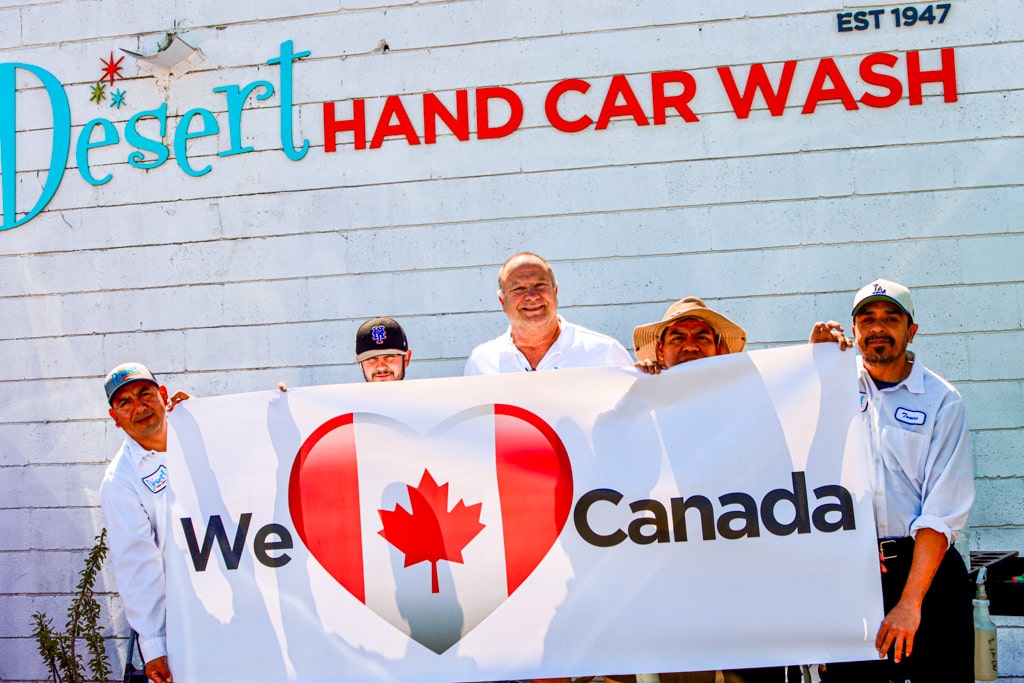
Bob Smiland, owner of Desert Hand Car Wash, emphasized the situation’s urgency, noting, “The Canadian business is 30% of my business in the winter. It’s essential we do something significant either as a city or as a valley.”
There are concerns from the tourism sector, too.
“We’re seeing a lot of things where people are passing right over the United States completely,” a Greater Palm Springs Convention and Visitors Bureau representative said at a Main Street Palm Springs meeting. “They’re going right down to Mexico, to the Caribbean, as well as traveling over to Europe and they’re redirecting their dollars from us.”

The city is trying to be proactive. Palm Springs Mayor Ron deHarte said Tuesday that officials are taking immediate steps to show appreciation for Canadian visitors who may still be in town.
“All the council members yesterday approved individually with the city manager paying for some ‘We love Canadians’ street banners,” deHarte said Tuesday. “We appreciate the support we get, and this is a good opportunity that will get picked up on social media.”
The timing of these efforts is critical, according to Smiland, who hung his own welcoming banner at his South Palm Canyon Drive car wash this week. He said many Canadians make their rental arrangements for the following winter by August, warning, “If we wait and see and hope for next year, it’s too late.”
Tourism officials indicated that collaborative efforts are underway across the Coachella Valley. A Greater Palm Springs Convention and Visitors Bureau representative noted that the organization is “putting together specific initiatives” to attract additional group business to offset an anticipated decline in convention bookings from Canada.
Concrete data to prove the local economy has suffered harm from a possible exodus of Canadian visitors may be months away. It has been less than three months since Trump took office. That’s not enough time to assert that there has been a drop-off in Canadian tourism and if so, what effect the drop-off had on the economy.
Later this year, when transient occupancy tax (TOT) revenue, airline passenger numbers, reports on future bookings, and other data become available, analysts will be better able to assess exactly how much damage the tensions between the countries have done to the local economy.
Author

Related Articles
Palm Springs homes selling faster than anywhere in the valley as market shifts to buyers
The latest housing report shows inventory dipped slightly year-over-year, but the city recorded the lowest average selling time in the valley at just 42 days.

Palm Springs home prices down slightly compared to last year in latest report
Detached home prices here fell 5% year-over-year to $1.13 million in December. Attached home prices fell 5% compared to the year before, with an average price at about $425,000.
Palm Springs International Airport reports record 3.3 million passengers in 2025
Officials attribute growth to increased demand for Coachella Valley as year-round destination, with five all-time monthly records set during the year.