
Three Palm Springs properties move closer to historic designation
The city’s Historic Site Preservation Board this week advanced designations for two homes and one mixed-use building, pending Palm Springs City Council approval.
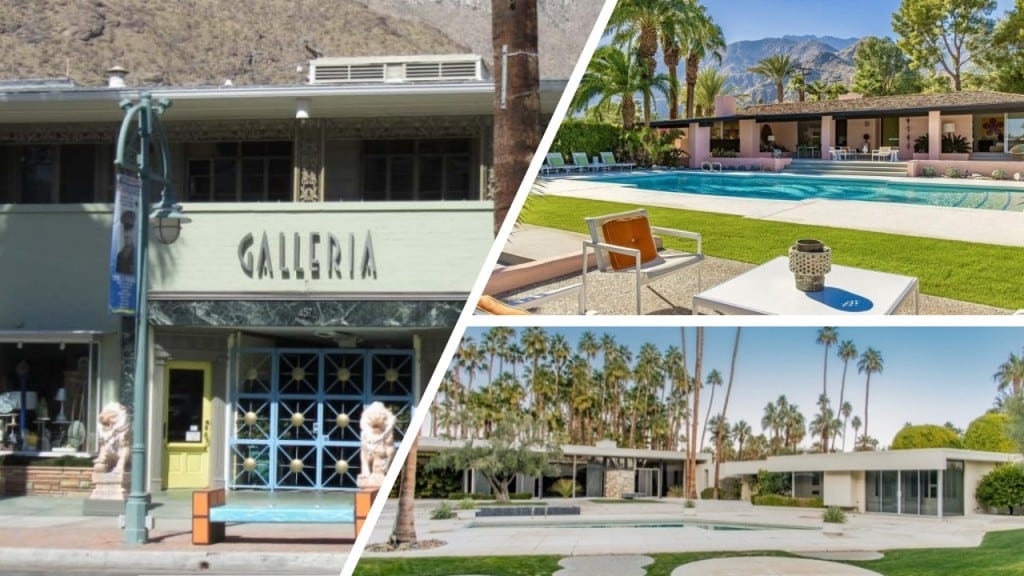
The Palm Springs Historic Site Preservation Board recommended approval of three new historic site designations on Tuesday for properties spanning the city’s architectural history from the 1940s through the 1960s.
All three sites are recommended to receive Class 1 historic designations and will go before the Palm Springs City Council for final approval.
Local reporting and journalism you can count on.
Subscribe to The Palm Springs Post
The Cullerton-Chaddick Residence at 572 West Santa Elena Rd. in the Little Tuscany neighborhood was first developed in 1948 as a ranch-style home, then completely rebuilt by architect William Cody in 1965. The home’s style is “almost like a hybrid” between California ranch homes and “some characteristics of the modern movement that was beginning to gain traction” at the time, a city staffer said at the meeting.
Key features include low slung pitched roofs, rectangular stucco columns, mirrored panels above doors, and access points to outdoor spaces from most rooms. “The house seen on the site today exemplifies the work of Cody,” notes the city’s staff report.
The Rubin Building at 457 North Palm Canyon Dr., located between Las Palmas Brewing and Blue Coyote Grill, was completed in 1946 by architect Albert R. Walker. The two-story building features commercial space downstairs and residential units on the upper level, with an open arcade space.
“The postwar period in Palm Springs was a time of growth, transition, and expression. Architectural experimentation became an identity, and mixed-use buildings became a solution for the diverse needs of a growing city,” states the staff report. The building is Regency Revival style architecture, with decorative iron work, balconettes, and columns styled after ancient Greece.
The Robinson Residence at 999 North Patencio Rd. was completed in 1957 and designed by architects A. Quincy Jones and Frederick Emmons, who also designed the Annenberg Estate in Rancho Mirage. The home is the only known single-family residence by the two architects in the city of Palm Springs.
Notable features of the home include an irregular L-shaped floor plan, a long covered entry walkway, exposed steel columns, a flat roof, and simple geometric forms.
Historic properties are subject to the Mills Act, which provides tax savings for property owners to put towards restoring and maintaining their historic site. Owners of Class 1 and Class 2 historic sites are required to apply for a certificate of appropriateness before any demolition or alterations to their building.
Author

Related Articles
Council to review updates on Dream Hotel, Orchid Tree Hotel projects
City leaders will review a revised development agreement for the Dream Hotel and a milestone update for the Orchid Tree Hotel proposal when they meet next week.

Palm Springs waste audits reveal recycling gains citywide, but one neighborhood tops 50% contamination
Commercial properties showed the largest numerical improvement, with passing audits rising from 154 in 2024 to 229 in 2025, an increase of 75.
Palm Springs board approves historic designation for Albert Frey-designed church turned theater
Dezart Performs purchased the modernist First Church of Christ Scientist in December 2024 to use as its new playhouse; the City Council must grant final approval.