
Palm Springs City Council narrowly approves biennial budget, boosts economic development funding
While public speakers Wednesday evening raised concerns about the budget’s sustainability, City Manager Scott Stiles told the council that city staff will provide quarterly financial updates throughout the two-year period.
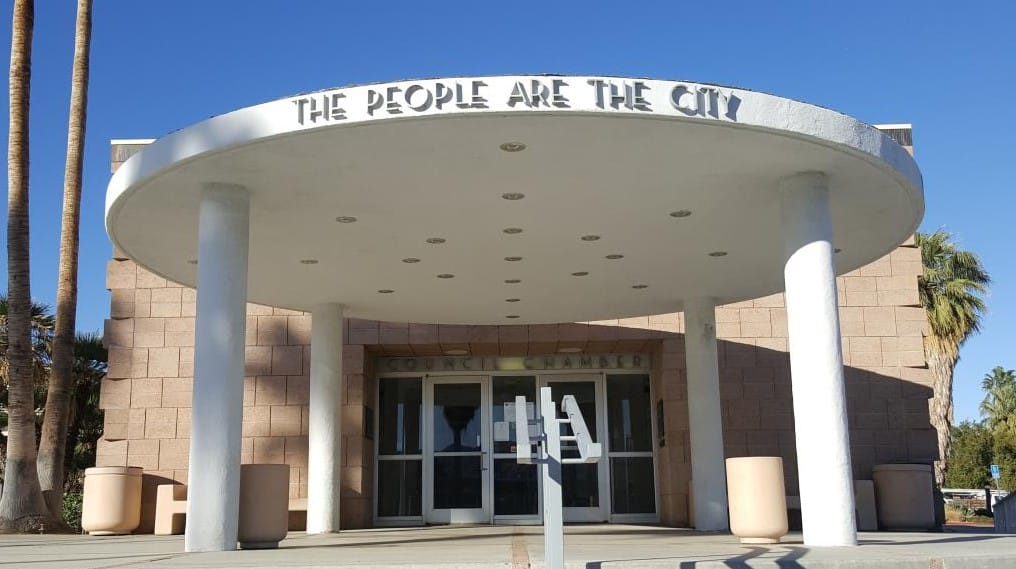
The Palm Springs City Council approved the city’s comprehensive budget for fiscal years 2025-2026 Wednesday night while increasing economic development funding by $500,000 annually amid concerns about uncertain economic conditions.
The council voted 3-2 to adopt the biennial budget, with Mayor Ron deHarte and Councilmember David Ready voting against it.
Local reporting and journalism you can count on.
Subscribe to The Palm Springs Post
“I remain concerned about our revenue projections,” deHarte said during deliberations. “Without preparing for lower revenue now and saying we’ll wait until mid-year to make adjustments, it’s inviting challenges for us in three months, six months that are potentially greater than where we are today.”
The approved budget includes significant investments in economic development as the city anticipates new revenue from incoming businesses. Finance Director Kristopher Mooney told the council that new restaurants including Chick-fil-A and In-N-Out could generate between $400,000 to $500,000 in combined annual sales tax revenue.
The budget maintains the city’s financial reserves while funding major infrastructure projects through Measure J sales tax revenue. The council moved several major projects from the general fund to Measure J to balance competing priorities while preserving core city services.
The budget includes funding for the city’s navigation center, affordable housing initiatives, and a $1 million contribution to the CalPERS retirement system to reduce unfunded pension liabilities.
Mooney presented revenue projections of $173.1 million for fiscal year 2026, with modest growth to $175.2 million in 2027. The budget relies heavily on transient occupancy tax at $49 million, property taxes at $38 million, and sales tax just under $30 million.
In a major budget restructuring, the council moved $5.2 million in deferred maintenance projects and vehicle purchases from the general fund to Measure J sales tax revenue in fiscal year 2026. The council also shifted six public safety personnel positions to safety augmentation funds, providing $1.9 million in relief to the general fund.
The city also expects substantial revenue from planned fulfillment centers and warehouses in northern Palm Springs. According to city staff, developers estimate one planned 700,000-square-foot fulfillment center could generate $7.6 million in local sales tax revenue annually, or $1.5 million if the building becomes a warehouse.
The additional economic development funding will come from cuts to contractual services totaling $400,000 in fiscal year 2026 and $350,000 in fiscal year 2027, plus moving a $500,000 electrical grid project to Measure J funding.
Public speakers raised concerns about the budget’s sustainability.
Resident Philip Hodges, who works in institutional finance, warned that the city faces a structural deficit where expenses are growing faster than revenues. “Your own forecasts say that expenses are growing faster than revenues and will continue to do so unless you intervene,” Hodges told the council.
Former Councilmember Ginny Foat added, “Our economy is facing a very uncertain future. We are looking at how we used to be and not looking at what our future looks like right now, which is not good.”
Councilmembers who supported the budget said it reflects the city’s priorities for economic development and infrastructure investment — and can be adjusted as conditions evolve.
City Manager Scott Stiles assured the council that staff will provide quarterly financial updates throughout the two-year period. “We’re entering an uncertain time, and I know how important it is for all of us to closely watch revenues and expenses,” he said.
The budget takes effect July 1, with the first quarterly review expected in the fall.
Author

Related Articles

Palm Springs appeals board moves to consider greater discretion in vacation rental cases
A representative of a local vacation rental group argued that treating every violation the same “undermines trust in the process.”
Public workshops bookend busy week at Palm Springs City Hall
Open houses on Fire Station 1 and traffic safety frame meetings on tourism, parks, development and city finances

Measure J tax revenue climbing; finance officials cautiously optimistic about coming months
Sales tax returns for the city’s Measure J fund are up 6% so far this year, though city leaders warn that the biggest revenue months for the tourist destination are still on the horizon.