
Historic board recommends landmark status for director Edmund Goulding’s ‘Little White House’ estate
The home, built eight years before the city of Palm Springs was incorporated, represents the Spanish Colonial Revival architecture that dominated in the interwar period.
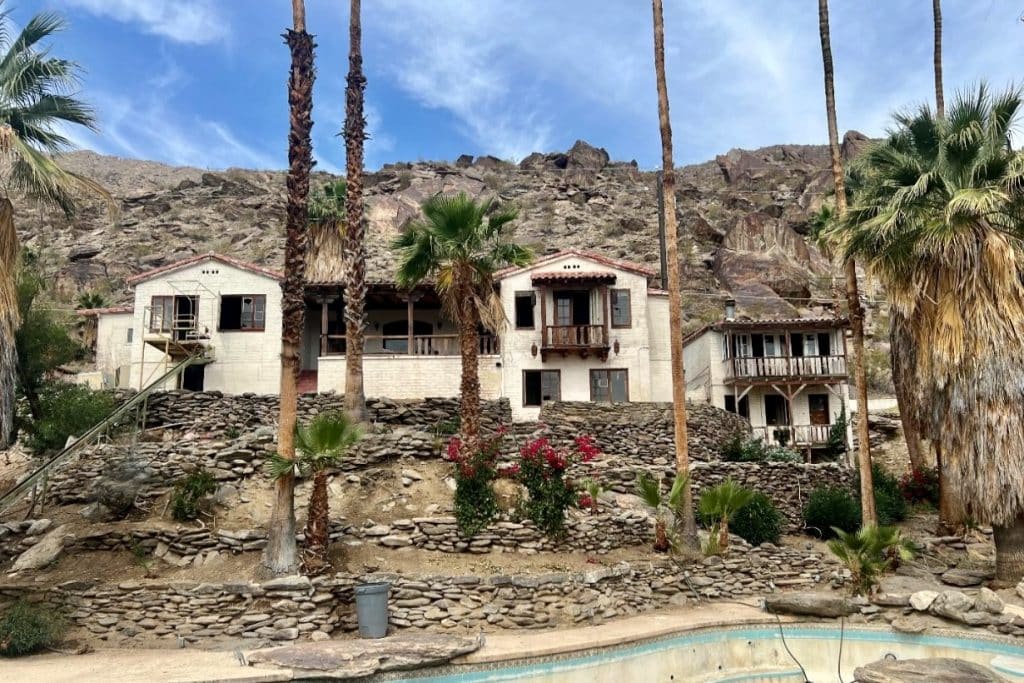
The Historic Site Preservation Board (HSPB) voted Tuesday to recommend that the City Council designate the Edmund Goulding Residence at 1752 Ridge Rd. as a Class 1 historic landmark, recognizing the property’s exceptional significance to Palm Springs’ development as an international resort destination.
The estate, known in the 1930s as “The Little White House,” was constructed in 1928 during the height of the first building boom in Palm Springs, according to a report about the property prepared by Steven Keylon for the Palm Springs Preservation Foundation. The original architect remains unknown, but the report said developer Edmond Fulford’s influences included Alfred Heineman of Pasadena and Paul R. Williams.
Local reporting and journalism you can count on.
Subscribe to The Palm Springs Post
The property was later transformed by acclaimed film director Edmund Goulding into a compound that hosted Hollywood royalty and European nobility.
The property exemplifies the Spanish Colonial Revival architecture that dominated Palm Springs development during the interwar period. The main residence and guest house feature hollow block concrete brick construction painted white with terra cotta barrel tile roofs, asymmetrical compositions, and distinctive indoor-outdoor integration through French doors and covered patios.
The estate’s landscape design by Paul H. Avery represents pioneering work in desert residential architecture. The centerpiece is a biomorphic swimming pool constructed in 1936, one of the first naturalistic pools ever created.
Avery, who also served as landscape architect at the San Diego Zoo, created a water feature system that included a bridge and waterfall.
“The biomorphic swimming pool was designed to resemble a naturalistic pond, with enormous native granite boulders and smaller rocks embedded directly into the pool’s coping,” the report reads.
Avery also created a terraced garden system utilizing granite boulders found naturally on the site to create retaining walls that cascaded down the hillside.
The property’s cultural significance stems from its role during Hollywood’s golden age. Film director Edmund Goulding purchased the estate in 1936 and transformed it into what became known as the “Little White House” compound, hosting celebrities including, Marlene Dietrich, the Duke of Warwick, and Greta Garbo, who stayed at the property the night “Camille” premiered at the Plaza Theatre.
Goulding directed “Grand Hotel” in 1932 and “Dark Victory” in 1939, and directed nine actors to Oscar nominations during his career.
The report also notes the property was used as a destination for the LGBTQ+ community at the time, “where Goulding’s well-documented ‘bisexual orgies’ and gatherings created one of the first safe spaces for Hollywood’s LGBTQ+ community during an era of intense studio surveillance and moral restrictions.”
By the time of its 1941 sale, contemporary accounts described it as “the most famed of Palm Springs winter colony estates” and the property’s canyon swimming pool was recognized as “one of the most beautiful private pools in the U.S.”
Current owner Lucien Wolff submitted the application for historic designation following discussions about future alterations to the property.
“I’d like to see it back where it used to be, because it’s so unique,” Wolff said. He said he intends to restore the property, including the pool, waterfall, and terraced landscaping.
If the City Council approves the Class 1 designation, the property would be subject to certificates of appropriateness for any future demolition or alteration of the historic resource.
Authors


Related Articles
City on track to close fiscal year with nearly $7 million surplus, report shows
The city’s three core revenue sources — Transient Occupancy Tax, Property Tax, and Sales and Use Tax — are up a combined 11.5% from the prior year’s mid-year numbers.

This week: Palm Springs boards to review housing project, historic designation, library budget
Architectural Review, Historic Preservation and Library boards meet this week, with one other meeting possible on Thursday.

Palm Springs City Council approves ban on vehicle sales, rentals in public rights of way
The ordinance includes a narrow exception for residents occasionally selling their own vehicle near where it is normally parked, provided the vehicle is within one-tenth of a mile of the owner’s registered address.