
From fame to survival: A reinvented Susan Powter is bringing her story to Palm Springs
At 67, the fitness icon who once dominated daytime TV in the 1990s will recount her remarkable journey at Oscar’s on Oct. 2.
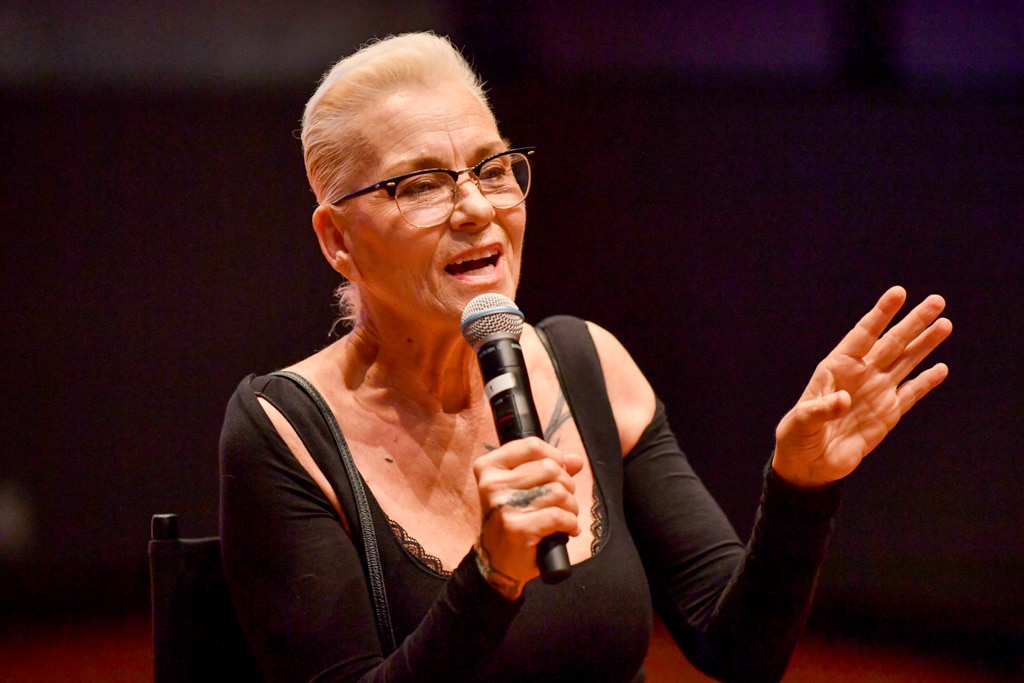
In November of 2018, Susan Powter, weight-loss and fitness icon of the 1990s, was standing at the KOA RV park in Las Vegas, a place she, her dog Em, and her 1950s Aristocrat camper had called home for the past five years. The corporation had a new rule: All RVs and campers older than 10 years had to go.
“KOA was home to me. It was safe. As safe as inner-city living could be in one of the worst neighborhoods in Vegas,” she wrote in her self-published memoir, And Then Em Died… Stop the Insanity! A Memoir. Written as a love letter to her dog, who passed away not long after the eviction, the book recounts the experience.
Local reporting and journalism you can count on.
Subscribe to The Palm Springs Post
Powter had until March to find a new place but couldn’t afford any other RV parks. When the deadline came, she had her camper towed to a storage lot.
“I literally had nowhere to go that afternoon,” she recalled in her book. “I had no credit. No money. Nowhere to go, so I drove to Harbor Island.”
Feeling more alone than ever, she moved into a rundown weekly rental, overrun with drugs, alcohol, and instability. For the next few years, she bounced from one place to another, living in unsafe housing and stricken by poverty. It was a far cry from 30 years earlier.
’90s Fame
If you were alive in the 1990s, you surely remember her blunt, tell-it-like-it-is infomercials with the catchphrase “Stop the Insanity!” They became a cultural phenomenon, leading to a multimillion-dollar empire, multiple New York Times best-selling books published by Simon & Schuster, and a syndicated daytime talk show, The Susan Powter Show.
To the outside world, she lived a life of wealth, fame, and influence. Behind the scenes, her career was defined by conflict, corporate exploitation, and betrayal. By the late 1990s, she walked away from it all, cutting ties with her manager, who was also her husband, and relocating to Seattle. There, she retreated from the public eye to raise her three sons and work multiple jobs to get by.
Her story is one of resilience and survival, touching on the issues of corporate structures, health care, social security, and societal disregard for older women in our country, and is now the subject of a forthcoming feature documentary, Stop the Insanity: Finding Susan Powter, directed by Zeberiah Newman and executive produced by Jamie Lee Curtis, which hits theaters later this year.
She’s also appearing at Oscar’s next week to share her story with An Evening With Susan Powter | From Fitness Guru to Truth Teller – Clips, Conversations and Stories.
Early Struggles
Born and raised in Australia, Powter was living in Garland, Texas, in the early 1980s. A single mother of two young boys and weighing 260 pounds, she found herself pushed into “magic” weight-loss drinks by doctors and tried taking fitness classes where, as an overweight woman, she felt ostracized and overlooked.
“There was no such thing as morbidly obese in the aerobic studio,” she said in a recent interview. “I was the only person who was anything over 90 pounds, standing in the back, because that’s where they sent you — to the back row.”
She scoured bookstores for diet books but found only conflicting advice. Stop the Insanity began as a rallying cry for herself. She decided to figure out her own way.
She knew the odds were stacked against her financially as a single mother in Garland. Her husband had just left, and she was caring for two sons born 11 months apart. Reeling from her divorce, she ate to numb the pain and, as she famously joked in her infomercial, “planned her ex-husband’s death.” Then one day, she woke up.
“The bottom line is this, which I’ve said to millions of people: I did not like having no strength and energy. I did not like being exhausted at two o’clock every afternoon. I did not like the way I looked or felt at 260 pounds,” Powter said.
Finding Fitness
She joined an organic food co-op that sold fruits, vegetables, unpasteurized milk, and meat from a local farm.
“We met in a back alley, and it was like where we were, we may as well have been dealing crack,” she said.
She taught herself to cook nourishing meals and created fitness modifications missing from aerobics classes. Slowly but surely, she lost the weight.
A year later, she was at the local Piggly Wiggly grocery store, showing women in the aisles pictures of what she had looked like a year earlier.
“If you want to get lean and strong, you have to modify. You have to work within your fitness level. It has nothing to do with a moment of motivation. Nothing is going to change in a minute,” she recalled. “Then I would look up and there would be a crowd of women. There would be tears in the aisles of the grocery store.”
She created a program called New to Fit, which emphasized fitness for everyone, with modifications for all body types, which was unheard of at the time. She opened her own studio in 1991, and it was a hit. With her signature buzzcut and no-nonsense teaching style, Powter never fit into a box.
“Everybody was like, no, no, no, she’s too loud, her hair is too short, she talks too fast,” Powter recalled.

She was vocal about her distaste for the diet and fitness industries, which told women the only way to lose weight was through expensive freeze-dried meals, diet shakes, and pills, leaving them feeling unmotivated and undisciplined. And don’t get her started on the food pyramid.
“I didn’t ask the fitness industry what they thought about my philosophy. I didn’t care. Wasn’t interested,” Powter said. “And then when it got popular, you know, Time Warner and Simon & Schuster, that’s when all of them came in and said, ‘Oh no, we think she’s fabulous.’”
Looking into the camera, she told women they were not the problem. The diet and fitness industries were. All they needed to do was eat, breathe, and move. And millions of women across the country tuned in.
“That’s why I love ‘Stop the Insanity,’ because it was a real grassroots movement that exploded onto the corporate scene,” Powter said.
Fame’s Downside
But the irony is not lost on her: the very industry she criticized ultimately led to her downfall. The same qualities that catapulted her to stardom were the ones corporate producers tried to stifle.
On her talk show, she was told she was too loud, told to hype the crowd instead of teaching, and pressured to deliver soundbites instead of education. They wanted to soften her, turn her into a typical talk show host, and package her as a product.
With misguidance from her manager and husband, book deals and contracts were negotiated in ways that left her powerless. She had started her show breaking the rules of television, speaking truth to women across the country, but over time her corporate reshaping stripped away the very things that made her famous. Unable to be herself, her show was canceled, and she walked away from Hollywood.
“It certainly was the most shocking for me; life doesn’t always work out. Family doesn’t always work out. The biggest and the best doesn’t always work out. Everything you believed and based however many years on doesn’t always work out, and what you do when it doesn’t, how you survive when it doesn’t, is everything,” she said.
A New Chapter
Her ability to survive that kind of loss came from the inner infrastructure she had spent years building. Now, at 67, she feels strong, healthy, and more energized than ever. And she’s ready to tell her story her way. On Thursday Oct. 2, she’ll be giving Palm Springs residents all the details in her signature style in an appearance at Oscar’s, starting at 5:30 p.m. Tickets range from $40 to $60 and are available here.
What else does she have in store?
“Everything. Everything I’ve done before and then some … with no corporations, managers, agents … between me and, because we can in this day and age, the world. What is happening now makes ‘Stop the Insanity’ look like the dress rehearsal it was, and I could not be more excited, ready and grateful.”
Author

Related Articles

Film producer, community advocate Kim Waltrip to receive next star on Walk of the Stars
Waltrip’s 487th star dedication ceremony is scheduled for Friday (April 3) at 275 South Palm Canyon Drive.

Award-winning local journalist Karen Devine to receive sidewalk star this month
The longtime broadcast journalist will be honored March 27 for her contributions to journalism and the community.

Dolores Robinson to receive next star on Palm Springs Walk of the Stars
The veteran personal manager, recognized as the first Black female personal manager in film and television, will be honored March 13.