
From tragedy to hope: How one family’s mental health crisis sparked a mission to help others
After her son’s bipolar diagnosis left them navigating a broken healthcare system, actress Mädchen Amick and her family are hoping to open what she said will be the first comprehensive mental health treatment center in the county in Palm Springs.

In 2011, Sylvester Alexis was walking home from a frat party at UC Irvine when he witnessed the death of a fellow student. He helped to keep the student alive until the ambulance could get there, but the student ultimately passed away that night.
At that time, he was a sophomore on an athletic scholarship with the university’s track team. Up until that point, everything was going great. After that event, he had a few school counseling sessions and relied on support from his family including his mother — actress/writer/director Mädchen Amick; his father — singer/songwriter/coach David Alexis; and younger sister, Mina Tobias, who was a freshman at Cornell University and also on an athletic scholarship at the time.
Local reporting and journalism you can count on.
Subscribe to The Palm Springs Post
However, soon after the incident, his track coach, teammates, and roommates began to notice a change in his personality. They noticed erratic behavior and delusional thinking.
He had started using substances to cope with the trauma, and doctors told the family it was a substance abuse disorder, so they immediately got him help. It wasn’t until he went to a psychiatric hospital and was cleared of any substances in his system, and was still exhibiting mania and psychosis, that the doctors told the family they suspected bipolar disorder.
“I always say that that moment just felt like a punch in the gut,” said Amick. “I mean, it just felt heart-wrenching because I didn’t really understand what that meant.”
Shortly after that moment, he was officially diagnosed with Bipolar I Disorder. Amick knew she needed to educate herself, her husband, and her daughter immediately. So they all dove into learning what it meant and what the ways to move forward were.
“And that’s when we realized how broken our mental health system was,” said Amick. “Because there wasn’t a path forward, there weren’t obvious health care choices to follow.”
This sent them down a years-long journey of navigating their son’s illness and learning the ins and outs of the healthcare system. In 2021, all four members of the family decided to take everything they had learned over that time and founded the Don’t Mind Me Foundation to help and advocate for other families that were in similar situations.
Now, Sylvester Alexis not only serves as co-founder for the organization and following in his parents footsteps as a hip-hop artist and screenwriter, he also works as a patient advocate at a treatment facility, he also uses his experience as an advocate and spokesperson for organizations like Bring Change 2 Mind, NAMI, and SAMSHA, all who partner with the Don’t Mind Me Foundation.
Built on the family’s journey of discovery, understanding, and hope, the foundation is dedicated to ending the stigma and discrimination surrounding mental illness and providing direct impact for those in need of care. The foundation provides an annual Crisis Intervention Scholarship Fund, a scholarship for specialized treatment to those suffering from severe mental illness and who have insufficient payment methods. It also features a speaker series, where high-profile individuals, mental health professionals, and diverse community voices come together to share their lived experiences and discuss resources that have been effective for them.
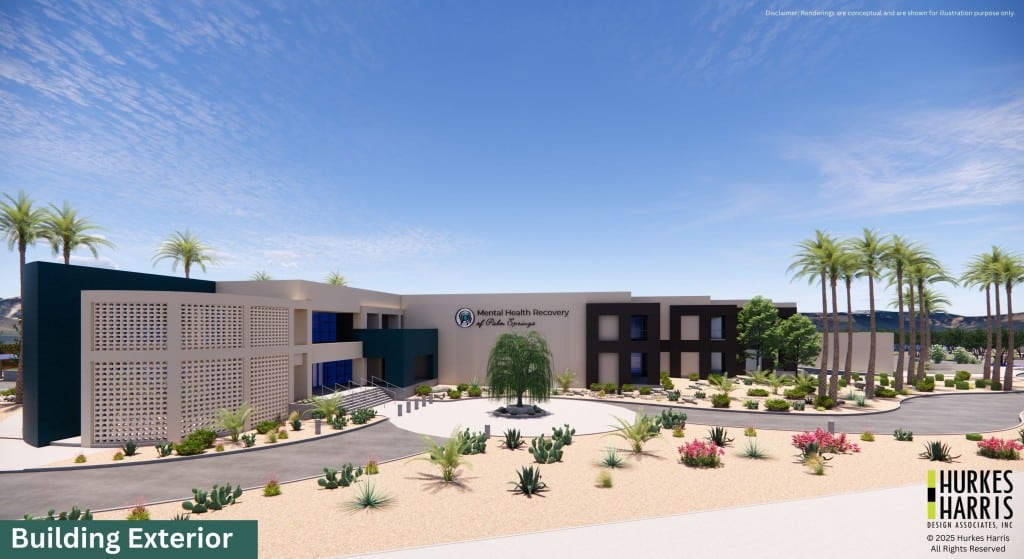
But they are currently working on what may be their most ambitious project yet, the opening of their treatment center, Mental Health Recovery of Palm Springs, which they hope to bring to life in the Desert Sun building at 750 North Gene Autry Trail.
If constructed, the treatment center — the first of its kind in Riverside County — would be a holistic, community-integrated recovery campus that serves as a centralized hub, offering crisis stabilization, substance use disorder and behavioral health residential treatment, outpatient services, preventive healthcare, and more.
When Amick learned of her son’s diagnosis, she had what was considered excellent health care through the time, through the Screen Actors Guild, but she found out that even her insurance had no mental health care coverage.
“So that was a reflection of how our healthcare system didn’t prioritize mental health,” said Amick. “It became a big journey, and now we cut to 15 years later, and we can look back on a lot of things along the way, and you know, that’s what fueled us wanting to start our foundation and try to help other families through.”
According to Amick, the lack of coverage led them to incur an endless amount of out-of-pocket costs for the family, and even though they found a way to make that happen, there were numerous problems with the care they were receiving.
“We were as a family, just, you know, with wide eyes, trying to figure it out, not knowing where to go, not being helped by our own insurance. Case managers telling us, well, unfortunately, some people die, and you might have to come to the realization that you could lose your son.”
A self-described “reluctant celebrity,” Amick had a lightbulb moment where she realized this would be the perfect way to utilize her platform and connections to effect change, not only by founding the foundation, but also by consistently advocating for policy change in Washington and at the UN.
With the treatment center, the Amick-Alexis family hopes not only to bridge the financial gap but also to ensure that every person going through what they did is treated with compassion and care.
Part of the facilities will include a Clubhouse International Model, a community-based approach to mental health recovery that emphasizes peer support and participation in the daily operations of the clubhouse.
“What’s great about a clubhouse is it can be an immediate help to the community,” said Amick, explaining that anyone with a mental illness diagnosis can become a member. It’s a free membership, and the members run the clubhouse and make the decisions on what the community needs. “And it’s a safe place for people to find community and for people to find resources.”
“We were as a family, just, you know, with wide eyes, trying to figure it out, not knowing where to go, not being helped by our own insurance. Case managers telling us, well, unfortunately, some people die, and you might have to come to the realization that you could lose your son.”
— Mädchen Amick
Another unique aspect of the campus will be its residential character. According to Amick, many patients are sent home from psychiatric hospitals within 2-3 days, but patients need much longer than that to recover.
“When you go into a manic episode, a severe manic episode, or into psychosis, the damage that happens to your brain is equivalent to the damage that happens to a heart with a heart attack. The brain needs at least six months to a year to heal from that one episode,” said Amick.
The treatment center will offer not only 150 beds for substance use disorder treatment and detox, but they will offer 32 beds for community residential treatment, eight beds for mental health urgent care and CSU, 40 beds for a sobering center, which serves as an alternative to incarceration, 32 beds for a locked mental health rehabilitation center, and facilities for both substance use and mental health outpatient facilities which will each be able to provide continuous care for 100 individuals.
They hope to have the clubhouse model opened by next year and the clinical services opened by the end of next year or the beginning of the following year. They were in the running but not awarded grant funding from the Behavioral Health Infrastructure Bond Act of 2024, which would have covered $76.5 million of the estimated $85 million required to complete the MHRPS. Another chance comes in October, but for now they are depending on donations.
Not only do they hope to impact our community, but they also aim to establish this as a pilot program for communities nationwide, demonstrating how Medicaid and private insurance can be combined to deliver high-quality care accessible to all.
“We just really encourage the community to keep an eye on what we’re doing and support us if they believe in what we’re doing, and reach out with any questions. We’re always available,” said Amick. “We’re just really wanting Palm Springs and the Coachella Valley to know that we want to be a solution for families, because every family deserves it.”
Author

Related Articles

Palm Springs prepares for strong El Niño with growing CERT ranks
Hundreds of residents have already received emergency training, and demand remains high as the city and volunteer groups brace for possible flooding and other severe weather.
Valley congregations pair American history with faith traditions in ongoing dialogue series
The faith250 initiative pairs founding documents like the Declaration of Independence with religious texts and regional history.

Officials set turf closure schedule for a dozen city parks
Rotating maintenance closures will affect fields and grass areas at parks across the city from September through December to allow reseeding and irrigation work.